
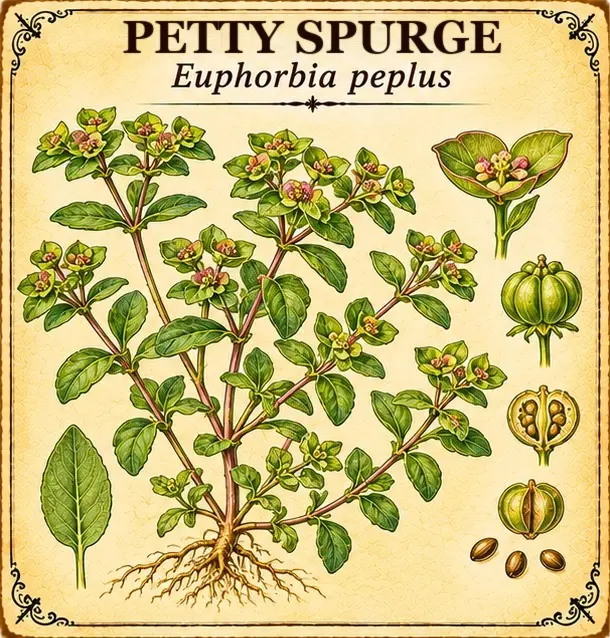
Petty Spurge
Euphorbia peplus
A small garden weed whose milky sap was used at home on skin cancers. A drug made from the sap was withdrawn in Europe over skin cancer risk.
Safety at a glance
- PregnancyNothing recorded
- BreastfeedingNothing recorded
- MedicinesNothing recorded
- Who should avoid itNothing recorded
- AllergiesNothing recorded
- Toxicity1 note →
Tap a box to read the safety notes below. “Nothing recorded” means our sources don't cover it, not that it's safe.
What is Petty Spurge?
- Plant family
- Euphorbiaceae, the spurge family
- Parts used
- The milky sap
- Genus
- Euphorbia
- Species
- peplus
Regional names
Radium Weed
Traditionally used for
- Skin cancers (home remedy)
Traditionally described as
- Sap contains ingenol mebutate
Health topics
Where Petty Spurge appears in symptom search, and why. Being listed doesn't mean it's a proven treatment.
- Cancer Research
Its sap has been used at home on skin cancers. In a small early study with no comparison group, roughly half to three quarters of treated skin cancers were still gone about 15 months later.
Safety
Side effects
In studies, the gel commonly caused redness, flaking, scabbing, pain, itching and swelling around the eyes where it was used.[1]Study
Toxicity testing
In 2020 the European Medicines Agency found that the Picato gel may raise the risk of skin cancer where it's applied, and that its risks outweigh its benefits. It's no longer sold in the EU.[2]Health agency
What does the research say?
Traditional use
These are traditional uses, not proven treatments.
A small garden weed with milky sap, known as radium weed in Australia. The sap has been used as a home treatment for skin cancers.[3]Study
Research in people
In a small early study, 36 people put the sap on 48 skin cancers once a day for 3 days. About 15 months later, roughly half to three quarters of the cancers were still gone, depending on the type. There was no comparison group.[3]Study
A compound from the sap, ingenol mebutate, was developed into a skin gel (Picato) for sun-damaged skin patches (actinic keratosis). The FDA approved it in 2012.[1]Study
In short
The sap-derived drug may raise skin cancer risk.
Sources
- [1] Ingenol mebutate: A novel topical drug for actinic keratosis · DOI: 10.4103/2229-5178.115538Peer-reviewed study
- [2] Picato (ingenol mebutate): referral. Risks of Picato for actinic keratosis outweigh benefits — European Medicines AgencyGovernment health agency
- [3] The sap from Euphorbia peplus is effective against human nonmelanoma skin cancers · DOI: 10.1111/j.1365-2133.2010.10184.xPeer-reviewed study
This information is educational and traditional in nature, and is not a substitute for professional medical advice. Unfamiliar word? See what these words mean.