
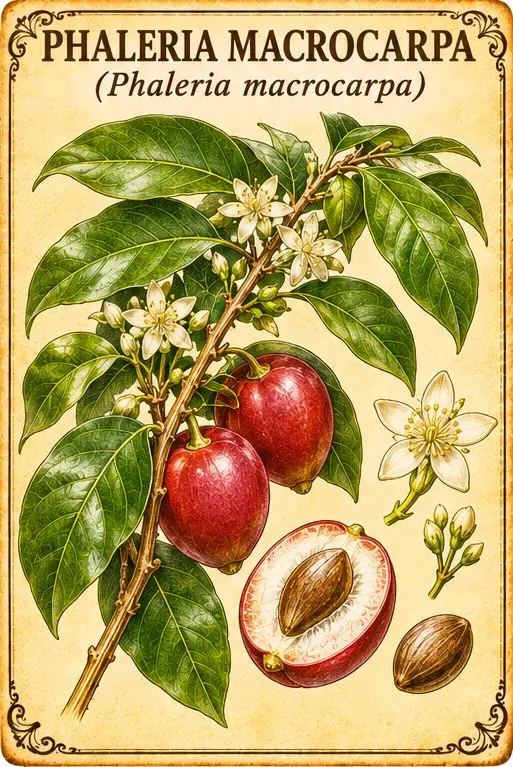
Phaleria Macrocarpa
Phaleria macrocarpa
Mahkota dewa, an Indonesian fruit used for pain, tumors, blood sugar and blood pressure. Lab studies mainly.
Safety at a glance
- PregnancyNothing recorded
- BreastfeedingNothing recorded
- MedicinesNothing recorded
- Who should avoid itNothing recorded
- AllergiesNothing recorded
- ToxicityNothing recorded
Tap a box to read the safety notes below. “Nothing recorded” means our sources don't cover it, not that it's safe.
What is Phaleria Macrocarpa?
- Plant family
- Thymelaeaceae, the daphne family
- Parts used
- The fruit
- Genus
- Phaleria
- Species
- macrocarpa
Also called
Mahkota Dewa
Traditionally used for
- Pain
- Blood sugar
- Blood pressure (traditional)
Traditionally described as
- Fruit contains mangiferin
Health topics
Where Phaleria Macrocarpa appears in symptom search, and why. Being listed doesn't mean it's a proven treatment.
- Cancer Research
Traditionally used for tumors. Lab studies found it slowed colon and breast cancer cells. Not tested against cancer in people.
What does the research say?
Traditional use
These are traditional uses, not proven treatments.
Known as mahkota dewa, it grows around Papua, Indonesia, and in Malaysia. Traditionally it is used to reduce pain, stomachache, diarrhea, tumors, blood sugar, cholesterol and blood pressure.[1]Study
Laboratory & animal research
Lab and animal results show what might be worth studying in people. They don't show that the herb has these effects in humans.
In short
No human safety data.
Sources
- [1] Phaleria macrocarpa (Scheff.) Boerl.: An updated review of pharmacological effects, toxicity studies, and separation techniques · DOI: 10.1016/j.jsps.2023.04.006Peer-reviewed study
- [2] Recent advances in anticancer approach of traditional medicinal plants: A novel strategy for cancer chemotherapy · DOI: 10.1016/j.ipha.2024.02.001Peer-reviewed study
This information is educational and traditional in nature, and is not a substitute for professional medical advice. Unfamiliar word? See what these words mean.