
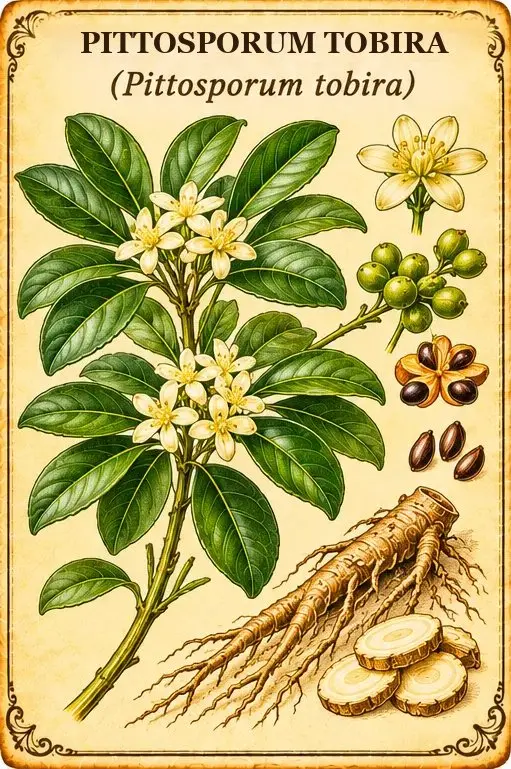
Pittosporum Tobira
Pittosporum tobira
An evergreen shrub whose extract was strongly active against gum-disease bacteria in the lab.
Safety at a glance
- PregnancyNothing recorded
- BreastfeedingNothing recorded
- MedicinesNothing recorded
- Who should avoid itNothing recorded
- AllergiesNothing recorded
- ToxicityNothing recorded
Tap a box to read the safety notes below. “Nothing recorded” means our sources don't cover it, not that it's safe.
What is Pittosporum Tobira?
- Plant family
- Pittosporaceae, the cheesewood family
- Parts used
- The leaves, stems, flowers and roots have been studied in the lab
- Genus
- Pittosporum
- Species
- tobira
Traditionally used for
- Lab research only
Traditionally described as
- Leaves contain essential oil and saponins
What does the research say?
Laboratory & animal research
Lab and animal results show what might be worth studying in people. They don't show that the herb has these effects in humans.
In a Korean screening of 558 plant extracts, Pittosporum tobira was the most active against bacteria that cause gum disease. Its main active compound is R1-barrigenol.[1]Study
Oil from the leaves killed the larvae of the mosquito that spreads dengue and yellow fever.[2]Study
Essential oils from its roots, stems, leaves and flowers contain compounds such as beta-caryophyllene and limonene.[3]Study
In short
No human safety data.
Sources
- [1] Antimicrobial activities against periodontopathic bacteria of Pittosporum tobira and its active compound · DOI: 10.3390/molecules19033607Peer-reviewed study
- [2] Larvicidal effects of the major essential oil of Pittosporum tobira against Aedes aegypti (L.) · DOI: 10.3109/14756360903185952Peer-reviewed study
- [3] Characterization of Volatile Organic Compounds and Essential Oil Profile of Pittosporum tobira (Thunb.) W.T. Aiton Cultivated in Tunisia · DOI: 10.1002/cbdv.202401360Peer-reviewed study
This information is educational and traditional in nature, and is not a substitute for professional medical advice. Unfamiliar word? See what these words mean.