
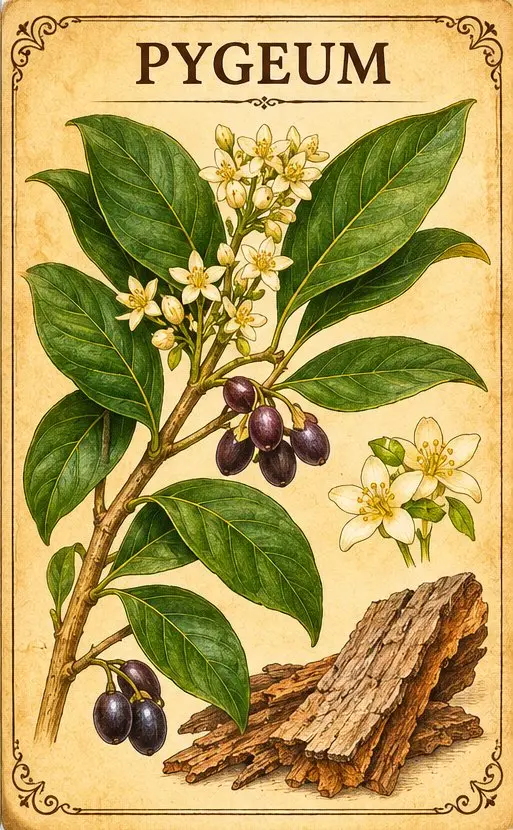
Pygeum
Prunus africana
The bark of an African tree. A Cochrane review found it moderately eased urinary symptoms of an enlarged prostate.
Safety at a glance
- PregnancyNothing recorded
- BreastfeedingNothing recorded
- MedicinesNothing recorded
- Who should avoid itNothing recorded
- AllergiesNothing recorded
- ToxicityNothing recorded
Tap a box to read the safety notes below. “Nothing recorded” means our sources don't cover it, not that it's safe.
What is Pygeum?
- Plant family
- Rosaceae, the rose family
- Parts used
- The bark, usually as an extract
- Genus
- Prunus
- Species
- africana
Also called
African Prune
Older scientific names
Pygeum africanum
Traditionally used for
- Prostate problems
- Wounds
- Diabetes
- Malaria
- Chest pain
Traditionally described as
- Bark extract
Health topics
Where Pygeum appears in symptom search, and why. Being listed doesn't mean it's a proven treatment.
- Cancer Research
Traditionally used in Africa for enlarged prostate and prostate cancer. Not shown to treat cancer.
- Enlarged Prostate (BPH)
A Cochrane review found it moderately eased urinary symptoms, including getting up at night, in small short trials.
Traditions that use it
- African Traditional Medicine
Used in traditional medicine across Africa for wounds, diabetes, malaria, chest pain and prostate problems.
Safety
Side effects
Side effects in trials were mild and about as common as with placebo.[1]Review or trial
What does the research say?
Traditional use
These are traditional uses, not proven treatments.
In traditional medicine across Africa, the tree has been used for:
- wounds
- diabetes
- malaria
- chest pain
- enlarged prostate and prostate cancer
Laboratory & animal research
Lab and animal results show what might be worth studying in people. They don't show that the herb has these effects in humans.
Studies of the tree's extracts have reported effects against inflammation, germs, male hormones and the growth of new blood vessels, as well as pain-relieving and astringent (tissue-tightening) effects.[2]Study
Technical detail: reported activities include anti-inflammatory, antimicrobial, antiandrogenic, antiangiogenic, antioxidant, DPP-4 inhibitory and analgesic effects.
Research in people
A Cochrane review of 18 trials in 1,562 men with an enlarged prostate found pygeum moderately improved urinary symptoms compared with placebo:
- Men were about twice as likely to say their symptoms had improved.
- They got up at night to urinate less often.
The studies were small and short, and used different doses and products.[1]Review or trial
Technical detail: Wilt et al. 2002, Cochrane CD001044; combined symptom and flow effect size −0.8 SD; men more than twice as likely to report improvement (RR 2.1); nocturia −19%, residual urine −24%, peak urine flow +23%; mean study length 64 days; no trials against standard BPH drugs.
In short
Mild side effects; see a doctor about prostate symptoms.
Sources
- [1] Pygeum africanum for benign prostatic hyperplasia — Cochrane · DOI: 10.1002/14651858.CD001044Review or clinical trial
- [2] A Comprehensive Review of Ethnomedicinal Uses, Phytochemistry, Pharmacology, and Toxicity of Prunus africana (Hook. F.) Kalkman from Africa · DOI: 10.1155/2024/8862996Peer-reviewed study
This information is educational and traditional in nature, and is not a substitute for professional medical advice. Unfamiliar word? See what these words mean.