
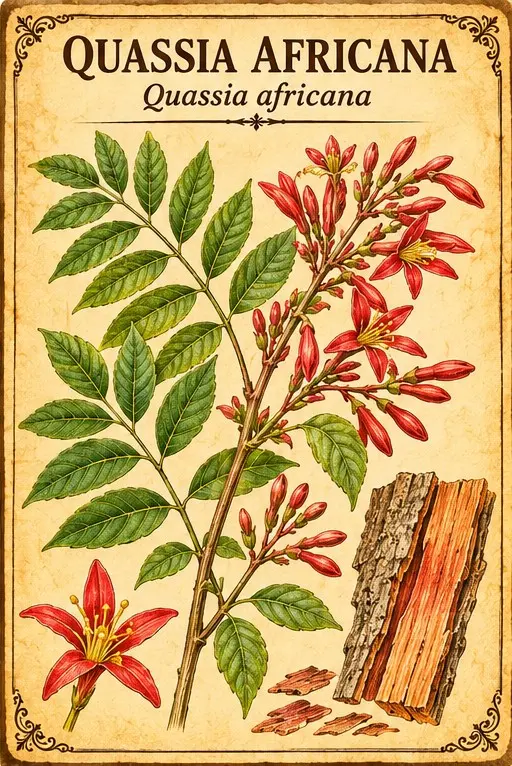
Quassia Africana
Quassia africana
An intensely bitter Central African shrub whose roots are a leading malaria remedy in Congo. Root and leaf extracts strongly blocked malaria parasites in lab tests.
Safety at a glance
- PregnancyNothing recorded
- BreastfeedingNothing recorded
- MedicinesNothing recorded
- Who should avoid itNothing recorded
- AllergiesNothing recorded
- Toxicity1 note →
Tap a box to read the safety notes below. “Nothing recorded” means our sources don't cover it, not that it's safe.
What is Quassia Africana?
- Plant family
- Simaroubaceae, the quassia family
- Parts used
- The roots, root bark and leaves
- Where it grows
- Central Africa
- Genus
- Quassia
- Species
- africana
Regional names
Simalikali, Mumpessi, Munkadi Nkadi
Traditionally used for
- Malaria
- Fever
- Worms
- Wounds (traditional)
Traditionally described as
- Contains bitter quassinoids such as simalikalactone D
Health topics
Where Quassia Africana appears in symptom search, and why. Being listed doesn't mean it's a proven treatment.
- Fever
A Congolese malaria remedy; blocked malaria parasites in lab tests. Not tested in people.
Safety
Toxicity testing
Its bitter compounds, called quassinoids, can be toxic. In animal studies of related quassinoids, their malaria-fighting effect came with toxicity, and none have been tested for malaria in people.[1]Study
Depends on how it's prepared
No human medical or safety studies were found.[2]Study
What does the research say?
Traditional use
These are traditional uses, not proven treatments.
Like others in its family it's intensely bitter; in Congo it's called simalikali, meaning bitterer than everything else. The bark and leaves are used for worms and stomach cramps, the root bark for wounds and skin ulcers, the roots for bronchitis, and the leaves for menstrual problems. It's also used for fever, malaria and sexually transmitted infections.[1]Study
A shrub whose roots are among the most used malaria remedies near Brazzaville, Republic of Congo.[3]Study
In the Democratic Republic of Congo the leaves and roots are used for diabetes, and also for worms, hemorrhoids, rheumatism, scabies, stomach pain and wounds.[4]Review or trial
In the Democratic Republic of Congo it's used to manage sickle cell anemia. In a lab test, its extract didn't change blood clotting.[5]Study
Laboratory & animal research
Lab and animal results show what might be worth studying in people. They don't show that the herb has these effects in humans.
Root and leaf extracts strongly blocked malaria parasites in lab tests, more than any of the 18 Congolese malaria plants tested.[2]Study
A compound from the root bark, simalikalactone D, was active against several viruses, including herpes, in lab tests.[6]Study
The same compound killed the larvae of malaria-carrying mosquitoes in lab tests.[7]Study
In short
Its bitter compounds can be toxic. No human safety studies were found.
Sources
- [1] Quassinoids: Anticancer and Antimalarial Activities · DOI: 10.1007/978-3-642-22144-6_161Peer-reviewed study
- [2] In vitro antiplasmodial activity of 18 plants used in Congo Brazzaville traditional medicine · DOI: 10.1016/j.jep.2005.08.068Peer-reviewed study
- [3] Ethnobotanical indicator values of Non-Timber Forest Products from the Djoumouna peri-urban forest in Brazzaville, Republic of Congo · DOI: 10.1016/j.heliyon.2021.e06579Peer-reviewed study
- [4] Antidiabetic Medicinal Plants Used in Democratic Republic of Congo: A Critical Review of Ethnopharmacology and Bioactivity Data · DOI: 10.3389/fphar.2021.757090Review or clinical trial
- [5] Decreased thrombin activity by a Congolese herbal medicine used in sickle cell anemia · DOI: 10.1016/j.jep.2013.05.038Peer-reviewed study
- [6] Antiviral activity of simalikalactone D, a quassinoid from Quassia africana · DOI: 10.1055/s-2002-19870Peer-reviewed study
- [7] Larvicidal properties of simalikalactone D from Quassia africana (Simaroubaceae) Baill and Baill, on the malaria vector Anopheles gambiaePeer-reviewed study
This information is educational and traditional in nature, and is not a substitute for professional medical advice. Unfamiliar word? See what these words mean.