
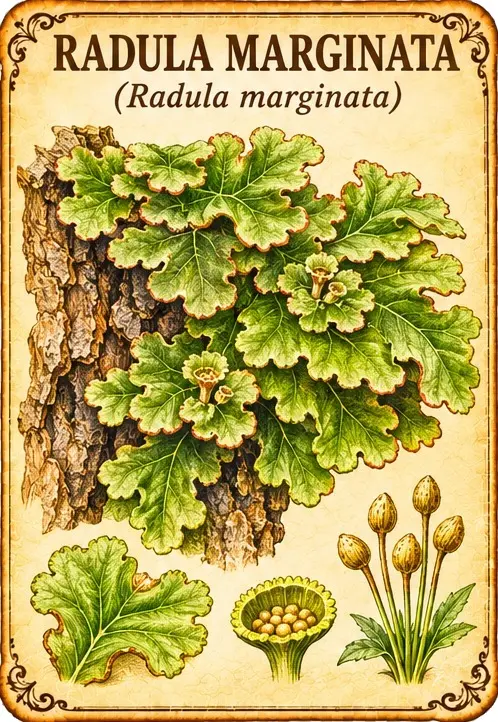
Radula Marginata
Radula marginata
A New Zealand liverwort that makes perrottetinene, a THC-like cannabinoid. Radula preparations are sold online as a legal high.
Safety at a glance
- PregnancyNothing recorded
- BreastfeedingNothing recorded
- MedicinesNothing recorded
- Who should avoid itNothing recorded
- AllergiesNothing recorded
- Toxicity1 note →
Tap a box to read the safety notes below. “Nothing recorded” means our sources don't cover it, not that it's safe.
What is Radula Marginata?
- Plant family
- Radulaceae, a family of leafy liverworts
- Parts used
- The whole plant
- Where it grows
- New Zealand
- Genus
- Radula
- Species
- marginata
Traditionally used for
- None established
Traditionally described as
- Contains perrottetinene
- a cannabinoid
Safety
Toxicity testing
Radula preparations are sold online as a legal high. Perrottetinene is a psychoactive cannabinoid, and there are no human safety studies.[1]Study
What does the research say?
Traditional use
These are traditional uses, not proven treatments.
A liverwort found only in New Zealand (Aotearoa). It makes perrottetinene, a cannabinoid similar to THC, the compound that makes cannabis cause a high. Some plants also make a CBD-like compound.[2]Study
Laboratory & animal research
Lab and animal results show what might be worth studying in people. They don't show that the herb has these effects in humans.
In mice, perrottetinene entered the brain and acted on the same receptor as THC (CB1). It lowered body temperature, slowed movement and eased pain.[1]Study
In short
Psychoactive; no human safety studies.
Sources
- [1] Uncovering the psychoactivity of a cannabinoid from liverworts associated with a legal high · DOI: 10.1126/sciadv.aat2166Peer-reviewed study
- [2] Unique bibenzyl cannabinoids in the liverwort Radula marginata: parallels with Cannabis chemistry · DOI: 10.1111/nph.20349Peer-reviewed study
This information is educational and traditional in nature, and is not a substitute for professional medical advice. Unfamiliar word? See what these words mean.