
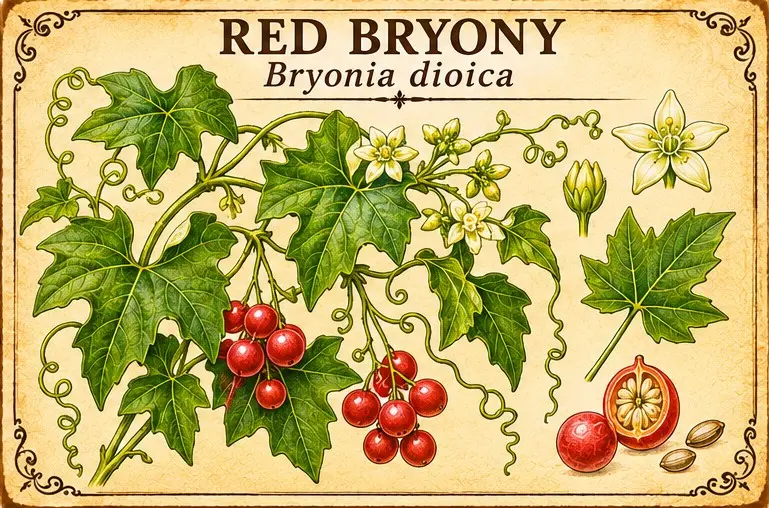
Red Bryony
Bryonia dioica
A climbing vine with red berries whose young shoots are boiled as a wild vegetable in the Mediterranean. Its berries and root contain toxic compounds.
Safety at a glance
- PregnancyNothing recorded
- BreastfeedingNothing recorded
- MedicinesNothing recorded
- Who should avoid itNothing recorded
- AllergiesNothing recorded
- Toxicity2 notes →
Tap a box to read the safety notes below. “Nothing recorded” means our sources don't cover it, not that it's safe.
What is Red Bryony?
- Plant family
- Cucurbitaceae, the gourd and cucumber family
- Parts used
- The root, and the young shoots as food
- Where it grows
- Europe, North Africa and western Asia
- Genus
- Bryonia
- Species
- dioica
Also called
Bryony, Cretan Bryony
Traditionally used for
- Wild vegetable (young shoots)
- Folk medicine
Traditionally described as
- Contains cucurbitacins and the toxic protein bryodin
Health topics
Where Red Bryony appears in symptom search, and why. Being listed doesn't mean it's a proven treatment.
- Cancer Research
Animal studies only: a root extract shrank melanoma tumors in mice. Not tested against cancer in people.
Safety
What does the research say?
Traditional use
These are traditional uses, not proven treatments.
A climbing vine with red berries and a large root. In the Mediterranean, its young shoots are gathered and boiled as a wild vegetable.[1]Study
Its close relative, white bryony, was once a common folk medicine in Europe and was sold as a fake mandrake root. It's still used as medicine in parts of the Balkans.[3]Study
Laboratory & animal research
Lab and animal results show what might be worth studying in people. They don't show that the herb has these effects in humans.
In mice with melanoma, a root extract shrank tumors by about 65% and reduced spread to the lungs, likely from compounds called cucurbitacins.[4]Study
In short
Poisonous berries and root; only cooked young shoots are eaten.
Sources
- [1] Nutritional and Phytochemical Composition of Mediterranean Wild Vegetables after Culinary Treatment · DOI: 10.3390/foods9121761Peer-reviewed study
- [2] Bryodin, a ribosome-inactivating protein from the roots of Bryonia dioica L. (white bryony) · DOI: 10.1042/bj2400659Peer-reviewed study
- [3] From medicinal plant to noxious weed: Bryonia alba L. (Cucurbitaceae) in northern and eastern Europe · DOI: 10.1186/s13002-019-0303-6Peer-reviewed study
- [4] Antitumor Effect of Bryonia dioïca Methanol Extract: In Vitro and In Vivo Study · DOI: 10.1080/01635581.2019.1654528Peer-reviewed study
This information is educational and traditional in nature, and is not a substitute for professional medical advice. Unfamiliar word? See what these words mean.