
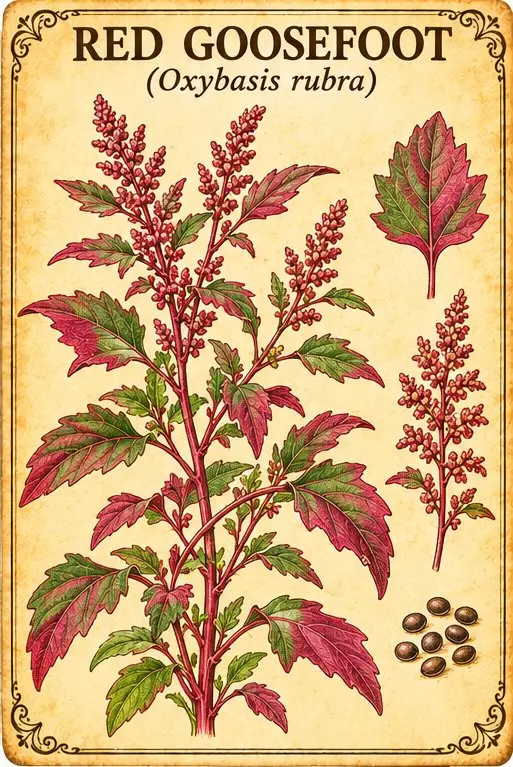
Red Goosefoot
Oxybasis rubra
A goosefoot whose saponins killed cancer cells in the lab. It hasn't been studied in people.
Safety at a glance
- PregnancyNothing recorded
- BreastfeedingNothing recorded
- MedicinesNothing recorded
- Who should avoid itNothing recorded
- AllergiesNothing recorded
- ToxicityNothing recorded
Tap a box to read the safety notes below. “Nothing recorded” means our sources don't cover it, not that it's safe.
What is Red Goosefoot?
- Plant family
- Amaranthaceae, the amaranth family
- Parts used
- The fruits and other parts have been studied in the lab
- Genus
- Oxybasis
- Species
- rubra
Older scientific names
Chenopodium rubrum
Traditionally used for
- Lab research only
Traditionally described as
- Contains saponins
Health topics
Where Red Goosefoot appears in symptom search, and why. Being listed doesn't mean it's a proven treatment.
- Cancer Research
Lab studies only: saponins from the fruits killed several kinds of cancer cells. Not tested against cancer in people.
What does the research say?
Laboratory & animal research
Lab and animal results show what might be worth studying in people. They don't show that the herb has these effects in humans.
In a 2025 lab study, saponins (soap-like compounds) taken from red goosefoot fruits killed several kinds of cancer cells, including skin, prostate, gut, thyroid and lung cancer cells. The strongest one was most active against melanoma cells and had little effect on normal skin cells. This has not been tested in animals or people.[1]Study
Technical detail: hederagenin glucosides, including a new monodesmoside; IC50 6.52 μg/mL against WM793 melanoma vs 39.94 μg/mL in HaCaT cells.
A 2025 lab analysis found two active saponins in red goosefoot for the first time.[2]Study
Technical detail: calenduloside E and chikusetsusaponin IVa.
In short
No human safety data.
Sources
- [1] Saponins from Oxybasis rubra (L.) S.Fuentes, Uotila & Borsh: Comparative Assessment of Cytotoxic Potential Against a Wide Panel of Cancer Cell Lines · DOI: 10.3390/molecules30153126Peer-reviewed study
- [2] Simultaneous Quantification of Bioactive Triterpene Saponins Calenduloside E and Chikusetsusaponin IVa in Different Plant Parts of Ten Amaranthaceae Species by UPLC-ESI-MS/MS Method · DOI: 10.3390/molecules30051088Peer-reviewed study
This information is educational and traditional in nature, and is not a substitute for professional medical advice. Unfamiliar word? See what these words mean.