
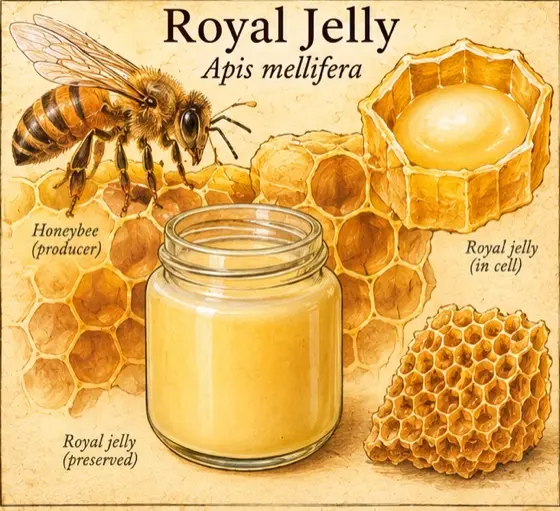
Royal Jelly
Apis mellifera
A milky secretion made by honeybees to feed their queen. A review of trials found it eased menopause symptoms, but bee products can cause serious allergic reactions.
Safety at a glance
- PregnancyNothing recorded
- BreastfeedingNothing recorded
- MedicinesNothing recorded
- Who should avoid itNothing recorded
- Allergies1 note →
- ToxicityNothing recorded
Tap a box to read the safety notes below. “Nothing recorded” means our sources don't cover it, not that it's safe.
What is Royal Jelly?
- Plant family
- Apidae, the bee family
- Parts used
- The jelly secreted by worker bees (fresh, freeze-dried or in capsules)
- Where it grows
- Produced by honeybees worldwide
- Genus
- Apis
- Species
- mellifera
Also called
Bee Milk
Traditionally used for
- Menopause symptoms (studied)
- Supplement
Traditionally described as
- Bee secretion rich in proteins
- sugars and fatty acids
Health topics
Where Royal Jelly appears in symptom search, and why. Being listed doesn't mean it's a proven treatment.
- Animal-Derived Remedies
A secretion made by honeybees, not a plant.
- Menopause Symptoms
A review of 6 trials found royal jelly eased menopause symptoms more than placebo.
Safety
Allergies
Bee products, including royal jelly, can occasionally cause allergic reactions, including life-threatening anaphylaxis. People with atopy (a tendency to allergies such as hay fever, eczema or asthma) and beekeepers are at higher risk and should be especially careful. If you're allergic, avoid bee products.[1]Study
Technical detail: both IgE-mediated (type I) and T-cell-mediated (type IV) reactions; may involve primary sensitisation or cross-reactivity.
What does the research say?
Research in people
A 2026 review of 6 trials with 471 women after menopause found that royal jelly supplements eased menopause symptoms more than a placebo. The authors suggest it may be a non-hormonal option, especially for women who can't or prefer not to use hormone therapy.[2]Review or trial
Technical detail: SMD 0.73 (95% CI 0.50 to 0.96); studies published 2011–2021; outcomes included genitourinary symptoms and quality of life.
In short
Can cause allergic reactions, including anaphylaxis, especially in people with allergies or asthma and in beekeepers.
Sources
- [1] Ensuring the Safe Use of Bee Products: A Review of Allergic Risks and Management · DOI: 10.3390/ijms262412074Peer-reviewed study
- [2] Royal jelly for management of postmenopausal symptoms: a systematic review and meta-analysis · DOI: 10.1097/GME.0000000000002688Review or clinical trial
This information is educational and traditional in nature, and is not a substitute for professional medical advice. Unfamiliar word? See what these words mean.