
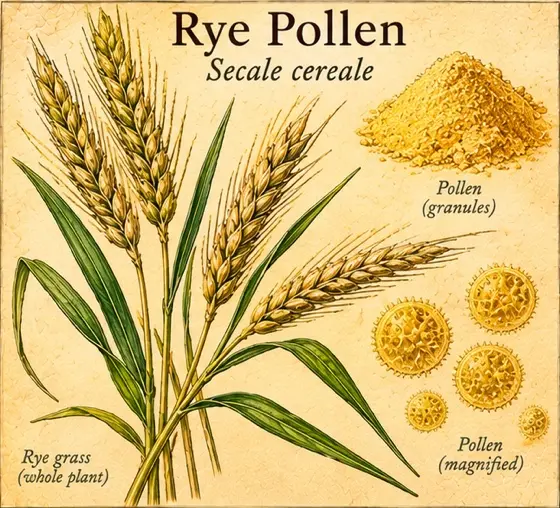
Rye Pollen
Secale cereale
A standardized extract of rye grass pollen (Cernilton). Trials suggest it modestly eases urinary symptoms of an enlarged prostate and pelvic pain from chronic prostatitis.
Safety at a glance
- PregnancyNothing recorded
- BreastfeedingNothing recorded
- MedicinesNothing recorded
- Who should avoid itNothing recorded
- AllergiesNothing recorded
- ToxicityNothing recorded
Tap a box to read the safety notes below. “Nothing recorded” means our sources don't cover it, not that it's safe.
What is Rye Pollen?
- Plant family
- Poaceae, the grass family
- Parts used
- The pollen, as a standardized extract
- Where it grows
- Grown as a grain crop worldwide; probably first domesticated in southwest Asia
- Genus
- Secale
- Species
- cereale
Also called
Rye Grass Pollen, Flower Pollen Extract, Cernilton, Cernitin
Traditionally used for
- Enlarged prostate (studied)
- Chronic prostatitis and pelvic pain (studied)
Traditionally described as
- Standardized pollen extract
Health topics
Where Rye Pollen appears in symptom search, and why. Being listed doesn't mean it's a proven treatment.
- Enlarged Prostate (BPH)
A review of 4 trials found modest improvements in urinary symptoms and night-time urination.
How it's prepared
Common ways Rye Pollen is prepared or sold. This isn't advice on how to take it; see Safety below.
Safety
Side effects
In the prostate trials, side effects were rare and mild. About 5 in 100 men stopped taking it, compared with about 3 in 100 on a placebo.[2]Review or trial
Technical detail: withdrawal rate 4.8% Cernilton vs 2.7% placebo and 5.2% Paraprost.
What does the research say?
Research in people
A review of 4 trials with 444 men with an enlarged prostate found that rye pollen extract (Cernilton), taken for 12 to 24 weeks, modestly improved urinary symptoms. Men were more than twice as likely to report improvement as with a placebo, and needed to get up at night to urinate less often. It didn't improve urine flow, leftover urine or prostate size.[2]Review or trial
Technical detail: self-rated improvement vs placebo RR 2.40 (95% CI 1.21–4.75); nocturia vs placebo RR 2.05 (1.41–3.00); comparators Tadenan and Paraprost.
The reviewers noted that the trials were short and small, some results weren't reported, and the quality of the products used was unknown. Longer trials are needed to confirm its benefits and safety.[2]Review or trial
In a 12-week trial, 100 men with ongoing chronic prostatitis or pelvic pain despite an alpha-blocker added either rye pollen extract (4 capsules a day) or tadalafil. Both improved symptoms, but the pollen extract reduced pain and overall symptom scores more.[1]Study
Technical detail: randomized, prospective; 42 cernitin vs 45 tadalafil analysed; NIH-CPSI total −6.8 vs −4.6 (P = .02); pain sub-score −4.1 vs −1.5.
In a study of 207 men with chronic prostatitis or pelvic pain at 2 centers in Romania, a pollen extract, alone or with an alpha-blocker, reduced pelvic pain and urinary symptoms more than an alpha-blocker alone. Fewer men needed painkillers. This study wasn't randomized.[3]Study
Technical detail: prospective, multicentre; standardized pollen extract Deprox 500; NIH-CPSI, IPSS and IIEF-5 (p = 0.01); reduced need for NSAID rescue medication.
In short
Side effects are rare and mild. Trials were small and short.
Sources
- [1] Comparison of cernitin pollen extract vs tadalafil therapy for refractory chronic prostatitis/chronic pelvic pain syndrome: A randomized, prospective study · DOI: 10.1002/nau.24454Peer-reviewed study
- [2] A systematic review of Cernilton for the treatment of benign prostatic hyperplasia · DOI: 10.1046/j.1464-410x.2000.00365.xReview or clinical trial
- [3] Clinical Evaluation of a Pollen-Extract-Based Phytotherapy Compared to Conventional Therapies in Chronic Prostatitis and Chronic Pelvic Pain Syndrome · DOI: 10.3390/medsci13030186Peer-reviewed study
This information is educational and traditional in nature, and is not a substitute for professional medical advice. Unfamiliar word? See what these words mean.