
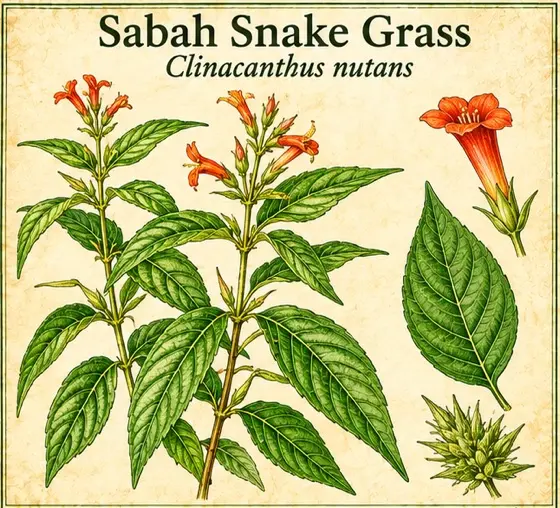
Sabah Snake Grass
Clinacanthus nutans
A Southeast Asian leafy shrub used for viral infections, inflammation and liver disease. In Thailand, a cream made from it is widely used for herpes, and it was tested in a small trial for genital warts.
Safety at a glance
- PregnancyNothing recorded
- BreastfeedingNothing recorded
- MedicinesNothing recorded
- Who should avoid itNothing recorded
- AllergiesNothing recorded
- Toxicity1 note →
Tap a box to read the safety notes below. “Nothing recorded” means our sources don't cover it, not that it's safe.
What is Sabah Snake Grass?
- Plant family
- Acanthaceae, the acanthus family
- Parts used
- The leaves
- Where it grows
- Southern China and Southeast Asia
- Genus
- Clinacanthus
- Species
- nutans
Also called
Clinacanthus
Traditional names
Belalai Gajah, Phaya Yo
Traditionally used for
- Herpes and skin infections (traditional and studied)
- Liver disease (traditional)
- Eczema (early research)
Traditionally described as
- Leaves rich in flavonoids
- triterpenoids and sulfur compounds
Health topics
Where Sabah Snake Grass appears in symptom search, and why. Being listed doesn't mean it's a proven treatment.
- Eczema
A review found early evidence it may help atopic dermatitis.
- Liver Disease (Hepatitis, Cirrhosis)
Traditionally used for liver disease and hepatitis; protected the liver in animal studies.
- Skin Irritation, Rashes and Itching
Used in Thailand as a cream for herpes and skin infections.
Natural compounds
How it's prepared
Common ways Sabah Snake Grass is prepared or sold. This isn't advice on how to take it; see Safety below.
Safety
Toxicity testing
In safety studies, Sabah snake grass had low short-term toxicity. However, there are concerns about its effects with longer use, and no robust clinical trials have tested its safety.[2]Study
Technical detail: low acute toxicity; subchronic toxicity concerns.
What does the research say?
Traditional use
These are traditional uses, not proven treatments.
Sabah snake grass is a leafy shrub of the acanthus family from southern China and Southeast Asia, with red-orange tube-shaped flowers. It's traditionally used for inflammation, viral infections, liver disease and metabolic problems. In Thailand, a cream made from it is widely used for herpes (cold sores).[2]Study
Laboratory & animal research
Lab and animal results show what might be worth studying in people. They don't show that the herb has these effects in humans.
More than 130 active compounds have been found in Sabah snake grass, including triterpenoids, flavonoids, alkaloids and sulfur-containing compounds. In lab and animal studies, these acted as antioxidants, reduced inflammation and acted against viruses and tumors. They also protected the liver and affected the immune system. It has been used clinically for hepatitis, skin infections, rheumatism and leptospirosis, but robust trials are lacking.[2]Study
Technical detail: NF-κB, Nrf2/ARE, AMPK and apoptosis pathways.
A 2025 review found lab and early clinical evidence that Sabah snake grass may help eczema (atopic dermatitis) by reducing inflammation and germs and supporting the skin barrier. Human trials are limited and products vary.[3]Study
Research in people
In a small trial in Thailand, 10 men with genital warts each had one wart treated with Sabah snake grass cream and another with podophyllin, the standard treatment, for 4 weeks. The standard treatment cleared about 97% of the wart, compared with 82% for the herbal cream. The authors suggest the cream may be an alternative, but the trial was very small.[1]Study
Technical detail: randomized within-patient comparison at Siriraj Hospital, 2018–2019; median clearance; mostly low-risk HPV types 6 and 11.
In short
Low short-term toxicity, but longer-term safety is uncertain.
Sources
- [1] Efficacy and Safety of Clinacanthus nutans Lindau Cream vs. Podophyllin for the Treatment of Adults with Condyloma Acuminata · DOI: 10.1155/2022/1577716Peer-reviewed study
- [2] The phytochemistry and pharmacological activities of Clinacanthus nutans (Burm. f.) Lindau: current evidence, mechanistic insights, and future therapeutic perspectives · DOI: 10.3389/fphar.2026.1900216Peer-reviewed study
- [3] Phytotherapeutic Potential of Medicinal Plants for Atopic Dermatitis: Centella asiatica, Clinacanthus nutans, Senna alata, and Coccinia grandis · DOI: 10.4062/biomolther.2025.115Peer-reviewed study
This information is educational and traditional in nature, and is not a substitute for professional medical advice. Unfamiliar word? See what these words mean.