
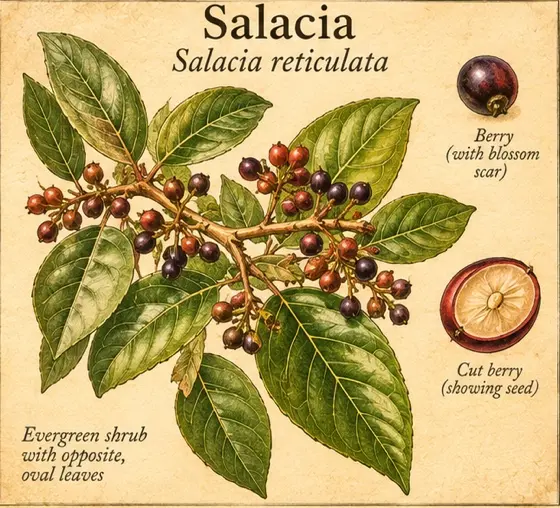
Salacia
Salacia reticulata
A woody plant from Sri Lanka and southern India whose root is an Ayurvedic remedy for diabetes. It slows sugar absorption from the gut, and trials in prediabetes found it lowered blood sugar.
Safety at a glance
- PregnancyNothing recorded
- BreastfeedingNothing recorded
- MedicinesNothing recorded
- Who should avoid itNothing recorded
- AllergiesNothing recorded
- ToxicityNothing recorded
Tap a box to read the safety notes below. “Nothing recorded” means our sources don't cover it, not that it's safe.
What is Salacia?
- Plant family
- Celastraceae, the staff-vine family
- Parts used
- The root and stem bark, and the leaves
- Where it grows
- Sri Lanka and southern India
- Genus
- Salacia
- Species
- reticulata
Regional names
Kothala Himbutu
Traditionally used for
- Blood sugar (Ayurveda and studied)
- Cholesterol (studied)
- Body fat (early research)
Traditionally described as
- Root rich in compounds that block the breakdown of starches and sugars
Health topics
Where Salacia appears in symptom search, and why. Being listed doesn't mean it's a proven treatment.
- High Blood Sugar
Trials in prediabetes found salacia extract lowered fasting and after-meal blood sugar.
- High Cholesterol
Root bark extract lowered LDL cholesterol in a small 6-week trial.
Traditions that use it
- Ayurveda
The root is used in Ayurvedic medicine for metabolic disorders such as diabetes.
Safety
Side effects
In a 6-week trial, no side effects occurred and all safety blood tests stayed normal.[1]Study
What does the research say?
Traditional use
These are traditional uses, not proven treatments.
Salacia is a woody plant whose root is used in Ayurvedic medicine for metabolic disorders. The root is rich in compounds that slow the breakdown of starches and sugars in the gut.[2]Study
Technical detail: alpha-glucosidase inhibitors.
Laboratory & animal research
Lab and animal results show what might be worth studying in people. They don't show that the herb has these effects in humans.
Salacia plants are known to block sugar absorption from the gut. In rats, salacia extract changed the gut bacteria and the activity of immune genes in the gut lining.[3]Study
Research in people
In a 12-week trial with 100 adults with prediabetes, a standardized salacia extract (500 mg a day) lowered fasting blood sugar and blood sugar 90 to 120 minutes after a sugary drink, compared with a placebo.[4]Study
Technical detail: randomized, double-blind, placebo-controlled; participants had both fasting (100–139 mg/dL) and post-meal (140–199 mg/dL) glucose impairment.
In a 6-week trial with 29 people with prediabetes and high cholesterol, salacia root bark extract (500 mg a day) lowered LDL cholesterol and fasting blood sugar compared with a placebo. A leaf extract lowered fasting blood sugar only. No side effects occurred.[1]Study
Technical detail: randomized, double-blind, placebo-controlled, alongside lifestyle changes; LDL-C and FBS fell significantly at weeks 3 and 6 with root bark extract.
In a 12-week trial with 133 adults with overweight or obesity, salacia extract reduced total body fat by about half a kilo more than a placebo. Body fat percentage didn't change significantly. The authors call the results preliminary.[5]Study
Technical detail: randomized, double-blind; fat mass difference −482.30 g (95% CI −907.05 to −57.54 g) by DXA; trial registered retrospectively.
In a placebo-controlled trial in Japan, salacia extract improved some measures of immune function and increased helpful gut bacteria (Bifidobacterium).[3]Study
Technical detail: improved T-cell proliferation; Bifidobacterium rose and Clostridium fell; immune-related gene expression in blood cells changed.
In short
No side effects were reported in a 6-week trial; long-term safety isn't well studied.
Sources
- [1] Salacia reticulata improves serum lipid profiles and glycemic control in patients with prediabetes and mild to moderate hyperlipidemia: a double-blind, placebo-controlled, randomized trial · DOI: 10.1089/jmf.2013.2751Peer-reviewed study
- [2] Complementary treatment of obesity and overweight with salacia reticulata and vitamin d · DOI: 10.1024/0300-9831/a000162Peer-reviewed study
- [3] Improvement in Human Immune Function with Changes in Intestinal Microbiota by Salacia reticulata Extract Ingestion: A Randomized Placebo-Controlled Trial · DOI: 10.1371/journal.pone.0142909Peer-reviewed study
- [4] Attenuation of Fasting and Postprandial Glucose Exposure by Standardized Salacia reticulata Extract in Adults with Prediabetes: A Randomized, Double-Blind, Placebo-Controlled Trial · DOI: 10.1177/1096620x261479626Peer-reviewed study
- [5] A 12-Week Randomized, Double-Blind, Placebo-Controlled Trial of Salacia reticulata Extract for Fat-Mass Reduction in Adults with Overweight/Obesity · DOI: 10.1177/1096620x261453229Peer-reviewed study
This information is educational and traditional in nature, and is not a substitute for professional medical advice. Unfamiliar word? See what these words mean.