
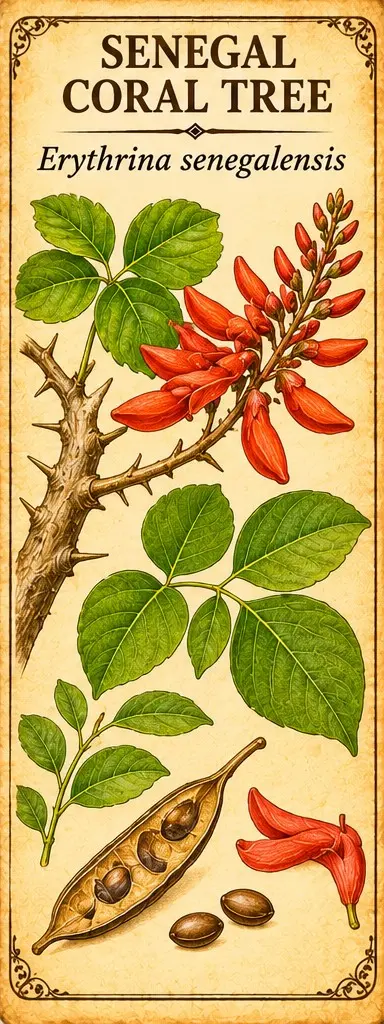
Senegal Coral Tree
Erythrina senegalensis
A West African tree used in traditional medicine for infections, high blood pressure, gut problems and diabetes.
Safety at a glance
- Pregnancy1 note →
- BreastfeedingNothing recorded
- MedicinesNothing recorded
- Who should avoid itNothing recorded
- AllergiesNothing recorded
- ToxicityNothing recorded
Tap a box to read the safety notes below. “Nothing recorded” means our sources don't cover it, not that it's safe.
What is Senegal Coral Tree?
- Plant family
- Fabaceae, the pea and bean family
- Parts used
- The stem bark, roots, leaves and seeds
- Where it grows
- West Africa
- Genus
- Erythrina
- Species
- senegalensis
Regional names
Nté
Traditionally used for
- Infections
- High blood pressure
- Diabetes (traditional)
Traditionally described as
- Flavonoids active against viruses and germs in lab tests
Health topics
Where Senegal Coral Tree appears in symptom search, and why. Being listed doesn't mean it's a proven treatment.
- Cancer Research
Lab studies only: many compounds from the tree, and stem bark extracts, killed cancer cells. Not tested against cancer in people.
- Fever
A common fever and malaria remedy in Nigeria and Mali; only slight effect on malaria parasites in mice.
- High Blood Pressure
A traditional remedy for high blood pressure; lowered it in rats. Not studied in people.
- Menstrual Discomfort
Used in Mali for missed or painful periods. It's also used to cause abortion; avoid in pregnancy.
Traditions that use it
- African Traditional Medicine
Used across West Africa for infections, high blood pressure, gut problems, diabetes and hemorrhoids.
Safety
Side effects
In lab tests on heart tissue and heart cells, a bark extract changed the heart rate, slowing it at very low doses and speeding it up at higher doses.[1]Study
Pregnancy
It's used traditionally to cause abortion, and a Malian healer warned against taking the bark powder during pregnancy. Avoid it if pregnant.[2]Study
Depends on how it's prepared
No human medical or safety studies were found.[3]Study
What does the research say?
Traditional use
These are traditional uses, not proven treatments.
In Africa it's traditionally used for infections, high blood pressure, stomach and gut problems, leprosy, diabetes and hemorrhoids.[4]Study
Healers in three areas of Mali use it for malaria, jaundice, infections, stomach problems, missed periods, period pain, infertility and body pain, and also to cause abortion. Preparations include decoctions and bark powder mixed with food or water.[2]Study
In northern Nigeria the stem bark is commonly used for fevers.[5]Study
In Cameroon it's used traditionally to relax the body and lower blood sugar, for heart and blood vessel problems and diabetes.[6]Study
Laboratory & animal research
Lab and animal results show what might be worth studying in people. They don't show that the herb has these effects in humans.
Compounds from the tree, mainly flavonoids, showed some of the strongest activity in its genus against viruses, including HIV and hepatitis, and against germs in lab tests. A protein from its seeds also killed bacteria.[3]Study
In rats and mice, a stem bark extract had only slight effects on malaria parasites but clearly reduced pain and swelling.[5]Study
In rats with diabetes and high blood pressure, a stem bark extract lowered blood pressure, blood sugar and blood fats about as well as standard drugs.[6]Study
A 2021 review found 19 of the 42 compounds isolated from the tree had anticancer activity in lab or animal studies. The stem bark is the most used part.[7]Review or trial
In a 2022 lab study, stem bark extracts were rich in antioxidant plant compounds and killed five types of cancer cells, through a form of cell death other than the usual self-destruct pathway.[8]Study
In short
No human medical or safety studies were found.
Sources
- [1] In vitro chronotropic effects of Erythrina senegalensis DC (Fabaceae) aqueous extract on mouse heart slice and pluripotent stem cell-derived cardiomyocytes · DOI: 10.1016/j.jep.2015.02.002Peer-reviewed study
- [2] Ethnopharmacological uses of Erythrina senegalensis: a comparison of three areas in Mali, and a link between traditional knowledge and modern biological science · DOI: 10.1186/1746-4269-4-6Peer-reviewed study
- [3] Therapeutic Potential of Erythrina Genus: Bioactive Phytoconstituents with Potent Antiviral and Antimicrobial Activities · DOI: 10.3390/plants14193053Peer-reviewed study
- [4] Antimicrobial activities and phylogenetic study of Erythrina senegalensis DC (Fabaceae) seed lectin · DOI: 10.5114/bta.2023.125083Peer-reviewed study
- [5] Antiplasmodial, analgesic, and anti-inflammatory activities of the aqueous extract of the stem bark of Erythrina senegalensis · DOI: 10.1016/S0378-8741(00)00188-4Peer-reviewed study
- [6] Antihypertensive and antidiabetic activities of Erythrina senegalensis DC (Fabaceae) stem bark aqueous extract on diabetic hypertensive rats · DOI: 10.1016/j.jep.2019.112200Peer-reviewed study
- [7] Systematic Review of Potential Anticancerous Activities of Erythrina senegalensis DC (Fabaceae) · DOI: 10.3390/plants11010019Review or clinical trial
- [8] In Vitro Antioxidant and Anticancer Properties of Various E. senegalensis Extracts · DOI: 10.3390/molecules27082583Peer-reviewed study
This information is educational and traditional in nature, and is not a substitute for professional medical advice. Unfamiliar word? See what these words mean.