
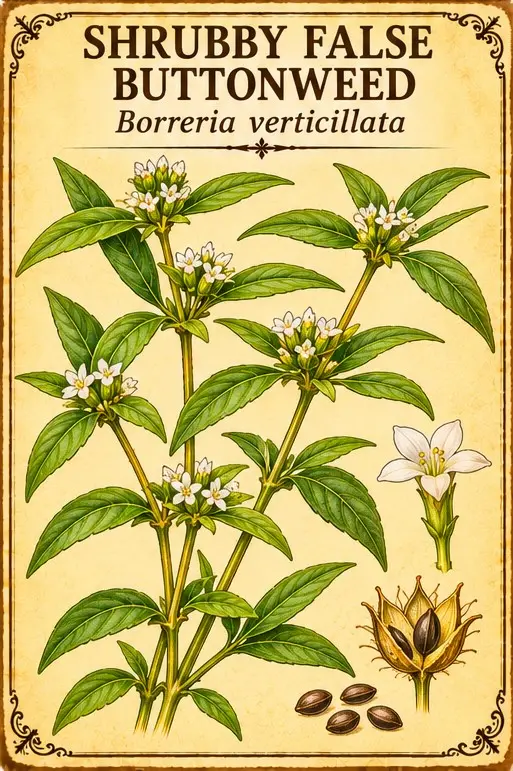
Shrubby False Buttonweed
Spermacoce verticillata
A weedy tropical herb used traditionally for eczema, scabies and other skin diseases. An extract eased swelling and pain in rats and mice.
Safety at a glance
- PregnancyNothing recorded
- BreastfeedingNothing recorded
- MedicinesNothing recorded
- Who should avoid itNothing recorded
- AllergiesNothing recorded
- ToxicityNothing recorded
Tap a box to read the safety notes below. “Nothing recorded” means our sources don't cover it, not that it's safe.
What is Shrubby False Buttonweed?
- Plant family
- Rubiaceae, the coffee family
- Parts used
- The leaves, roots and whole plant
- Where it grows
- Tropical Americas; now widespread
- Genus
- Spermacoce
- Species
- verticillata
Regional names
Vassourinha
Older scientific names
Borreria verticillata
Traditionally used for
- Eczema
- Scabies
- Diarrhea (traditional)
Traditionally described as
- Contains ursolic acid
Health topics
Where Shrubby False Buttonweed appears in symptom search, and why. Being listed doesn't mean it's a proven treatment.
- Eczema
Traditionally used for eczema. Not tested in people.
- Head Lice and Scabies
A traditional remedy for scabies and other skin diseases. Not tested in people.
Safety
Depends on how it's prepared
No human medical or safety studies were found.[1]Study
What does the research say?
Traditional use
These are traditional uses, not proven treatments.
A common weedy herb in the coffee family, used traditionally for skin diseases such as eczema, infected rashes and scabies. In Brazil, the root is used to cause vomiting and the leaves for diarrhea, hemorrhoids and the skin infection erysipelas.[1]Study
Laboratory & animal research
Lab and animal results show what might be worth studying in people. They don't show that the herb has these effects in humans.
In short
No human medical or safety studies were found.
Sources
- [1] A review on Borreria verticillata: A potential bionematicide, channeling its significant antimicrobial activity against root-knot nematodes · DOI: 10.1016/j.heliyon.2020.e05322Peer-reviewed study
- [2] Antinociceptive Activity of Borreria verticillata: In vivo and In silico Studies · DOI: 10.3389/fphar.2017.00283Peer-reviewed study
This information is educational and traditional in nature, and is not a substitute for professional medical advice. Unfamiliar word? See what these words mean.