
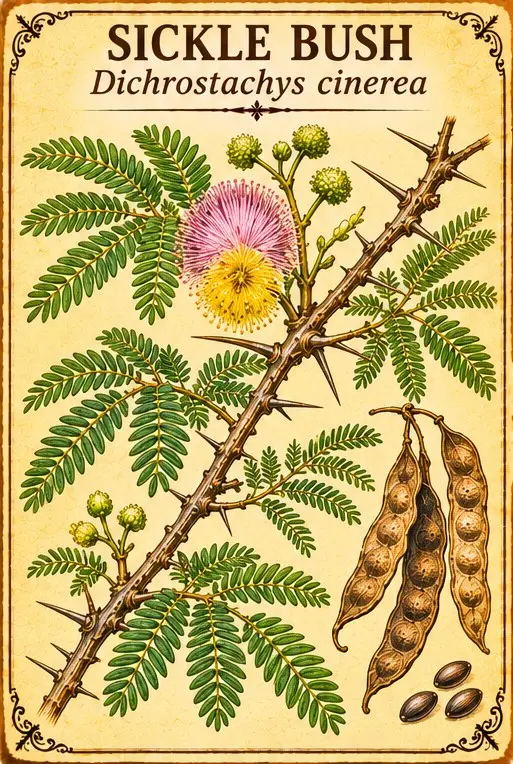
Sickle Bush
Dichrostachys cinerea
A thorny shrub used in Ayurveda for painful urination and by the Maasai for malaria. A decoction eased painful urination in a small Ayurvedic study.
Safety at a glance
- PregnancyNothing recorded
- BreastfeedingNothing recorded
- MedicinesNothing recorded
- Who should avoid itNothing recorded
- AllergiesNothing recorded
- Toxicity2 notes →
Tap a box to read the safety notes below. “Nothing recorded” means our sources don't cover it, not that it's safe.
What is Sickle Bush?
- Plant family
- Fabaceae, the pea and bean family
- Parts used
- The bark, roots, leaves and fruit
- Where it grows
- Tropical Africa, South Asia and Australia
- Genus
- Dichrostachys
- Species
- cinerea
Regional names
Veerataru
Traditionally used for
- Painful urination
- Malaria
- Arthritis (traditional)
Traditionally described as
- Fruit rich in polyphenols
Health topics
Where Sickle Bush appears in symptom search, and why. Being listed doesn't mean it's a proven treatment.
- Joint Discomfort
Fruit extracts eased arthritis in rats. Not tested in people.
Safety
What does the research say?
Traditional use
These are traditional uses, not proven treatments.
A thorny shrub with pink-and-yellow flower spikes. Called veerataru in Ayurveda, it's used for urinary problems; the Maasai of Tanzania use the stem bark for malaria.[1]Study
Laboratory & animal research
Lab and animal results show what might be worth studying in people. They don't show that the herb has these effects in humans.
Research in people
In an Ayurvedic clinical study of painful urination, a decoction gave better symptom relief than the standard Ayurvedic remedy punarnava. The study was small and not blinded.[4]Study
In short
One stem extract was toxic to cells in lab tests.
Sources
- [1] In vitro and in vivo studies on anti-malarial activity of Commiphora africana and Dichrostachys cinerea used by the Maasai in Arusha region, Tanzania · DOI: 10.1186/s12936-019-2752-8Peer-reviewed study
- [2] Evaluation of acute toxicity and hepatoprotective activity of the methanolic extract of Dichrostachys cinerea (Wight and Arn.) leaves · DOI: 10.4103/0974-8490.79114Peer-reviewed study
- [3] Polyphenols from Dichrostachys cinerea Fruits Anti-Inflammatory, Analgesic, and Antioxidant Capacity in Freund's Adjuvant-Induced Arthritic Rat Model · DOI: 10.3390/molecules27175445Peer-reviewed study
- [4] Clinical evaluation of Veerataru (Dichrostachys cinerea Linn.) in the management of Mootrakruchchhra (Dysuria) · DOI: 10.4103/0974-8520.123105Peer-reviewed study
This information is educational and traditional in nature, and is not a substitute for professional medical advice. Unfamiliar word? See what these words mean.