
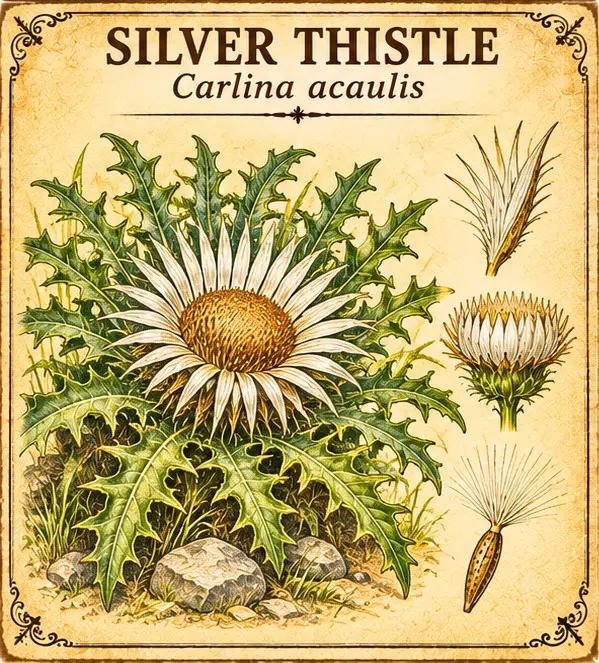
Silver Thistle
Carlina acaulis
A stemless thistle whose root was an official medicine in Germany and Poland until the 1800s, for skin diseases and worms. Its main root compound is toxic.
Safety at a glance
- PregnancyNothing recorded
- BreastfeedingNothing recorded
- MedicinesNothing recorded
- Who should avoid itNothing recorded
- AllergiesNothing recorded
- Toxicity1 note →
Tap a box to read the safety notes below. “Nothing recorded” means our sources don't cover it, not that it's safe.
What is Silver Thistle?
- Plant family
- Asteraceae, the daisy family
- Parts used
- The root
- Where it grows
- Central and southern Europe
- Genus
- Carlina
- Species
- acaulis
Also called
Stemless Carline Thistle, Carline Thistle
Traditionally used for
- Skin diseases
- Worms (historical)
Traditionally described as
- Root oil contains carlina oxide
Safety
Toxicity testing
Carlina oxide, the main compound in the root's oil, killed both normal and cancer skin cells in lab tests and was highly toxic to zebrafish. Researchers say root extracts for medicine should have it removed.[1]Study
What does the research say?
Traditional use
These are traditional uses, not proven treatments.
A stemless thistle with a large silvery flower that sits flat on the ground. Its root was described by ancient Greek and Roman physicians and was an official medicine in Germany and Poland until the 1800s, used for skin diseases, to cause sweating, to increase urine and to expel worms.[2]Study
The root is still used in folk medicine in rural parts of the Balkans.[2]Study
Laboratory & animal research
Lab and animal results show what might be worth studying in people. They don't show that the herb has these effects in humans.
Modern research on the root is very limited, mostly lab studies.[2]Study
In short
Carlina oxide is toxic to cells and zebrafish.
Sources
- [1] Toxicity of Carlina Oxide-A Natural Polyacetylene from the Carlina acaulis Roots-In Vitro and In Vivo Study · DOI: 10.3390/toxins12040239Peer-reviewed study
- [2] Historical and traditional medical applications of Carlina acaulis L. - A critical ethnopharmacological review · DOI: 10.1016/j.jep.2019.111842Peer-reviewed study
This information is educational and traditional in nature, and is not a substitute for professional medical advice. Unfamiliar word? See what these words mean.