
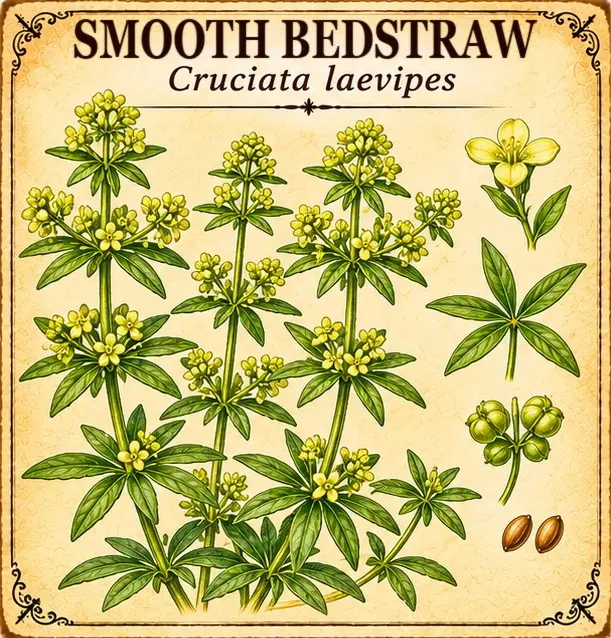
Smooth Bedstraw
Cruciata laevipes
A small yellow-flowered herb with leaves in crosses of four. In central Italy its leaf juice was drunk to expel worms, and its roots dyed wool red.
Safety at a glance
- PregnancyNothing recorded
- BreastfeedingNothing recorded
- MedicinesNothing recorded
- Who should avoid itNothing recorded
- AllergiesNothing recorded
- ToxicityNothing recorded
Tap a box to read the safety notes below. “Nothing recorded” means our sources don't cover it, not that it's safe.
What is Smooth Bedstraw?
- Plant family
- Rubiaceae, the coffee family
- Parts used
- The leaves, aerial parts and roots
- Where it grows
- Europe and western Asia
- Genus
- Cruciata
- Species
- laevipes
Also called
Crosswort
Older scientific names
Galium cruciata
Traditionally used for
- Worms
- Intestinal blockage (traditional)
Traditionally described as
- Contains benzyl alcohol and phenylacetaldehyde
Safety
Depends on how it's prepared
No human medical or safety studies were found.[1]Study
What does the research say?
Traditional use
These are traditional uses, not proven treatments.
A small yellow-flowered plant of the coffee family with leaves in crosses of four. Around Ancona, Italy, the leaf juice was drunk to expel worms and a leaf decoction used for intestinal blockages; the roots were used to dye wool red.[1]Study
In eastern Albania it's crushed with salt and fed to sheep on St. George's Day for the animals' health.[2]Study
Laboratory & animal research
Lab and animal results show what might be worth studying in people. They don't show that the herb has these effects in humans.
In short
No human medical or safety studies were found.
Sources
- [1] Ethnobotanical uses in the Ancona district (Marche region, Central Italy) · DOI: 10.1186/s13002-019-0288-1Peer-reviewed study
- [2] Resilience at the border: traditional botanical knowledge among Macedonians and Albanians living in Gollobordo, Eastern Albania · DOI: 10.1186/1746-4269-10-31Peer-reviewed study
- [3] Identification of the Volatile Components of Galium verum L. and Cruciata leavipes Opiz from the Western Italian Alps · DOI: 10.3390/molecules25102333Peer-reviewed study
- [4] Screening Study on Serine Protease Inhibitory Activity of 10 Plant Species · DOI: 10.1002/cbdv.202402776Peer-reviewed study
This information is educational and traditional in nature, and is not a substitute for professional medical advice. Unfamiliar word? See what these words mean.