
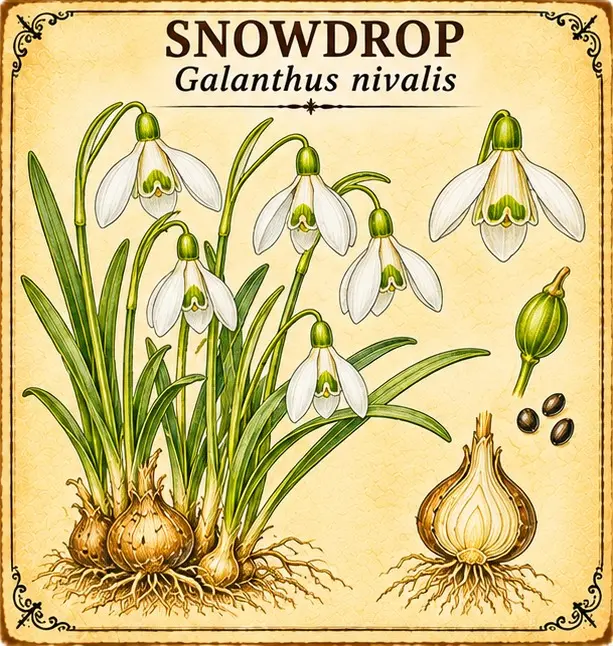
Snowdrop
Galanthus nivalis
An early-spring bulb whose galantamine was developed into a prescription drug for Alzheimer's disease. Folk medicine used it for pain and headache.
Safety at a glance
- PregnancyNothing recorded
- BreastfeedingNothing recorded
- MedicinesNothing recorded
- Who should avoid itNothing recorded
- AllergiesNothing recorded
- ToxicityNothing recorded
Tap a box to read the safety notes below. “Nothing recorded” means our sources don't cover it, not that it's safe.
What is Snowdrop?
- Plant family
- Amaryllidaceae, the amaryllis and onion family
- Parts used
- The bulbs and leaves
- Where it grows
- Europe
- Genus
- Galanthus
- Species
- nivalis
Traditionally used for
- Pain
- Headache (traditional)
Traditionally described as
- Contains galantamine and lycorine
Health topics
Where Snowdrop appears in symptom search, and why. Being listed doesn't mean it's a proven treatment.
- Cancer Research
Lab and animal studies only: listed among many effects, it slowed or killed some cancer cells. Not tested against cancer in people.
Safety
Side effects
Galantamine, the drug from snowdrop, is a prescription medicine. Common side effects include nausea, vomiting, diarrhea, dizziness and weight loss. Serious ones include a slow heartbeat, fainting and seizures.[1]Health agency
Depends on how it's prepared
Wild snowdrops are protected under international trade rules (CITES Appendix II), and wild collection is limited.[2]Study
What does the research say?
Traditional use
These are traditional uses, not proven treatments.
A small early-spring bulb with nodding white flowers. In folk medicine it was used for pain, migraine and headache. In Bulgaria, people reportedly rubbed the leaves and bulbs on their foreheads to ease nerve pain.[2]Study
Snowdrop bulbs contain galantamine (also spelled galanthamine), which was developed into a prescription drug for Alzheimer's disease. They also contain lycorine.[2]Study
Researchers have suggested that "moly," the plant Odysseus used against Circe's poisons in Homer's Odyssey, may have been the snowdrop.[3]Study
Laboratory & animal research
Lab and animal results show what might be worth studying in people. They don't show that the herb has these effects in humans.
In lab tests, snowdrop extracts and compounds blocked the enzyme that galantamine targets in Alzheimer's disease, and showed antimicrobial, antioxidant and anticancer activity. These haven't been tested as snowdrop remedies in people.[2]Study
In short
Galantamine is a prescription drug with serious side effects.
Sources
- [1] Galantamine — MedlinePlus, U.S. National Library of Medicine (NIH)Government health agency
- [2] Biological Activities of Snowdrop (Galanthus spp., Family Amaryllidaceae) · DOI: 10.3389/fphar.2020.552453Peer-reviewed study
- [3] Homer's moly identified as Galanthus nivalis L.: physiologic antidote to stramonium poisoning · DOI: 10.1097/00002826-198303000-00001Peer-reviewed study
This information is educational and traditional in nature, and is not a substitute for professional medical advice. Unfamiliar word? See what these words mean.