
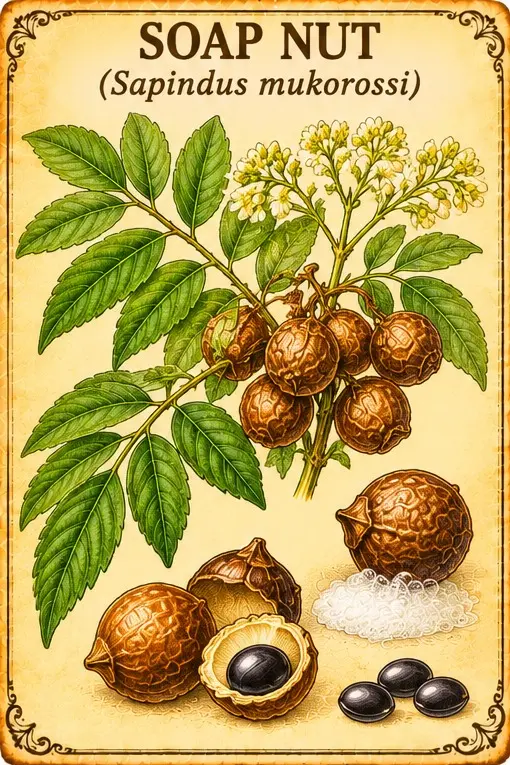
Soap Nut
Sapindus mukorossi
A tropical Asian tree whose saponin-rich fruit is used as a natural soap. Its seeds are used for tooth problems, colds and constipation.
Safety at a glance
- PregnancyNothing recorded
- BreastfeedingNothing recorded
- MedicinesNothing recorded
- Who should avoid itNothing recorded
- AllergiesNothing recorded
- ToxicityNothing recorded
Tap a box to read the safety notes below. “Nothing recorded” means our sources don't cover it, not that it's safe.
What is Soap Nut?
- Plant family
- Sapindaceae, the soapberry family
- Parts used
- The fruit shells and seeds
- Where it grows
- Tropical and subtropical Asia
- Genus
- Sapindus
- Species
- mukorossi
Also called
Soapnut, Washnut, Chinese Soapberry
Traditional names
Reetha
Traditionally used for
- Natural soap
- Folk remedies
Traditionally described as
- Rich in triterpenoid saponins
Safety
Side effects
Studies report it can cause vomiting.[1]Study
What does the research say?
Traditional use
These are traditional uses, not proven treatments.
A tropical Asian tree whose fruit is used as a natural soap and detergent, thanks to its saponins. Ground seeds are used for tooth problems, arthritis, colds, nausea and constipation.[2]Study
Laboratory & animal research
Lab and animal results show what might be worth studying in people. They don't show that the herb has these effects in humans.
In lab and animal studies, extracts killed sperm, protected the liver, eased inflammation and acted against protozoa (single-celled parasites).[1]Study
In short
May cause vomiting.
Sources
- [1] Pharmacological effects of Sapindus mukorossi · DOI: 10.1590/s0036-46652012000500007Peer-reviewed study
- [2] Triterpenoid Saponins from Washnut (Sapindus mukorossi Gaertn.)-A Source of Natural Surfactants and Other Active Components · DOI: 10.3390/plants11182355Peer-reviewed study
This information is educational and traditional in nature, and is not a substitute for professional medical advice. Unfamiliar word? See what these words mean.