
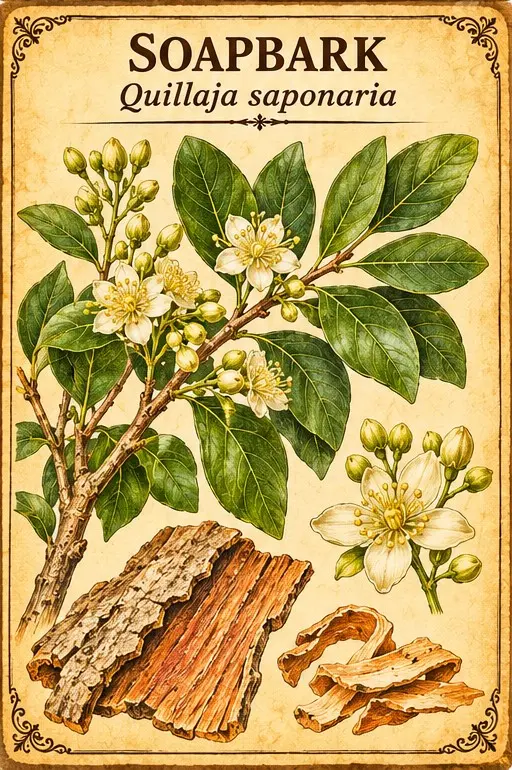
Soapbark
Quillaja saponaria
A Chilean tree whose bark foams like soap. It's used as a food additive (E 999), and a compound from it, QS-21, is used in human vaccines.
Safety at a glance
- PregnancyNothing recorded
- BreastfeedingNothing recorded
- MedicinesNothing recorded
- Who should avoid itNothing recorded
- AllergiesNothing recorded
- ToxicityNothing recorded
Tap a box to read the safety notes below. “Nothing recorded” means our sources don't cover it, not that it's safe.
What is Soapbark?
- Plant family
- Quillajaceae, the soapbark family
- Parts used
- The inner bark
- Where it grows
- Central Chile
- Genus
- Quillaja
- Species
- saponaria
Also called
Quillaja, Quillay, Soap Bark Tree, Quillaia Extract (E 999)
Traditionally used for
- Soap
- Food additive
- Vaccine ingredient
Traditionally described as
- Bark rich in saponins
- including QS-21
Health topics
Where Soapbark appears in symptom search, and why. Being listed doesn't mean it's a proven treatment.
- Diarrhea
Reduced rotavirus diarrhea in mice. Not tested in people.
Natural compounds
Safety
How much to use
In the EU, quillaia extract (E 999) is approved in foods and drinks. EFSA set a safe daily limit of 3 mg of its saponins per kg of body weight and found typical intake stays below it.[1]Health agency
Depends on how it's prepared
The FDA allows soapbark (quillaia) as a natural flavoring in foods and drinks.[2]Health agency
What does the research say?
Traditional use
These are traditional uses, not proven treatments.
Laboratory & animal research
Lab and animal results show what might be worth studying in people. They don't show that the herb has these effects in humans.
Research in people
QS-21, a compound from the bark, is approved for use in human vaccines, where it helps the immune system respond more strongly.[3]Study
In short
Approved in foods by the FDA and EFSA within set limits.
Sources
- [1] Re-evaluation of Quillaia extract (E 999) as a food additive and safety of the proposed extension of use — European Food Safety Authority · DOI: 10.2903/j.efsa.2019.5622Government health agency
- [2] 21 CFR 172.510 — Natural flavoring substances and natural substances used in conjunction with flavors — US Food and Drug Administration (Code of Federal Regulations)Government health agency
- [3] The Cinderella tree, Quillaja saponaria - A soap story · DOI: 10.1002/ppp3.70108Peer-reviewed study
- [4] Evaluation of the anti-inflammatory activities of Quillaja saponaria Mol. saponin extract in mice · DOI: 10.1016/j.toxrep.2015.11.006Peer-reviewed study
- [5] Characterization of in vivo anti-rotavirus activities of saponin extracts from Quillaja saponaria Molina · DOI: 10.1016/j.antiviral.2011.04.004Peer-reviewed study
- [6] Quillaja saponaria bark saponin protects Wistar rats against ferrous sulphate-induced oxidative and inflammatory liver damage · DOI: 10.1080/13880209.2017.1345950Peer-reviewed study
This information is educational and traditional in nature, and is not a substitute for professional medical advice. Unfamiliar word? See what these words mean.