
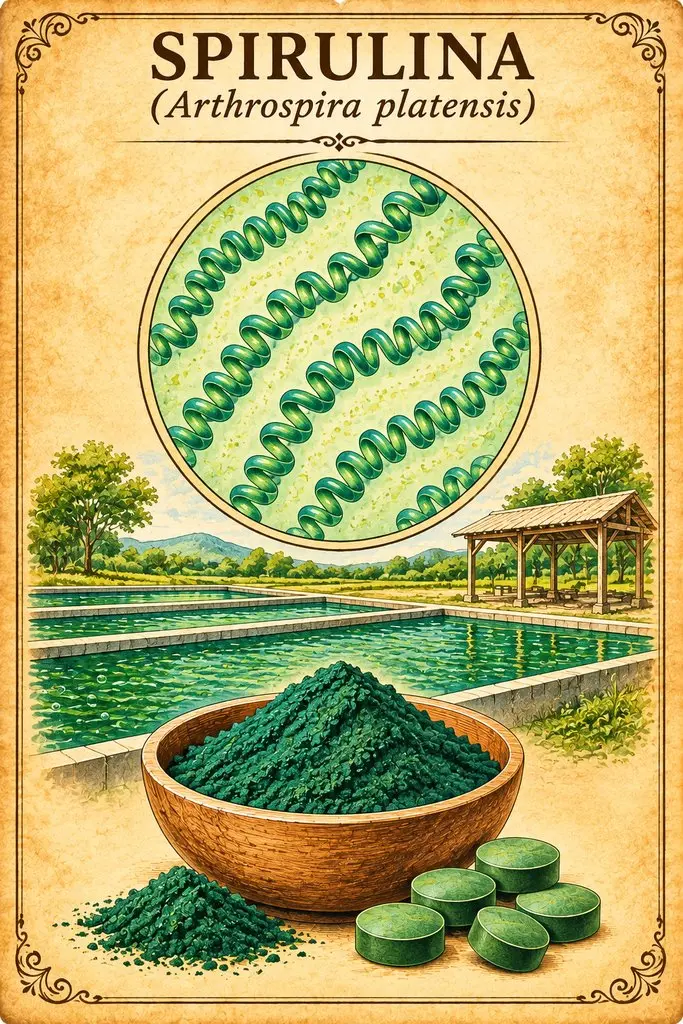
Spirulina
Arthrospira platensis
A blue-green alga eaten as a food. Trials suggest it can improve cholesterol and blood fats.
Safety at a glance
- Pregnancy1 note →
- BreastfeedingNothing recorded
- Medicines1 note →
- Who should avoid itNothing recorded
- Allergies1 note →
- ToxicityNothing recorded
Tap a box to read the safety notes below. “Nothing recorded” means our sources don't cover it, not that it's safe.
Spirulina may interact with some medicines. If you take any medicine, read Interactions with medicines below and talk to your doctor or pharmacist before using it.
What is Spirulina?
- Plant family
- Microcoleaceae, a family of blue-green algae (cyanobacteria)
- Parts used
- The whole dried alga, usually as a powder or tablet
- Genus
- Arthrospira
- Species
- platensis
Also called
Blue-green Algae, Tecuitlatl
Older scientific names
Spirulina platensis
Traditionally used for
- Food (protein and vitamins)
Traditionally described as
- Protein- and vitamin-rich alga
Health topics
Where Spirulina appears in symptom search, and why. Being listed doesn't mean it's a proven treatment.
- High Blood Pressure
Lowered diastolic (bottom number) blood pressure in overweight and obese adults in a 2025 review of trials.
- High Cholesterol
Reviews of trials found it lowered total and LDL cholesterol and triglycerides and raised HDL cholesterol.
Safety
Interactions with medicines
Research suggests spirulina may slow how the body breaks down some medicines, which could raise their side effects. Whether this matters in people is not known. Ask your doctor or pharmacist if you take medicines.[1]General reference
Technical detail: inhibits CYP1A2 and CYP2E1.
Allergies
Severe allergic reactions (anaphylaxis) have been reported.[1]General reference
Side effects
A 28-year-old man developed rhabdomyolysis (severe muscle breakdown, with muscle weakness and pain) after taking spirulina supplements for a month. He recovered after stopping.[1]General reference
Pregnancy
A newborn baby had seizures caused by high blood calcium, which was linked to the mother taking spirulina supplements for a long time.[1]General reference
Contamination
Blue-green algae products can be contaminated with toxic algae. In rare cases these toxins have caused liver damage, kidney failure, nerve damage, seizures, breathing failure, pancreatitis and heart muscle damage.[1]General reference
Technical detail: cyanotoxins such as microcystins, anatoxin and saxitoxin, mainly from Microcystis species.
What does the research say?
Traditional use
These are traditional uses, not proven treatments.
Spirulina is a blue-green alga, a tiny water organism related to bacteria. It is grown in alkaline fresh water and eaten as a food in some parts of the world. It is a natural source of protein and vitamins.[1]General reference
Laboratory & animal research
Lab and animal results show what might be worth studying in people. They don't show that the herb has these effects in humans.
In lab studies, a substance from spirulina stopped several viruses from multiplying, including HIV, herpes and flu viruses. In animals, spirulina protected against genetic damage from chemicals and radiation. It isn't known whether these effects happen in people.[1]General reference
Technical detail: calcium spirulan inhibited HIV-1, herpes simplex 1, cytomegalovirus and influenza replication in vitro.
Research in people
A 2016 review of 7 randomized trials found spirulina lowered total cholesterol, LDL ("bad") cholesterol and triglycerides, and raised HDL ("good") cholesterol.[2]Review or trial
Technical detail: total cholesterol weighted mean difference −46.76 mg/dL.
A 2025 review of 23 studies in 1,035 overweight or obese adults found that spirulina:
- slightly lowered body weight
- lowered total cholesterol, LDL ("bad") cholesterol and triglycerides, and raised HDL ("good") cholesterol
- lowered the bottom number of blood pressure (diastolic)
It had little effect on body fat or blood sugar. Longer studies are needed.[3]Review or trial
Technical detail: Hedges' g: body weight −0.30, total cholesterol −0.79, triglycerides −0.64, LDL-C −0.71, diastolic BP −0.73, HDL-C +0.53.
Spirulina has not been shown to treat or prevent cancer, AIDS, ADHD or other serious medical conditions. There is no good evidence that it suppresses appetite or relieves fatigue.[1]General reference
In short
Products can be contaminated with algae toxins; rare allergic reactions.
Sources
- [1] Blue-green Algae — Memorial Sloan Kettering Cancer Center, About HerbsGeneral reference
- [2] A systematic review and meta-analysis of the impact of Spirulina supplementation on plasma lipid concentrations · DOI: 10.1016/j.clnu.2015.09.007Review or clinical trial
- [3] Effects of spirulina supplementation alone or with exercise on cardiometabolic health in overweight and obese adults: a systematic review and meta-analysis · DOI: 10.3389/fnut.2025.1624982Review or clinical trial
This information is educational and traditional in nature, and is not a substitute for professional medical advice. Unfamiliar word? See what these words mean.