
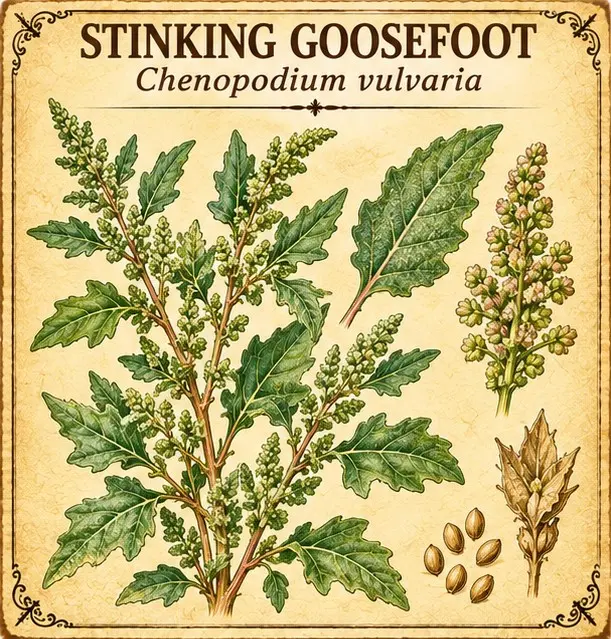
Stinking Goosefoot
Chenopodium vulvaria
A grey-green weed that smells of rotten fish, from trimethylamine. It has become rare in northern Europe. No published medicinal uses were found.
Safety at a glance
- PregnancyNothing recorded
- BreastfeedingNothing recorded
- MedicinesNothing recorded
- Who should avoid itNothing recorded
- AllergiesNothing recorded
- ToxicityNothing recorded
Tap a box to read the safety notes below. “Nothing recorded” means our sources don't cover it, not that it's safe.
What is Stinking Goosefoot?
- Plant family
- Amaranthaceae, the amaranth family
- Parts used
- The whole plant
- Where it grows
- Southern Europe, North Africa and western Asia
- Genus
- Chenopodium
- Species
- vulvaria
Traditionally used for
- None documented
Traditionally described as
- Contains trimethylamine
Safety
Depends on how it's prepared
No published medicinal uses or human safety studies were found.[1]Study
What does the research say?
Traditional use
These are traditional uses, not proven treatments.
A low, grey-green weed known for its foul smell, often compared to rotten fish. It has become much rarer in northern Europe as its habitats changed. Grazing animals eat it despite the smell.[1]Study
Laboratory & animal research
Lab and animal results show what might be worth studying in people. They don't show that the herb has these effects in humans.
Its fishy smell comes from trimethylamine, the same compound that makes old fish smell.[2]Study
In short
No published medicinal uses or human safety studies were found.
Sources
- [1] Piecing together the biogeographic history of Chenopodium vulvaria L. using botanical literature and collections · DOI: 10.7717/peerj.723Peer-reviewed study
- [2] The micro-estimation and origin of trimethylamine in Chenopodium vulvaria L. · DOI: 10.1042/bj0460578Peer-reviewed study
This information is educational and traditional in nature, and is not a substitute for professional medical advice. Unfamiliar word? See what these words mean.