
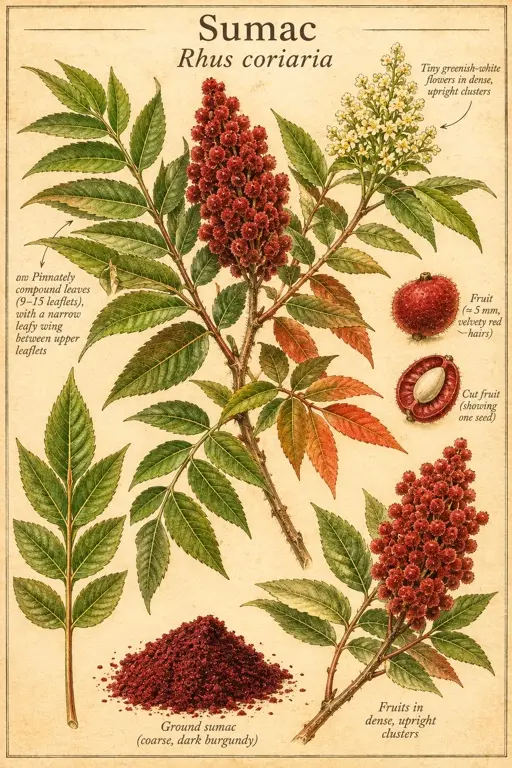
Sumac
Rhus coriaria
A Mediterranean and Middle Eastern shrub whose tangy, dark red ground fruit is a popular spice. Trials suggest it can improve blood sugar and cholesterol, and a sumac gel helped mouth ulcers heal.
Safety at a glance
- PregnancyNothing recorded
- BreastfeedingNothing recorded
- MedicinesNothing recorded
- Who should avoid itNothing recorded
- AllergiesNothing recorded
- ToxicityNothing recorded
Tap a box to read the safety notes below. “Nothing recorded” means our sources don't cover it, not that it's safe.
What is Sumac?
- Plant family
- Anacardiaceae, the cashew and mango family
- Parts used
- The dried, ground red fruits (the spice)
- Where it grows
- The Mediterranean and the Middle East
- Genus
- Rhus
- Species
- coriaria
Also called
Sicilian Sumac, Tanner's Sumac, Elm-leaved Sumac
Regional names
Sumaq
Traditionally used for
- Spice
- Blood sugar and cholesterol (studied)
- Mouth ulcers (gel
- studied)
- Heavy periods (traditional Persian)
Traditionally described as
- Tangy and astringent; rich in tannins
- flavonoids and organic acids
Health topics
Where Sumac appears in symptom search, and why. Being listed doesn't mean it's a proven treatment.
- High Blood Sugar
A review of 15 trials found sumac improved fasting blood sugar and insulin sensitivity.
- High Cholesterol
A review of 15 trials found sumac improved cholesterol and triglycerides.
Natural compounds
Safety
How much to use
In trials, people took sumac powder in capsules for 4 to 12 weeks, often at 3 g a day or more. There's no established dose.[1]Review or trial
What does the research say?
Traditional use
These are traditional uses, not proven treatments.
Sumac is a shrub from the Mediterranean and Middle East. Its tangy, dark red ground fruit is a popular spice. It's also used as a medicinal remedy in Middle Eastern countries, including on skin injuries.[2]Study
Technical detail: the fruit is rich in flavonoids, tannins, polyphenols and organic acids.
In traditional Persian medicine, sumac is valued for being astringent (tightening tissues) and for helping to stop bleeding. It's currently being tested in a trial for heavy menstrual periods.[3]Study
Technical detail: these properties are attributed to its tannins and flavonoids.
Laboratory & animal research
Lab and animal results show what might be worth studying in people. They don't show that the herb has these effects in humans.
In mice with inflamed skin, sumac fruit extracts applied to the skin reduced the inflammation. Earlier lab work had shown the same effect in human skin cells.[2]Study
Technical detail: acetone and ethanol fruit extracts tested in a croton oil-induced dermatitis model; prior in vitro anti-inflammatory activity in HaCaT keratinocytes.
Research in people
A 2026 review pooled 15 trials with 917 people who took sumac for 4 to 12 weeks. Sumac improved blood sugar and blood fats (cholesterol and triglycerides). It didn't change weight, waist size or inflammation markers.[1]Review or trial
Technical detail: random-effects meta-analysis with dose-response modelling; glycemic outcomes (fasting glucose, HOMA-IR, insulin) and lipid outcomes improved; anthropometric and inflammatory outcomes did not. Risk of bias: low in 9 trials, moderate in 4, high in 2.
A 2025 review of 7 trials found that sumac slightly lowered C-reactive protein, a blood marker of inflammation. Results varied between trials. The drop was clearest in people with fatty liver disease.[4]Review or trial
Technical detail: hs-CRP SMD −0.33 (95% CI −0.64 to −0.02; P = 0.03); I² = 60.2%.
In a trial with 60 people with mouth ulcers (canker sores), a sumac gel healed the ulcers fastest. It also shrank them most and eased pain more than a steroid paste or a placebo. The authors say more studies are needed.[5]Study
Technical detail: triple-blind randomized trial comparing sumac adhesive gel, Triadent (triamcinolone) oral paste and placebo; outcomes were healing time, lesion size and VAS pain.
In short
No established dose; trials used about 3 g a day for up to 12 weeks.
Sources
- [1] Sumac (Rhus coriaria L.) and Human Metabolic Health: A Systematic Review and Meta-Analysis · DOI: 10.1002/edm2.70135Review or clinical trial
- [2] In vivo and in vitro investigation of skin anti-inflammatory effect of Sumac (Rhus coriaria L.) · DOI: 10.1007/s10787-026-02368-2Peer-reviewed study
- [3] Sumac (Rhus coriaria L.) Capsules for the management of hypermenorrhea: Protocol for a randomized triple-blind trial · DOI: 10.1371/journal.pone.0361956Peer-reviewed study
- [4] Sumac (Rhus coriaria L.) Supplementation on High-Sensitivity C-Reactive Protein Concentrations in Adults: A Systematic Review and Dose-Response Meta-Analysis · DOI: 10.1016/j.cdnut.2025.107555Review or clinical trial
- [5] Comparison of Two Oral Pastes Containing Triamcinolone and Rhus Coriaria L. for Treating Minor Aphthous Lesions · DOI: 10.1016/j.identj.2024.09.008Peer-reviewed study
This information is educational and traditional in nature, and is not a substitute for professional medical advice. Unfamiliar word? See what these words mean.