
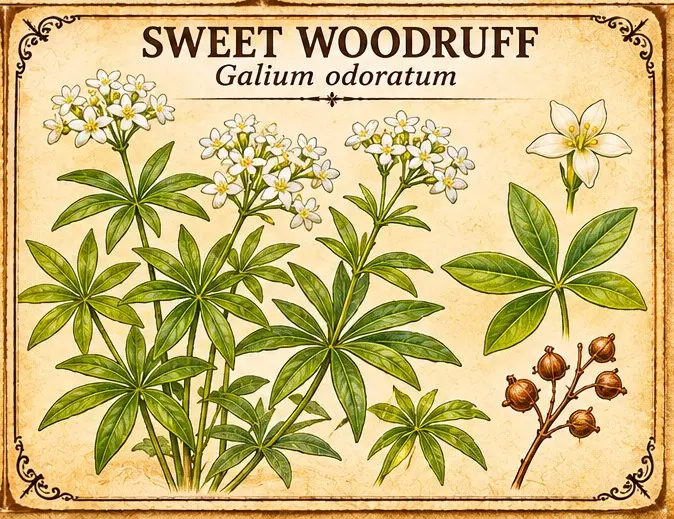
Sweet Woodruff
Galium odoratum
A hay-scented European woodland herb used to flavor German May wine. Its scent comes from coumarin, which can harm the liver in large amounts.
Safety at a glance
- PregnancyNothing recorded
- BreastfeedingNothing recorded
- MedicinesNothing recorded
- Who should avoid itNothing recorded
- AllergiesNothing recorded
- Toxicity2 notes →
Tap a box to read the safety notes below. “Nothing recorded” means our sources don't cover it, not that it's safe.
What is Sweet Woodruff?
- Plant family
- Rubiaceae, the coffee family
- Parts used
- The leaves and flowering shoots
- Where it grows
- Europe, North Africa and western Asia
- Genus
- Galium
- Species
- odoratum
Also called
Woodruff
Regional names
Waldmeister
Older scientific names
Asperula odorata
Traditionally used for
- Flavoring (May wine)
- Wounds
- Digestion (traditional)
Traditionally described as
- Contains coumarin
Safety
Toxicity testing
What does the research say?
Traditional use
These are traditional uses, not proven treatments.
A European woodland herb that smells of fresh hay when dried, from coumarin. It's traditionally used to flavor drinks, especially German May wine (Maibowle), and was used on wounds and for digestive problems, coughs and anxiety.[2]Study
Laboratory & animal research
Lab and animal results show what might be worth studying in people. They don't show that the herb has these effects in humans.
In rats, a leaf extract reduced swelling and helped burns heal. There's no good clinical evidence for sweet woodruff preparations.[2]Study
In short
Coumarin can damage the liver in large amounts.
Sources
- [1] Coumarins in Food and Methods of Their Determination · DOI: 10.3390/foods9050645Peer-reviewed study
- [2] Sweet Woodruff (Galium odoratum L.)-More than Just Coumarin: From Fundamental to Biomass Valorization · DOI: 10.3390/molecules31162920Peer-reviewed study
This information is educational and traditional in nature, and is not a substitute for professional medical advice. Unfamiliar word? See what these words mean.