
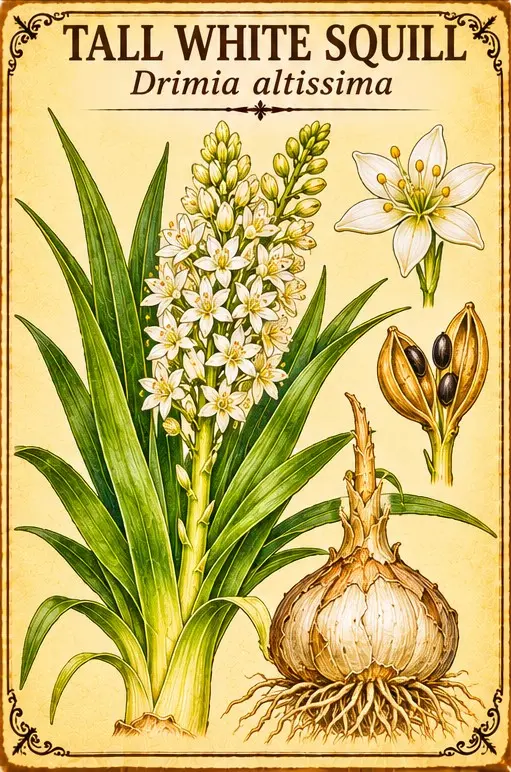
Tall White Squill
Drimia altissima
An African bulb used for colds, skin problems and rheumatism. Its bulbs contain powerful heart-acting compounds, and related squills are among southern Africa's most common poisonous plants.
Safety at a glance
- PregnancyNothing recorded
- BreastfeedingNothing recorded
- MedicinesNothing recorded
- Who should avoid itNothing recorded
- AllergiesNothing recorded
- Toxicity2 notes →
Tap a box to read the safety notes below. “Nothing recorded” means our sources don't cover it, not that it's safe.
What is Tall White Squill?
- Plant family
- Asparagaceae, the asparagus family
- Parts used
- The bulb
- Where it grows
- Tropical and southern Africa
- Genus
- Drimia
- Species
- altissima
Older scientific names
Urginea altissima
Traditionally used for
- Colds
- Skin problems
- Rheumatism (traditional)
Traditionally described as
- Bulb contains bufadienolides
Health topics
Where Tall White Squill appears in symptom search, and why. Being listed doesn't mean it's a proven treatment.
- Cancer Research
Lab studies only: compounds from the bulb killed cancer cells at very low doses. Not tested against cancer in people. The bulb is poisonous.
Safety
Side effects
Rubbing the bulb on the skin causes itching and mild inflammation, partly from needle-like calcium oxalate crystals.[1]Study
Toxicity testing
Drimia bulbs contain bufadienolides, powerful heart-acting compounds, and some species are among southern Africa's six most common poisonous plants for people and livestock.[2]Study
The gap between a helpful and a toxic dose is very narrow. These plants have been used as rat poison and shouldn't be taken without medical supervision.[3]Study
What does the research say?
Traditional use
These are traditional uses, not proven treatments.
Laboratory & animal research
Lab and animal results show what might be worth studying in people. They don't show that the herb has these effects in humans.
Heart-active compounds from the bulb (bufadienolides) killed cancer cells at very low doses in lab tests.[4]Study
In short
Poisonous; heart-acting compounds with a very narrow safe dose.
Sources
- [1] Study of two plants used in traditional medicine in Zimbabwe for skin problems and rheumatism: Dioscorea sylvatica and Urginea altissima · DOI: 10.1016/s0378-8741(00)00347-0Peer-reviewed study
- [2] Bulbous Plants Drimia: "A Thin Line between Poisonous and Healing Compounds" with Biological Activities · DOI: 10.3390/pharmaceutics13091385Peer-reviewed study
- [3] Traditional medical uses of Drimia species in terms of phytochemistry, pharmacology and toxicology · DOI: 10.1016/s0254-6272(17)30036-5Peer-reviewed study
- [4] Antiproliferative Bufadienolides from the Bulbs of Drimia altissima · DOI: 10.1021/acs.jnatprod.0c01079Peer-reviewed study
This information is educational and traditional in nature, and is not a substitute for professional medical advice. Unfamiliar word? See what these words mean.