
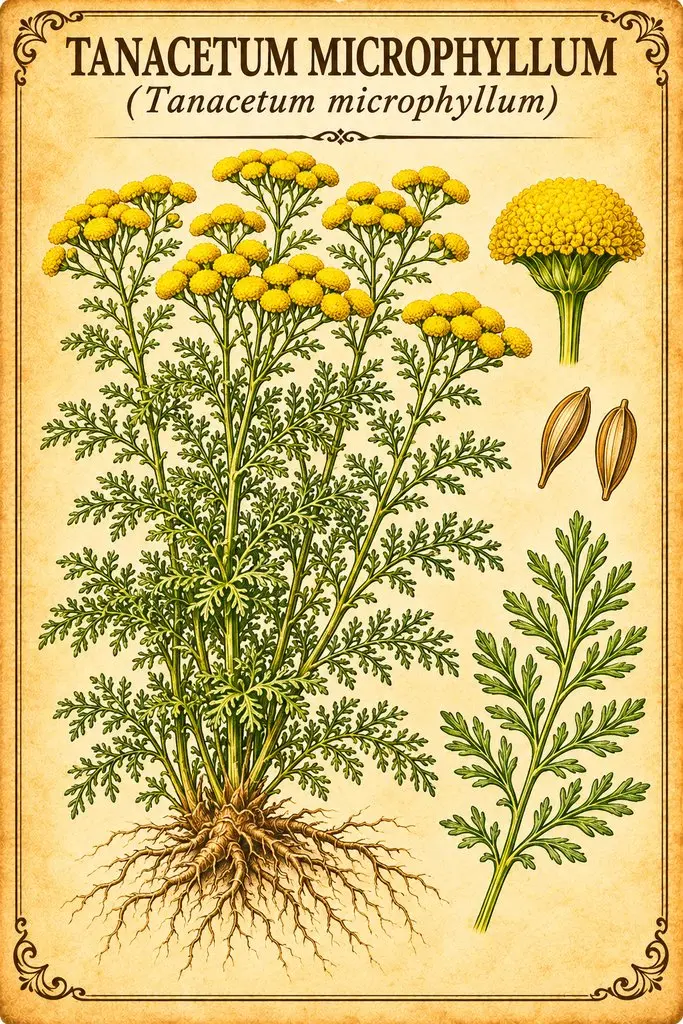
Tanacetum Microphyllum
Tanacetum microphyllum
A plant in the tansy genus used in folk medicine for inflammation and ulcers. Its compounds reduced inflammation in lab and mouse studies.
Safety at a glance
- PregnancyNothing recorded
- BreastfeedingNothing recorded
- MedicinesNothing recorded
- Who should avoid itNothing recorded
- AllergiesNothing recorded
- ToxicityNothing recorded
Tap a box to read the safety notes below. “Nothing recorded” means our sources don't cover it, not that it's safe.
What is Tanacetum Microphyllum?
- Plant family
- Asteraceae, the daisy family
- Parts used
- The above-ground parts
- Genus
- Tanacetum
- Species
- microphyllum
Older scientific names
Vogtia microphylla
Traditionally used for
- Inflammation
- Ulcers
Traditionally described as
- Flavonoid-rich aerial parts
What does the research say?
Traditional use
These are traditional uses, not proven treatments.
The above-ground parts of this plant have been used in folk medicine for inflammation and ulcers.[1]Study
Laboratory & animal research
Lab and animal results show what might be worth studying in people. They don't show that the herb has these effects in humans.
In mice, hydroxyachillin, a compound from the plant, reduced paw swelling caused by an irritant. In lab tests it blocked two enzymes involved in inflammation.[1]Study
Technical detail: carrageenan-induced paw edema; dual cyclooxygenase and lipoxygenase inhibitor.
In lab studies on immune cells, flavonoids and hydroxyachillin from the plant lowered several signals the body uses to drive inflammation. None of this has been tested in people.[2]Study
Technical detail: santin, ermanin, centaureidin and hydroxyachillin inhibited LPS-induced NO, PGE2 and (for some) TNF-α, and suppressed iNOS and COX-2 expression.
A 2006 lab study found the plant's flavonoids switched off two inflammation enzymes in immune cells.[3]Study
Technical detail: suppressed LPS-induced iNOS and COX-2 expression in RAW 264.7 cells; ermanin most potent.
In short
No human studies or safety data.
Sources
- [1] Anti-inflammatory activity of hydroxyachillin, a sesquiterpene lactone from Tanacetum microphyllum · DOI: 10.1055/s-2006-959464Peer-reviewed study
- [2] Flavonoids and a sesquiterpene lactone from Tanacetum microphyllum inhibit anti-inflammatory mediators in LPS-stimulated mouse peritoneal macrophages · DOI: 10.1055/s-2004-815452Peer-reviewed study
- [3] Inhibition of inducible nitric oxide synthase and cyclooxygenase-2 expression by flavonoids isolated from Tanacetum microphyllum · DOI: 10.1016/j.intimp.2006.07.012Peer-reviewed study
This information is educational and traditional in nature, and is not a substitute for professional medical advice. Unfamiliar word? See what these words mean.