
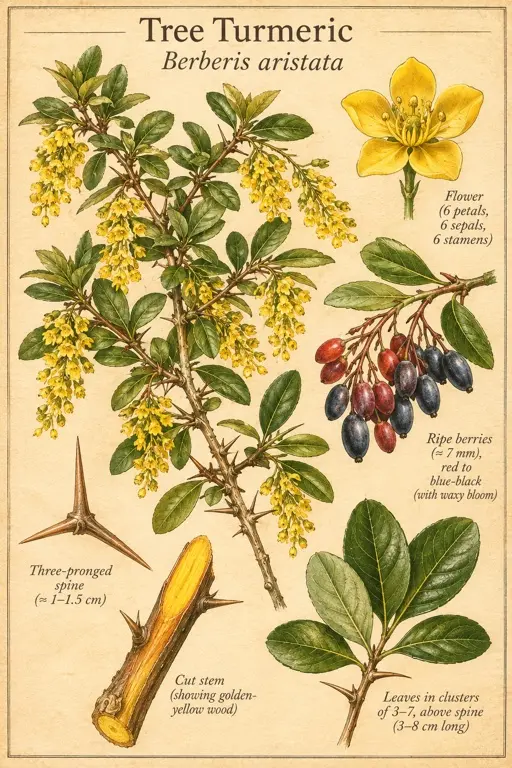
Tree Turmeric
Berberis aristata
A spiny barberry from the Indian subcontinent with bright yellow wood; despite its name, it isn't a turmeric. Known in Ayurveda as daruharidra, it's rich in berberine, and trials of its root extract combined with milk thistle lowered cholesterol and blood sugar.
Safety at a glance
- Pregnancy2 notes →
- Breastfeeding1 note →
- Medicines3 notes →
- Who should avoid it1 note →
- AllergiesNothing recorded
- ToxicityNothing recorded
Tap a box to read the safety notes below. “Nothing recorded” means our sources don't cover it, not that it's safe.
Tree Turmeric may interact with some medicines. If you take any medicine, read Interactions with medicines below and talk to your doctor or pharmacist before using it.
What is Tree Turmeric?
- Plant family
- Berberidaceae, the barberry family
- Parts used
- The root and stem (bark and yellow wood)
- Where it grows
- The Indian subcontinent, including the Himalayas
- Genus
- Berberis
- Species
- aristata
Also called
Indian Barberry, Nepal Barberry, Ophthalmic Barberry
Regional names
Daruhaldi
Traditional names
Daruharidra
Traditionally used for
- Liver problems
- skin and eye infections (Ayurveda)
- High cholesterol (studied)
- Blood sugar (studied)
Traditionally described as
- Bitter; root and wood rich in berberine
Health topics
Where Tree Turmeric appears in symptom search, and why. Being listed doesn't mean it's a proven treatment.
- High Blood Sugar
In trials, combinations containing tree turmeric lowered fasting blood sugar and improved insulin sensitivity.
- High Cholesterol
Trials of a tree turmeric and milk thistle combination lowered LDL and total cholesterol; evidence is limited.
Traditions that use it
- Ayurveda
Known as daruharidra. Used in Ayurveda for liver and pancreas problems, skin infections, diabetes and eye inflammation.
Natural compounds
Safety
Interactions with medicines
Don't take tree turmeric with cyclosporine (Neoral, Sandimmune), a medicine used after organ transplants. Tree turmeric may slow how fast the body breaks it down, leading to too much cyclosporine and more side effects. This is rated a major interaction.[1]General reference
Be careful combining tree turmeric with medicines the liver breaks down through the same pathway. It may raise their levels and side effects. Examples include:
- Lovastatin (for cholesterol)
- Clarithromycin (an antibiotic)
- Indinavir (for HIV)
- Sildenafil (Viagra)
- Triazolam (a sleeping pill)
Technical detail: rated a moderate interaction with cytochrome P450 3A4 (CYP3A4) substrates.
Berberine-containing herbs may change how the body processes many medicines. In one study, goldenseal extract lowered levels of the diabetes drug metformin by about 25%, enough to affect blood sugar control. If you take any medicine, talk with your health care provider before using tree turmeric.[2]Health agency
Who should avoid it
Tree turmeric is considered unsafe for newborn babies, because berberine can cause kernicterus (brain damage linked to severe jaundice).[1]General reference
Pregnancy
Tree turmeric is considered unsafe during pregnancy. Berberine can cross the placenta and may harm the unborn baby. Newborns exposed to berberine have developed kernicterus, a rare type of brain damage linked to severe jaundice.[1]General reference
Technical detail: berberine may stop the liver from clearing bilirubin quickly enough.
Tree turmeric's main compound, berberine, can harm newborns. The US National Institutes of Health advises that women who are pregnant or breastfeeding shouldn't use goldenseal, another berberine-rich plant, and that it shouldn't be given to infants, for this reason.[2]Health agency
Breastfeeding
Tree turmeric is considered unsafe while breastfeeding. Berberine can pass to the baby through breast milk and may harm them.[1]General reference
How much to use
There isn't enough information to know whether tree turmeric is safe for adults in medicinal amounts, or to set a dose.[1]General reference
What does the research say?
Traditional use
These are traditional uses, not proven treatments.
Tree turmeric, or Indian barberry, is a spiny shrub from the Indian subcontinent with yellow flowers and red to purple berries. Despite its name, it isn't related to turmeric; it belongs to the barberry family.
In Ayurveda and other traditional medicine systems, including in the Middle East, it's used for:
- Liver and pancreas problems
- Skin infections
- Diabetes
- Eye inflammation (conjunctivitis)
The fruit, stems, leaves, wood, root and root bark are all used as medicine. People take tree turmeric for:
- Heart failure
- Liver disease and jaundice
- Malaria
- Trachoma (an eye infection that can cause blindness)
- Skin diseases
- Heavy periods
- Stomach upsets and diarrhea
It's also put on the skin for burns and wounds. A US supplement reference rates the evidence for every one of these uses as insufficient.[1]General reference
Laboratory & animal research
Lab and animal results show what might be worth studying in people. They don't show that the herb has these effects in humans.
Its main active compounds are alkaloids, especially berberine, the same yellow compound found in barberry and goldenseal. In lab and animal studies, tree turmeric substances have shown effects on blood sugar, blood fats, germs, inflammation and cancer cells.[3]Study
Technical detail: isoquinoline alkaloids, particularly berberine, are the primary phytochemicals; reported activities include antidiabetic, lipid-lowering, antimicrobial, anti-inflammatory and anticancer effects.
Research in people
Most human studies used tree turmeric root extract combined with other ingredients, usually milk thistle. A 2020 review pooled 4 trials with 491 adults with high cholesterol who took this combination (sold as Berberol) for 3 months. Compared with a placebo, it lowered LDL ("bad") cholesterol, total cholesterol and fasting blood sugar, and improved insulin sensitivity. It didn't change HDL cholesterol, triglycerides or body mass index.
It appeared safe, with no rise in liver or muscle enzymes. But the evidence is very limited, and the best dose and length of treatment aren't known.[4]Review or trial
Technical detail: fixed combination of Berberis aristata and Silybum marianum; HOMA index improved; ALT, AST and creatine kinase did not rise.
In a 6-month trial, 175 people with high cholesterol who couldn't tolerate high-dose statins halved their statin dose. Those who also took the tree turmeric and milk thistle combination kept their cholesterol steady, while it rose in the placebo group. Blood sugar and insulin also fell with the combination. No one had serious side effects.[5]Study
Technical detail: randomized, double-blind, placebo-controlled; one tablet at lunch and one at dinner. Total cholesterol, LDL-C, triglycerides and myeloperoxidase were unchanged with Berberol but rose with placebo; fasting glucose, insulin and HOMA index fell.
A 2023 review of trials in people with metabolic syndrome found that tree turmeric and common barberry both lowered LDL cholesterol, total cholesterol, triglycerides and blood sugar. Tree turmeric also raised HDL ("good") cholesterol.[6]Review or trial
Technical detail: random-effects meta-regression comparing Berberis vulgaris and Berberis aristata with controls.
In short
Its berberine can harm newborns, so it's considered unsafe in pregnancy, breastfeeding and for babies. Don't combine it with cyclosporine; it may also affect metformin and other medicines.
Sources
- [1] Tree Turmeric: Health Benefits, Side Effects, Uses, Dose & Precautions — RxList (Internet Brands)General reference
- [2] Goldenseal: Usefulness and Safety — National Center for Complementary and Integrative Health (NIH)Government health agency
- [3] Berberis aristata DC. (Indian barberry): Current insight into botanical, phytochemical, and pharmacological aspects, pharmacokinetics, safety of use and modern therapeutic applications · DOI: 10.1016/j.fitote.2025.106539Peer-reviewed study
- [4] The Effects of a Fixed Combination of Berberis aristata and Silybum marianum on Dyslipidaemia - A Meta-analysis and Systematic Review · DOI: 10.1055/a-1063-1649Review or clinical trial
- [5] Berberis aristata/Silybum marianum fixed combination (Berberol®) effects on lipid profile in dyslipidemic patients intolerant to statins at high dosages: a randomized, placebo-controlled, clinical trial · DOI: 10.1016/j.phymed.2014.11.018Peer-reviewed study
- [6] The effects of Berberis vulgaris L. and Berberis aristata L. in metabolic syndrome patients: a systematic and meta-analysis study · DOI: 10.1080/13813455.2020.1828482Review or clinical trial
This information is educational and traditional in nature, and is not a substitute for professional medical advice. Unfamiliar word? See what these words mean.