
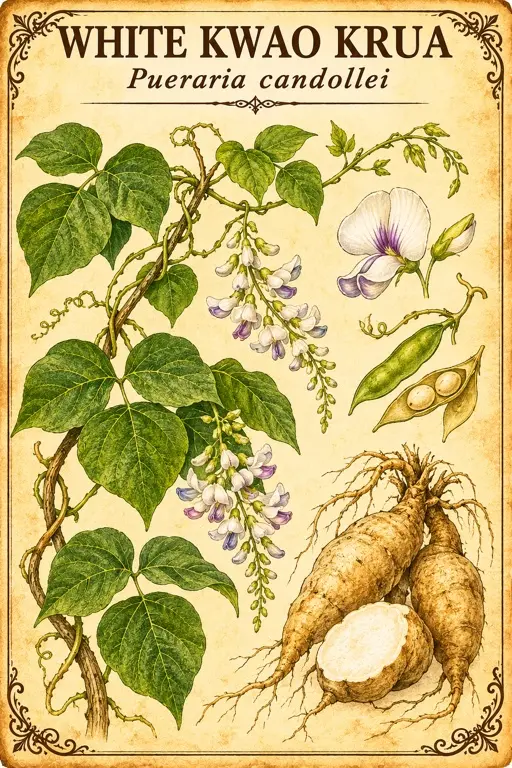
White Kwao Krua
Pueraria candollei var. mirifica
A Thai climbing plant whose large root is a traditional rejuvenating tonic for women. It contains some of the strongest known plant estrogens, and small trials suggest it may help vaginal dryness after menopause.
Safety at a glance
- PregnancyNothing recorded
- BreastfeedingNothing recorded
- MedicinesNothing recorded
- Who should avoid itNothing recorded
- AllergiesNothing recorded
- Toxicity1 note →
Tap a box to read the safety notes below. “Nothing recorded” means our sources don't cover it, not that it's safe.
What is White Kwao Krua?
- Plant family
- Fabaceae, the pea and bean family
- Parts used
- The tuberous root
- Where it grows
- Thailand (also reported in Myanmar, Laos and Vietnam)
- Genus
- Pueraria
- Species
- candollei var. mirifica
Also called
White Kudzu
Regional names
Kwao Krua Khao, Sâm tố nữ
Older scientific names
Pueraria mirifica
Traditionally used for
- Menopause symptoms (studied)
- Vaginal dryness (studied)
- Rejuvenation (traditional Thai)
Traditionally described as
- Rich in potent phytoestrogens
- including miroestrol
- puerarin and daidzein
Health topics
Where White Kwao Krua appears in symptom search, and why. Being listed doesn't mean it's a proven treatment.
- Menopause Symptoms
Small trials suggest it may ease menopause symptoms and vaginal dryness, but study quality is poor; it acts strongly like estrogen.
- Sexual Health
Capsules and a vaginal gel improved vaginal dryness and pain during sex in postmenopausal women in small trials.
Natural compounds
Safety
Side effects
In menopause trials, side effects included breast pain, vaginal spotting and dizziness. These were about as common as with estrogen cream or placebo. A marker of inflammation in the blood (C-reactive protein) doubled.[1]Review or trial
Toxicity testing
White kwao krua acts strongly like estrogen. In animal studies, high doses:
- Overstimulated the womb lining and breast tissue
- Disrupted menstrual cycles in monkeys
- Reduced fertility in female mice and sperm quality in male mice
- Promoted breast cancer in rats when given long term
The review says long-term safety in people hasn't been defined.[2]Study
Technical detail: findings include endometrial hyperplasia, mammary lobular hyperplasia, suppressed FSH and LH, persistent estrus, reduced sperm motility at 100 mg/kg in mice, micronucleus increases at 600–800 mg/kg in rats, and promotion of DMBA-induced breast cancer with long-term extract in Donryu rats.
What does the research say?
Traditional use
These are traditional uses, not proven treatments.
White kwao krua is a climbing plant with a large root, mainly from Thailand. For more than a century, the root has been used as a rejuvenating tonic, especially for age-related problems in women around menopause. It may be taken on its own or mixed with milk, honey or other Thai herbs.
Traditional uses include:
- Rejuvenation and physical strength
- Better sleep and appetite
- Breast enlargement
- Preventing hair loss or graying
- Improving memory
Laboratory & animal research
Lab and animal results show what might be worth studying in people. They don't show that the herb has these effects in humans.
The root contains more than 100 compounds, including some of the strongest known plant estrogens (substances that act like the hormone estrogen). In lab and animal studies, it had strong estrogen-like effects and helped prevent bone loss.[2]Study
Technical detail: 106 secondary metabolites, including isoflavones (puerarin, daidzein) and the potent phytoestrogen miroestrol; reported estrogenic, anti-osteoporotic, antioxidant, neuroprotective and immunomodulatory activity.
Research in people
A 2018 review of 8 trials with 309 women around menopause found that menopause symptom scores fell by about half from the start in 5 studies. But the trials were poorly designed and the products weren't standardized. So whether it really works for menopause symptoms is still unclear.[1]Review or trial
Technical detail: high risk of bias and low quality scores; placebo effects in self-reported questionnaires could not be excluded; bone alkaline phosphatase halved.
In a 24-week trial, 71 healthy women after menopause took capsules (20, 30 or 50 mg a day) or a placebo. Vaginal dryness and pain during sex improved, and the vaginal lining showed signs of estrogen activity. Side effects were no more common than with placebo.[3]Study
Technical detail: randomized, double-blind, placebo-controlled; vaginal maturation index shifted from 46:43:11 to 11:65:24 (parabasal:intermediate:superficial).
In a 12-week trial with 72 women after menopause who had vaginal dryness and urinary symptoms, a 6% white kwao krua vaginal gel improved blood flow to the vagina and the health of the vaginal lining, compared with a placebo gel.[4]Study
Technical detail: randomized, double-blind, placebo-controlled (TCTR20200624007); 63 completed. Doppler pulsatility index at week 12 3.03 vs 6.88 (p = 0.002); vaginal maturation index 55.19 vs 20.29 (p = 0.012).
In short
Acts strongly like estrogen. High doses harmed the womb, breasts and fertility in animals, and long-term safety in people isn't known.
Sources
- [1] Efficacy and safety of Pueraria candollei var. mirifica (Airy Shaw & Suvat.) Niyomdham for menopausal women: A systematic review of clinical trials and the way forward · DOI: 10.1016/j.jep.2018.01.028Review or clinical trial
- [2] Pueraria mirifica: a critical review of the ethnobotany, phytochemistry, pharmacology and challenges in standardization and safety · DOI: 10.3389/fphar.2026.1820644Peer-reviewed study
- [3] Effect of Pueraria mirifica on vaginal health · DOI: 10.1097/gme.0b013e3180399486Peer-reviewed study
- [4] Effects of Pueraria mirifica on vaginal artery vascularization in postmenopausal women with genitourinary syndrome of menopause · DOI: 10.1016/j.maturitas.2022.01.005Peer-reviewed study
This information is educational and traditional in nature, and is not a substitute for professional medical advice. Unfamiliar word? See what these words mean.