
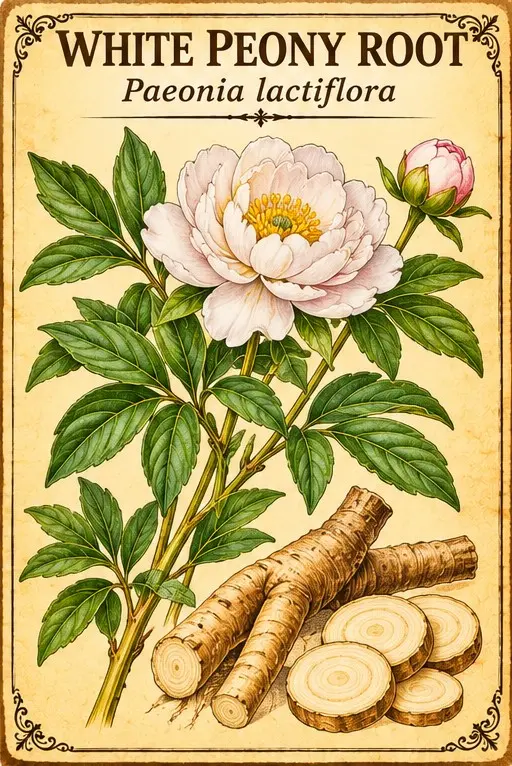
White Peony Root
Paeonia lactiflora
Bai shao, the peeled root of Chinese peony, used for over 1,200 years for joint and period pain and cramps. An extract eased arthritis, lupus and psoriasis when added to standard care in many small trials.
Safety at a glance
- PregnancyNothing recorded
- BreastfeedingNothing recorded
- MedicinesNothing recorded
- Who should avoid itNothing recorded
- AllergiesNothing recorded
- ToxicityNothing recorded
Tap a box to read the safety notes below. “Nothing recorded” means our sources don't cover it, not that it's safe.
What is White Peony Root?
- Plant family
- Paeoniaceae, the peony family
- Parts used
- The dried root, with the bark removed
- Where it grows
- China, Mongolia, Korea and eastern Siberia
- Genus
- Paeonia
- Species
- lactiflora
Also called
Total Glucosides of Paeony (TGP)
Regional names
Bai Shao
Traditionally used for
- Joint pain
- Period pain
- Muscle cramps
- IBS
Traditionally described as
- Main compound is paeoniflorin
Health topics
Where White Peony Root appears in symptom search, and why. Being listed doesn't mean it's a proven treatment.
- Irritable Bowel Syndrome (IBS)
Formulas pairing it with bai zhu relieved IBS symptoms in trials.
- Joint Discomfort
An extract added to standard care eased arthritis symptoms in many small Chinese trials.
Natural compounds
Safety
Side effects
The most common side effect of the extract is stomach upset, mostly mild diarrhea.[1]Study
What does the research say?
Traditional use
These are traditional uses, not proven treatments.
In China, Korea and Japan, a tea of the peeled, dried root has been used for more than 1,200 years for joint pain, period pain, muscle cramps and spasms, hepatitis and fever.[1]Study
Laboratory & animal research
Lab and animal results show what might be worth studying in people. They don't show that the herb has these effects in humans.
In animal studies, the extract and its main compound, paeoniflorin, eased pain and inflammation and calmed an overactive immune system.[1]Study
Research in people
An extract of the root (TGP) is used as a medicine in China. A 2023 review of 63 trials (5,293 people) found that adding it to standard care may ease symptoms and inflammation in rheumatoid arthritis, ankylosing spondylitis and other arthritis, but most trials were small and low quality.[2]Review or trial
In 14 trials in lupus, adding the extract to standard care lowered disease activity and the steroid doses people needed. The evidence was moderate to low quality.[3]Review or trial
In 30 trials in psoriasis, adding the extract to other treatment helped more people improve and cut relapses. The trials were mostly low quality.[4]Review or trial
Chinese formulas built around white peony and bai zhu relieved IBS symptoms better than placebo or standard drugs in 24 trials, especially IBS with diarrhea.[5]Review or trial
In short
Most common side effect is mild diarrhea.
Sources
- [1] Anti-inflammatory and immunomodulatory effects of Paeonia lactiflora Pall., a traditional Chinese herbal medicine · DOI: 10.3389/fphar.2011.00010Peer-reviewed study
- [2] Efficacy and safety of total glucosides of paeony in the treatment of 5 types of inflammatory arthritis: A systematic review and meta-analysis · DOI: 10.1016/j.phrs.2023.106842Review or clinical trial
- [3] Total Glucosides of Paeonia lactiflora for Safely Reducing Disease Activity in Systemic Lupus Erythematosus: A Systematic Review and Meta-Analysis · DOI: 10.3389/fphar.2022.834947Review or clinical trial
- [4] Total glucosides of paeony for the treatment of psoriasis: A systematic review and meta-analysis of randomized controlled trials · DOI: 10.1016/j.phymed.2019.152940Review or clinical trial
- [5] Atractylodes macrocephala-Paeonia lactiflora Class Formula for the Treatment of Irritable Bowel Syndrome: A Systematic Review With Meta-Analysis and Trial Sequential Analysis · DOI: 10.7759/cureus.49997Review or clinical trial
This information is educational and traditional in nature, and is not a substitute for professional medical advice. Unfamiliar word? See what these words mean.