
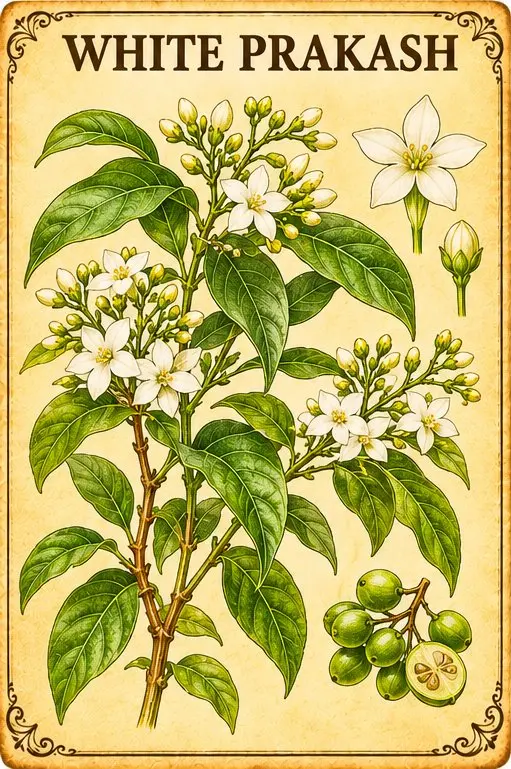
White Prakash
Camellia sinensis
A white tea from Nepal, from the same plant as green tea. White tea improved cholesterol in one study; it isn't necessarily low in caffeine.
Safety at a glance
- PregnancyNothing recorded
- BreastfeedingNothing recorded
- MedicinesNothing recorded
- Who should avoid itNothing recorded
- AllergiesNothing recorded
- ToxicityNothing recorded
Tap a box to read the safety notes below. “Nothing recorded” means our sources don't cover it, not that it's safe.
What is White Prakash?
- Plant family
- Theaceae, the tea family
- Parts used
- The young leaves and buds, lightly processed into white tea
- Genus
- Camellia
- Species
- sinensis
Also called
White Tea
Traditionally used for
- Tea (drink)
Traditionally described as
- Contains caffeine
- catechins and L-theanine
Health topics
Where White Prakash appears in symptom search, and why. Being listed doesn't mean it's a proven treatment.
- Cancer Research
Lab studies only: saponins from tea plant flowers slowed ovarian cancer cells. Not tested against cancer in people.
- High Cholesterol
White tea with diet and exercise lowered cholesterol and triglycerides in a 12-week study.
- Stress
Tea's L-theanine may modestly reduce short-term stress in supplement trials; not tested with this tea.
What does the research say?
Traditional use
These are traditional uses, not proven treatments.
White Prakash is a white tea from Nepal, made from the same plant as green and black tea (Camellia sinensis). Its seller promotes it for calm, immune support and mood, but those claims are not based on studies of this tea. The research below is on white tea in general and on tea compounds.[1]General reference
Laboratory & animal research
Lab and animal results show what might be worth studying in people. They don't show that the herb has these effects in humans.
A 2021 lab analysis compared white and green teas from the same plants. The white teas had fewer catechins (tea antioxidants) than the green teas but still showed strong antioxidant activity. They also had more caffeine than the green teas, so white tea is not necessarily low in caffeine.[2]Study
Technical detail: caffeine 6.2–27.7 mg/g, ordered white tea > green tea > tea flowers.
A 2024 review of plants studied against cancer describes a lab study in which saponins (soap-like compounds) from tea plant flowers slowed the growth of ovarian cancer cells and triggered their death. This used the flowers, not white tea leaves, and has not been tested in people.[3]Study
Technical detail: 1.5 μg/ml saponins in A2780/CP70 and OVCAR-3 cells; p53-dependent apoptosis and S-phase arrest.
Research in people
In a 2024 study, people with obesity followed a diet and exercise plan for 12 weeks and drank white tea, or took one of two weight-loss medicines, or nothing extra. Everyone lost weight. The white tea group also had lower cholesterol, triglycerides and markers of inflammation, and higher HDL ("good") cholesterol.[4]Study
L-theanine is a calming amino acid found in tea. A 2026 review of 31 trials of L-theanine supplements found a single 200 mg dose improved attention, and may modestly lower short-term stress and low mood. Effects on anxiety were inconsistent. These trials used concentrated supplements, not cups of tea, and no serious side effects were reported.[5]Review or trial
In short
Contains caffeine; seller's health claims are not studied for this tea.
Sources
- [1] White Prakash (product page) — Baskota Group (tea seller, Nepal)General reference
- [2] Comparative Analysis of the Polyphenols, Caffeine, and Antioxidant Activities of Green Tea, White Tea, and Flowers from Azorean Camellia sinensis Varieties Affected by Different Harvested and Processing Conditions · DOI: 10.3390/antiox10020183Peer-reviewed study
- [3] Recent advances in anticancer approach of traditional medicinal plants: A novel strategy for cancer chemotherapy · DOI: 10.1016/j.ipha.2024.02.001Peer-reviewed study
- [4] White Tea Consumption Alleviates Anthropometric and Metabolic Parameters in Obese Patients · DOI: 10.3390/medicina60101568Peer-reviewed study
- [5] Cognitive and affective effects of L-Theanine: a systematic review and meta-analysis of 31 randomized trials · DOI: 10.1038/s41380-026-03727-9Review or clinical trial
This information is educational and traditional in nature, and is not a substitute for professional medical advice. Unfamiliar word? See what these words mean.