
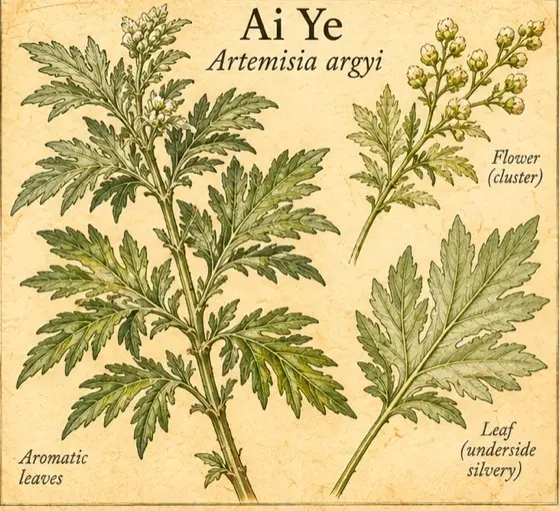
Ai Ye
Artemisia argyi
Chinese mugwort, whose silvery dried leaves are the moxa burned in moxibustion. It's used in Chinese medicine for breathing, digestive and women's health problems, and acts against germs in lab studies.
Safety at a glance
- PregnancyNothing recorded
- BreastfeedingNothing recorded
- MedicinesNothing recorded
- Who should avoid itNothing recorded
- AllergiesNothing recorded
- ToxicityNothing recorded
Tap a box to read the safety notes below. “Nothing recorded” means our sources don't cover it, not that it's safe.
What is Ai Ye?
- Plant family
- Asteraceae, the daisy family
- Parts used
- The dried leaves (for moxa, tea, baths and extracts)
- Where it grows
- China, Korea, Japan and Mongolia
- Genus
- Artemisia
- Species
- argyi
Also called
Chinese Mugwort, Silvery Wormwood, Moxa
Traditional names
Artemisiae Argyi Folium
Traditionally used for
- Moxibustion
- Women's health (traditional Chinese)
- Infections (lab research)
Traditionally described as
- Aromatic leaves rich in essential oil
- terpenes and flavonoids
Traditions that use it
- Traditional Chinese Medicine
The world's best-known moxibustion material; also used for respiratory, digestive, nervous system and gynecological conditions.
What does the research say?
Traditional use
These are traditional uses, not proven treatments.
Ai ye, or Chinese mugwort, is best known worldwide as the material for moxibustion, a traditional Chinese therapy in which the dried, fluffy leaf (moxa) is burned near the skin. In clinical practice in China, it's mainly used for breathing, immune, digestive and nervous system problems, and in women's health (gynecology).[1]Study
Laboratory & animal research
Lab and animal results show what might be worth studying in people. They don't show that the herb has these effects in humans.
136 compounds have been identified in the leaf. In lab and animal studies, ai ye mainly showed effects against inflammation, tumors, bacteria and oxidation (cell damage).[1]Study
Ancient Chinese texts describe ai ye being used against germs. In lab studies, it slowed common bacteria (E. coli and staph), fungi (Candida and Aspergillus) and some viruses, including the shingles virus, RSV and hepatitis B.[2]Study
Ai ye essential oil, distilled from the leaves and stems, acted as an antioxidant and reduced inflammation in lab studies.[3]Study
Technical detail: inhibits NLRP3 inflammasome activation and NF-κB p65 phosphorylation, lowering IL-1β, IL-6 and TNF-α.
In short
Hasn't been tested on its own in human trials.
Sources
- [1] A review of the research progress on Artemisia argyi Folium: botany, phytochemistry, pharmacological activities, and clinical application · DOI: 10.1007/s00210-024-03122-7Peer-reviewed study
- [2] Anti-pathogenic effects of Artemisia argyi and its applications: the past, present, and future · DOI: 10.1016/S1875-5364(26)61113-2Peer-reviewed study
- [3] Pharmacological and bioactive properties of Artemisia argyi H. Lév. & Vaniot essential oil: a review · DOI: 10.3389/fphar.2025.1664658Peer-reviewed study
This information is educational and traditional in nature, and is not a substitute for professional medical advice. Unfamiliar word? See what these words mean.