
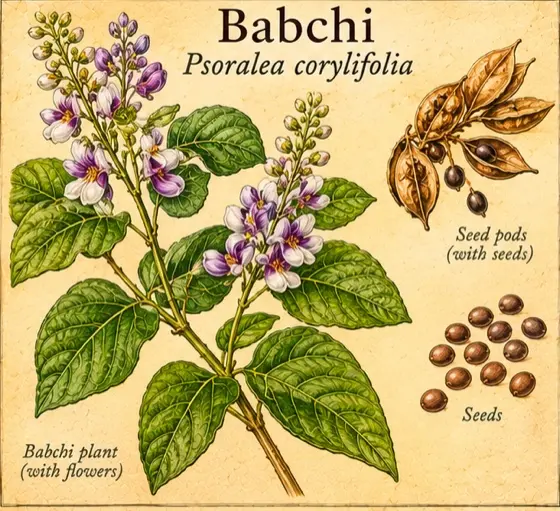
Babchi
Psoralea corylifolia
An Asian pea-family plant whose seeds are a traditional Ayurvedic and Chinese remedy for vitiligo and bone loss. Its psoralens make skin sensitive to light, and it can seriously damage the liver.
Safety at a glance
- PregnancyNothing recorded
- BreastfeedingNothing recorded
- MedicinesNothing recorded
- Who should avoid it1 note →
- AllergiesNothing recorded
- Toxicity2 notes →
Tap a box to read the safety notes below. “Nothing recorded” means our sources don't cover it, not that it's safe.
What is Babchi?
- Plant family
- Fabaceae, the pea and bean family
- Parts used
- The seeds (fruits)
- Where it grows
- India, China and other parts of tropical and subtropical Asia
- Genus
- Psoralea
- Species
- corylifolia
Also called
Psoralea, Scurfy Pea
Traditional names
Bakuchi, Bu Gu Zhi
Older scientific names
Cullen corylifolium
Traditionally used for
- Vitiligo (traditional)
- Osteoporosis (traditional and animal research)
Traditionally described as
- Seeds rich in furocoumarins such as psoralen
Health topics
Where Babchi appears in symptom search, and why. Being listed doesn't mean it's a proven treatment.
- Liver Safety Warnings
Can cause liver injury, including a severe case in a child exposed to a skin tincture.
Traditions that use it
- Ayurveda
Babchi seed is a classic Ayurvedic and Unani remedy for vitiligo (patches of skin that have lost their color).
- Traditional Chinese Medicine
Known as bu gu zhi, it's used for bone-related disorders.
Natural compounds
How it's prepared
Common ways Babchi is prepared or sold. This isn't advice on how to take it; see Safety below.
Safety
Who should avoid it
Be especially careful with children. Herbal products put on the skin can harm children if applied near the mouth or where they might lick or swallow them.[1]Study
Side effects
Babchi's furocoumarins make skin very sensitive to sunlight. At uncontrolled doses, they can cause severe light-induced skin injury.[2]Study
Technical detail: phototoxicity.
Toxicity testing
Babchi can damage the liver, and possibly the kidneys. Liver injury after taking babchi preparations by mouth has been reported, mainly in adults. Concerns about liver toxicity limit its wider use.[1]Study
Technical detail: hepatotoxicity and nephrotoxicity attributed to active constituents; processing may reduce the toxicity of some oral formulations.
A 3-year-old boy developed vomiting, jaundice (yellow skin and eyes) and severe liver injury after a psoralea tincture was put around his mouth for vitiligo for about a month. He probably swallowed some of it. The tincture had a high level of psoralen. His liver took about 9 months to recover.[1]Study
Technical detail: psoralen estimated at 9.6–15.5 mg/mL; treated with intravenous methylprednisolone and hepatoprotective therapy.
What does the research say?
Traditional use
These are traditional uses, not proven treatments.
Babchi is a small plant in the pea family whose seeds are widely used in China, India and other countries. Traditional uses include:
- Vitiligo (patches of skin that have lost their color)
- Osteoporosis (thinning bones)
- Rheumatoid arthritis
- Inflammatory bowel disease
- Cancer
The seeds are rich in furocoumarins, such as psoralen, which make skin very sensitive to light. Egyptian, Unani and Ayurvedic medicine all used these compounds for vitiligo, centuries before anyone understood how they worked. At controlled doses combined with light, they can bring color back to the skin. At uncontrolled doses, they can cause severe light-induced burns.[2]Study
Technical detail: clinical trial evidence is concentrated almost entirely in a single compound; the review found no controlled human trial for several of the best-documented plant species.
Laboratory & animal research
Lab and animal results show what might be worth studying in people. They don't show that the herb has these effects in humans.
A 2026 analysis of 23 studies in rats and mice with bone loss like that after menopause found that babchi greatly improved bone density and bone structure. The authors suggested a possible dose range, but say it must be tested in people before it can be relied on.[3]Review or trial
Technical detail: bone mineral density SMD 4.32 (I² = 89%); 7 separate toxicity studies assessed ALT and AST; model-informed reference of 4.5 mg/kg psoralen (human-equivalent dose) for 7 weeks.
In short
Can cause liver injury and severe sunburn-like skin reactions. A child was badly poisoned by a skin tincture.
Sources
- [1] Severe hepatic injury following suspected inadvertent oral exposure to topical psoralea tincture applied periorally in a 3-year-old boy: a case report and literature review · DOI: 10.1186/s12906-026-05504-1Peer-reviewed study
- [2] Furocoumarin-Rich Medicinal Plants for Vitiligo: Phytochemistry, Melanogenic Mechanisms, and Nano-Encapsulation Strategies · DOI: 10.3390/pharmaceutics18111475Peer-reviewed study
- [3] Efficacy and hepatotoxicity of Psoralea corylifolia L.: A meta-analysis and machine learning assessment in postmenopausal osteoporosis · DOI: 10.1016/j.jep.2026.122099Review or clinical trial
This information is educational and traditional in nature, and is not a substitute for professional medical advice. Unfamiliar word? See what these words mean.