
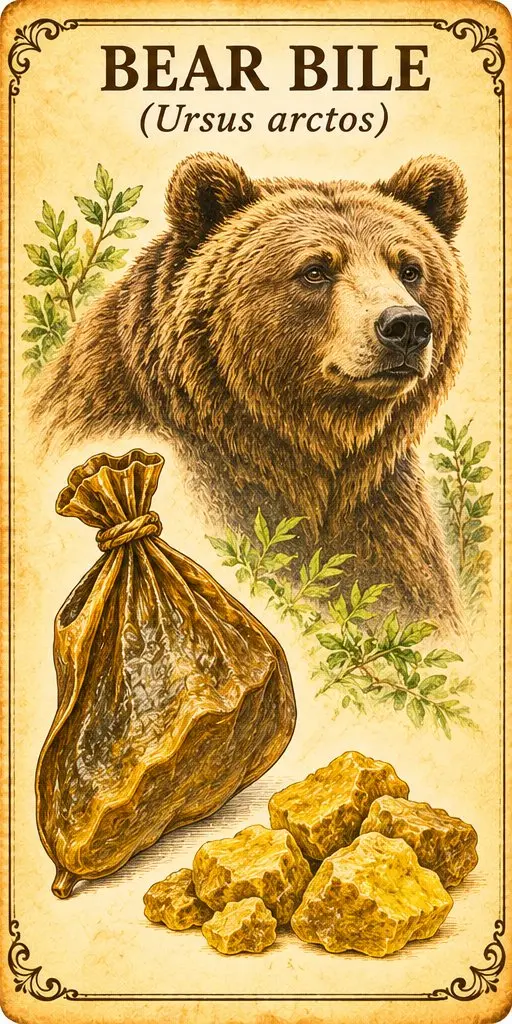
Bear Bile
Ursus arctos
An animal remedy used in traditional Chinese medicine for the liver. Its compound UDCA is now an approved liver drug made without bears; raw bear bile has caused liver injury.
Safety at a glance
- PregnancyNothing recorded
- BreastfeedingNothing recorded
- MedicinesNothing recorded
- Who should avoid itNothing recorded
- AllergiesNothing recorded
- Toxicity1 note →
Tap a box to read the safety notes below. “Nothing recorded” means our sources don't cover it, not that it's safe.
What is Bear Bile?
- Plant family
- Ursidae, the bear family
- Parts used
- Bile from the gallbladder, usually dried to a powder
- Genus
- Ursus
- Species
- arctos
Also called
Bear Bile Powder, Ursodeoxycholic Acid, UDCA, Ursodiol
Traditionally used for
- Liver
- Bile flow
- Fever (traditional)
Traditionally described as
- Contains ursodeoxycholic acid (UDCA)
Health topics
Where Bear Bile appears in symptom search, and why. Being listed doesn't mean it's a proven treatment.
- Animal-Derived Remedies
A traditional remedy made from bear bile, with serious animal-welfare and conservation concerns.
- Gallbladder, Gallstones and Bile Flow
Its compound UDCA (ursodiol) is used as a medicine to dissolve certain gallstones and improve bile flow.
- Liver Disease (Hepatitis, Cirrhosis)
Its compound UDCA (ursodiol) is an approved medicine for primary biliary cholangitis; raw bear bile itself has caused liver injury.
- Liver Safety Warnings
Drinking bear bile caused liver injury with jaundice in a case report.
Traditions that use it
- Traditional Chinese Medicine
Used for more than 1,300 years to calm the liver, help bile flow, relieve fever, clear toxins, ease spasms and protect the liver.
Safety
Toxicity testing
A woman in Bhutan developed liver injury with jaundice (yellow skin and eyes) after drinking a pea-sized spoonful of bear bile dissolved in water once. The authors warn that bear bile can cause severe liver damage.[1]Study
Depends on how it's prepared
About 17,000 bears across Asia are kept in bile-extraction facilities, often in small cages, with bile drawn from the gallbladder through needles, implanted tubes or surgical openings. These bears suffer high rates of high blood pressure damage and kidney disease. The Asiatic black bear, the species most used, is listed as vulnerable, and international trade is restricted under CITES Appendix I. Proven alternatives exist, including the approved medicine ursodiol.[2]Study
What does the research say?
Traditional use
These are traditional uses, not proven treatments.
Bear bile has been used in traditional Chinese medicine for more than 1,300 years, to calm the liver, help bile flow, relieve fever, clear toxins, ease spasms and protect the liver.[3]Study
In traditional Bhutanese medicine (Sowa Rigpa), bear bile has been taken for fever, clearing toxins, liver problems and pain. Mainstream Bhutanese traditional practitioners no longer endorse taking pure bear bile.[1]Study
Research in people
Bear bile's key compound, ursodeoxycholic acid (UDCA, also called ursodiol), is now an approved medicine made without bears. The FDA approved it in 1997 for primary biliary cirrhosis (now called primary biliary cholangitis), a long-term liver disease. It is used to dissolve certain gallstones and to treat several other liver and bile-flow problems. These results are for the purified medicine, not for raw bear bile.[3]Study
In short
Raw bear bile can injure the liver; serious animal-welfare and conservation concerns.
Sources
- [1] Toxin-Induced Liver Injury Following Bear Bile Consumption in a Middle-Aged Female in Bhutan: A Case Report · DOI: 10.1002/ccr3.70692Peer-reviewed study
- [2] High Prevalence of Lesions of Systemic Hypertension in Bile-Extracted Asiatic Black Bears (Ursus thibetanus) and Associated Renal Disease · DOI: 10.3390/ani15131940Peer-reviewed study
- [3] Advances in Pharmacological Activities, Biosynthesis, and Structural Modification of Ursodeoxycholic Acid (UDCA): A Review · DOI: 10.2147/DDDT.S557300Peer-reviewed study
This information is educational and traditional in nature, and is not a substitute for professional medical advice. Unfamiliar word? See what these words mean.