
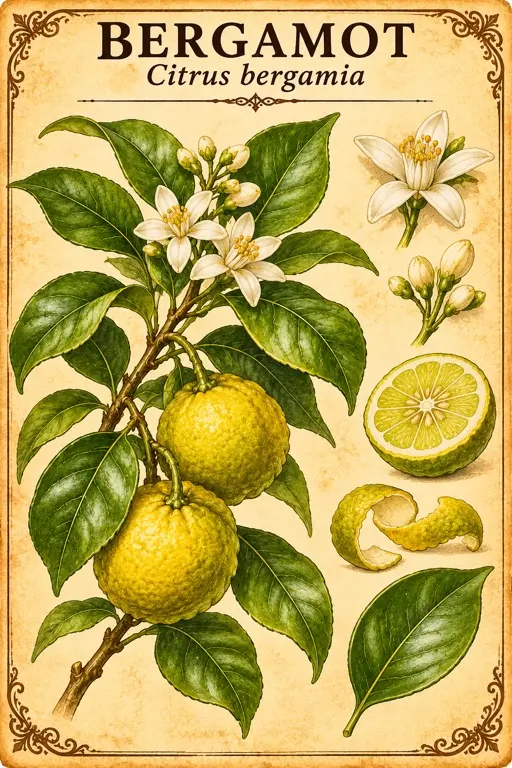
Bergamot
Citrus bergamia
A fragrant citrus from Calabria, Italy, whose rind oil scents perfumes and flavors foods. Bergamot supplements have been studied for cholesterol, blood sugar and weight, though most trials are low quality.
Safety at a glance
- PregnancyNothing recorded
- BreastfeedingNothing recorded
- MedicinesNothing recorded
- Who should avoid itNothing recorded
- AllergiesNothing recorded
- ToxicityNothing recorded
Tap a box to read the safety notes below. “Nothing recorded” means our sources don't cover it, not that it's safe.
What is Bergamot?
- Plant family
- Rutaceae, the citrus family
- Parts used
- The rind (for essential oil) and the fruit juice and pulp (for polyphenol extracts)
- Where it grows
- Calabria, southern Italy (a hybrid of bitter orange and lemon)
- Genus
- Citrus
- Species
- bergamia
Also called
Bergamot Orange
Regional names
Bergamotto
Older scientific names
Citrus × bergamia
Traditionally used for
- Essential oil and perfume
- Cholesterol (studied)
- Weight (studied)
- Anxiety (aromatherapy)
Traditionally described as
- Oil rich in limonene and linalyl acetate; juice rich in flavonoids such as naringin
Health topics
Where Bergamot appears in symptom search, and why. Being listed doesn't mean it's a proven treatment.
- Anxiety
Aromatherapy studies with the essential oil suggest it may reduce anxiety and stress; study quality is often weak.
- High Blood Sugar
Pooled trials linked bergamot supplements to modestly lower blood sugar; evidence is very low certainty.
- High Cholesterol
Pooled trials linked bergamot supplements to lower LDL cholesterol, but the evidence is low to very low certainty.
Traditions that use it
- Mediterranean Folk Medicine
In Italian folk medicine, bergamot oil was used mainly for fever and parasites, and for mouth, skin, throat and urinary infections.
Natural compounds
Safety
Side effects
Bergamot essential oil contains bergapten, a compound that makes skin react strongly to sunlight. Oil on the skin can cause burns or rashes when exposed to the sun. For this reason, a version of the oil with these compounds removed has been made for perfumes and cosmetics.[1]Study
Technical detail: 5-methoxypsoralen (bergapten, 5-MOP) is in the non-volatile fraction of the oil and causes phototoxicity.
What does the research say?
Traditional use
These are traditional uses, not proven treatments.
Bergamot is a citrus fruit, a hybrid of bitter orange and lemon. More than 90% of the world's bergamot is grown along the southern coast of Calabria, Italy. Its essential oil, pressed from the rind, is widely used in perfumes, cosmetics, food and sweets.
In Italian folk medicine, it was used mainly for:
- Fever and parasite infections
- Mouth, skin, breathing and urinary infections
- Sore throats and tonsillitis
Research in people
Studies of the essential oil in people have focused on aromatherapy, by breathing it in or in hand massage. They suggest it may help reduce anxiety and stress, but many of the studies had weak designs. One study in children having stem cell transplants found no benefit for pain or nausea.[1]Study
A 2026 review pooled 9 trials with 615 adults with high blood fats or metabolic syndrome. Bergamot supplements were linked to modest drops in LDL ("bad") cholesterol, blood sugar, insulin, systolic blood pressure and waist size.
But most trials were of poor quality, and the certainty of the evidence was low to very low. The authors say this doesn't prove bergamot works.[2]Review or trial
Technical detail: random-effects dose-response meta-analysis with GRADE. LDL-C WMD −39.53 mg/dL (95% CI −53.46 to −25.60); glucose −12.12 mg/dL; insulin −2.93 IU/L; systolic BP −2.09 mmHg; waist −0.96 cm. Six trials rated poor, two fair, one good.
A 2026 review of 11 trials found that bergamot supplements lowered body weight, body mass index and waist size in adults. Results varied a lot between trials. Effects showed mainly in people with overweight or obesity, over 12 weeks or less, at doses of 600 mg a day or less.[3]Review or trial
Technical detail: body weight SMD −0.64 (95% CI −1.15 to −0.13; I² = 90%); BMI −0.85; waist circumference −0.41. No effect on other body composition measures.
In short
The essential oil contains bergapten, which can cause burns or rashes on skin exposed to the sun.
Sources
- [1] Citrus bergamia essential oil: from basic research to clinical application · DOI: 10.3389/fphar.2015.00036Peer-reviewed study
- [2] Bergamot (Citrus bergamia) Supplementation and Cardiovascular Disease Risk Factors: A Systematic Review and Meta-Analysis · DOI: 10.1002/fsn3.72357Review or clinical trial
- [3] Effect of Citrus bergamia Supplementation on Body Composition in Humans: A Systematic Review and Meta-Analysis of Randomized Controlled Trials · DOI: 10.1111/obr.70094Review or clinical trial
This information is educational and traditional in nature, and is not a substitute for professional medical advice. Unfamiliar word? See what these words mean.