
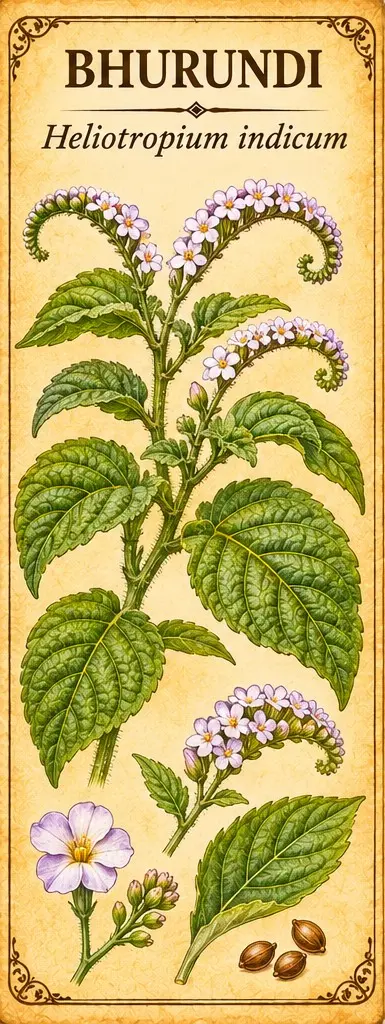
Bhurundi
Heliotropium indicum
Indian heliotrope, a tropical weed used in folk medicine for wounds, fever and infections. It contains liver-toxic pyrrolizidine alkaloids.
Safety at a glance
- PregnancyNothing recorded
- BreastfeedingNothing recorded
- MedicinesNothing recorded
- Who should avoid itNothing recorded
- AllergiesNothing recorded
- Toxicity2 notes →
Tap a box to read the safety notes below. “Nothing recorded” means our sources don't cover it, not that it's safe.
What is Bhurundi?
- Plant family
- Boraginaceae, the borage family
- Parts used
- The aerial parts
- Where it grows
- Tropical Africa, Asia and the Americas
- Genus
- Heliotropium
- Species
- indicum
Also called
Indian Heliotrope
Traditionally used for
- Wounds
- Fever
- Skin infections (traditional)
Traditionally described as
- Contains pyrrolizidine alkaloids such as indicine
Health topics
Where Bhurundi appears in symptom search, and why. Being listed doesn't mean it's a proven treatment.
- Cuts, Wounds, Burns and Skin Ulcers
Used on wounds and skin infections in Benin. Contains liver-toxic alkaloids.
- Fever
A traditional fever remedy. Contains liver-toxic alkaloids; not studied in people.
Traditions that use it
- African Traditional Medicine
Aerial parts used in Benin for inflammation, wounds, fever and infections.
Natural compounds
Safety
What does the research say?
Traditional use
These are traditional uses, not proven treatments.
In Benin and elsewhere, a decoction or tea of the aerial parts is taken by mouth or put on the skin for inflammation, wounds, skin infections, fever and stomach problems.[3]Study
Laboratory & animal research
Lab and animal results show what might be worth studying in people. They don't show that the herb has these effects in humans.
In lab and animal studies, extracts killed some drug-resistant urinary bacteria and eased pain, and in one rat study didn't harm the liver or kidneys.[3]Study
In short
Contains liver-toxic pyrrolizidine alkaloids.
Sources
- [1] Roots of Indian heliotrope (Heliotropium indicum) produce simple pyrrolizidine alkaloids using the same homospermidine oxidase involved in biosynthesis of complex pyrrolizidine alkaloids in aerial parts · DOI: 10.1111/plb.70077Peer-reviewed study
- [2] Phytochemical Profiling and Computational Docking Studies Revealing the Potential Anticancer and Antioxidant Properties of Heliotropium indicum L. · DOI: 10.1155/sci5/1079290Peer-reviewed study
- [3] Phytochemical Profile and Biological Activities of the Roots of Caesalpinia bonduc and the Aerial Part of Heliotropium indicum · DOI: 10.1155/bri/9058679Peer-reviewed study
This information is educational and traditional in nature, and is not a substitute for professional medical advice. Unfamiliar word? See what these words mean.