
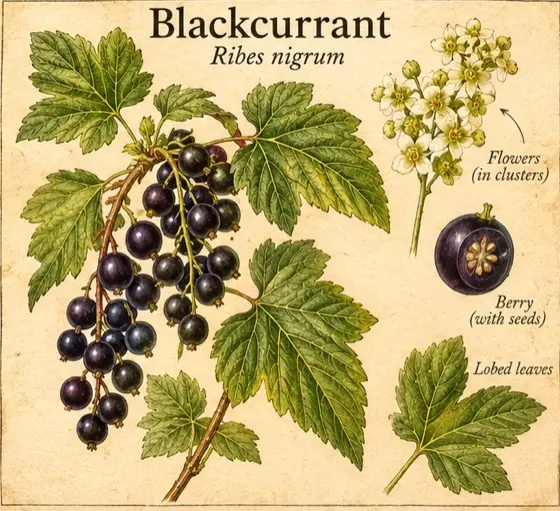
Blackcurrant
Ribes nigrum
A shrub with tart black berries rich in anthocyanins. Its leaf tea is a traditional European remedy for minor joint pain and urinary complaints, and berry extracts have modestly helped exercise performance.
Safety at a glance
- PregnancyNothing recorded
- BreastfeedingNothing recorded
- MedicinesNothing recorded
- Who should avoid it1 note →
- AllergiesNothing recorded
- ToxicityNothing recorded
Tap a box to read the safety notes below. “Nothing recorded” means our sources don't cover it, not that it's safe.
What is Blackcurrant?
- Plant family
- Grossulariaceae
- Parts used
- The berries (as juice, powder or extract) and the leaves (as tea)
- Where it grows
- Northern Europe and northern Asia
- Genus
- Ribes
- Species
- nigrum
Also called
Black Currant
Regional names
Cassis
Traditional names
Ribis Nigri Folium
Traditionally used for
- Fruit and juice
- Minor joint pain (leaf
- traditional)
- Minor urinary complaints (leaf
- traditional)
- Exercise performance (studied)
Traditionally described as
- Berries rich in anthocyanins
Health topics
Where Blackcurrant appears in symptom search, and why. Being listed doesn't mean it's a proven treatment.
- High Blood Pressure
A review of 4 trials found blackcurrant didn't lower blood pressure.
- Joint Discomfort
Blackcurrant leaf is a European traditional remedy for minor joint pain, accepted on the basis of long use.
Traditions that use it
- European Folk Medicine
Blackcurrant leaf tea is a traditional European remedy for minor joint pain and minor urinary complaints.
Natural compounds
Safety
Who should avoid it
Don't use blackcurrant leaf medicines for urinary complaints if you've been told to limit how much you drink, for example because of severe heart or kidney disease.[1]Health agency
How much to use
Blackcurrant leaf medicines should only be used by adults. See a doctor if symptoms get worse or last more than 4 weeks for joint pain, or more than 2 weeks for urinary complaints.[1]Health agency
What does the research say?
Traditional use
These are traditional uses, not proven treatments.
Based on long-standing use, European regulators accept blackcurrant leaf tea and preparations as a traditional remedy for:
- Minor joint pain
- Minor urinary complaints, by increasing urine to flush the urinary tract
This is based on at least 30 years of safe use, not on clinical trials. Lab studies in rats and mice found the leaf reduced pain and inflammation and increased urine. No studies in patients have been done.[1]Health agency
Research in people
A 2023 review of 4 trials found that blackcurrant didn't lower blood pressure.[2]Review or trial
Technical detail: systolic WMD −1.46 mmHg (95% CI −6.62 to 3.7; p = 0.579); diastolic −2.09 mmHg (95% CI −4.38 to 0.20; p = 0.07).
A 2025 review of berries and bone health found that small trials suggested modest benefits of blackcurrant and blueberry on bone density and markers of bone turnover. The certainty of the evidence was low to moderate.[3]Review or trial
A 2026 review of 21 small trials found that New Zealand blackcurrant extract gave a small-to-moderate boost to sports performance. The biggest effect was in team sports with repeated sprints. Benefits in endurance cycling and running were smaller or inconsistent.
The certainty of the evidence was low for performance and moderate for effects on fat burning.[4]Review or trial
Technical detail: randomized crossover trials; mean Cohen's d = 0.44 overall and 0.6 for intermittent, team-based activities; no effect under hypoxic conditions.
A 2026 review of 15 studies with 226 active adults found that blackcurrant extract made the body burn more fat and less carbohydrate during exercise. Responses varied a lot from person to person.[5]Review or trial
Technical detail: fat oxidation increased by 0.042 g/min; training status, sex, dose and duration may affect response.
In short
Don't use the leaf for urinary complaints if you must limit fluids, for example with severe heart or kidney disease.
Sources
- [1] Blackcurrant leaf (Ribis nigri folium): summary for the public — European Medicines Agency, Committee on Herbal Medicinal Products (HMPC)Government health agency
- [2] The Effects of Blackcurrant and Raspberry Consumption on Blood Pressure: A Systematic Review and Meta-Analysis of Randomized Controlled Trials · DOI: 10.7762/cnr.2023.12.1.54Review or clinical trial
- [3] Berries derived Polyphenols and Bone Health: A Systematic Review · DOI: 10.3390/nu17213440Review or clinical trial
- [4] Effect of New Zealand Blackcurrant Supplementation on Sports Performance: A Systematic Review · DOI: 10.1016/j.cdnut.2026.109388Review or clinical trial
- [5] Blackcurrant Anthocyanin Supplementation Alters Exercise-Induced Substrate Utilization - A Systematic Review and Meta-Analysis · DOI: 10.1080/19390211.2026.2624114Review or clinical trial
This information is educational and traditional in nature, and is not a substitute for professional medical advice. Unfamiliar word? See what these words mean.