
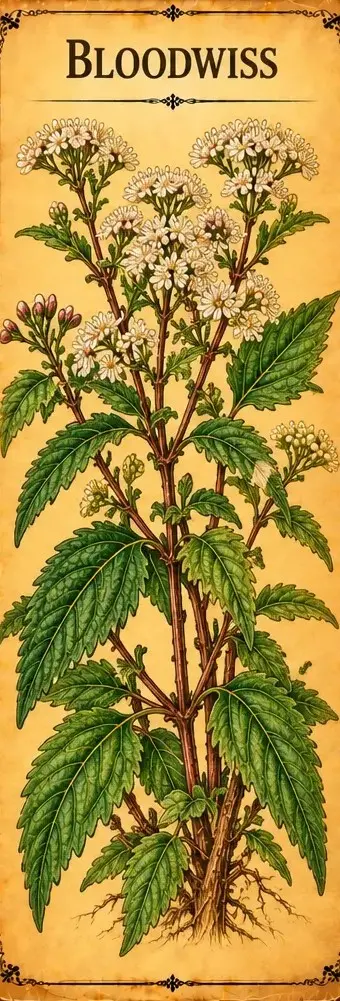
Bloodwiss
Vitis tiliifolia
A wild grapevine. Old Mexican records list it for increasing urination, fever and gout, and the vine has been used as a source of drinking water. Very little research exists.
Safety at a glance
- PregnancyNothing recorded
- BreastfeedingNothing recorded
- MedicinesNothing recorded
- Who should avoid itNothing recorded
- AllergiesNothing recorded
- ToxicityNothing recorded
Tap a box to read the safety notes below. “Nothing recorded” means our sources don't cover it, not that it's safe.
What is Bloodwiss?
- Plant family
- Vitaceae, the grape family
- Parts used
- The leaves, usually as a tea; the vine is also a source of water
- Genus
- Vitis
- Species
- tiliifolia
Also called
Blood Wiss, Vitis tiliifolia
Traditionally used for
- Increasing urination (traditional)
- Fever (traditional)
- Gout (traditional)
- Drinking water from the vine
Traditionally described as
- Antioxidant (in lab studies)
Health topics
Where Bloodwiss appears in symptom search, and why. Being listed doesn't mean it's a proven treatment.
- Cancer Research
Traditionally used in Mexico for tumors, among other uses. Not studied for cancer.
How it's prepared
Common ways Bloodwiss is prepared or sold. This isn't advice on how to take it; see Safety below.
- Tea / Infusion
A tea is made from the leaves of wild Mexican grapevines.[1]Study
What does the research say?
Traditional use
These are traditional uses, not proven treatments.
Bloodwiss is a wild grapevine. Folk-use records collected by the US Department of Agriculture, mostly from older Mexican surveys, list it for:
- Increasing urination
- Fever
- Gout
- Tumors
In Mexico and Honduras, the vine has also been used as a source of drinking water. These are recorded uses, not tested treatments.[2]General reference
Laboratory & animal research
Lab and animal results show what might be worth studying in people. They don't show that the herb has these effects in humans.
A 2020 lab study of tea made from the leaves of wild Mexican vines found 14 plant compounds, including resveratrol, quercetin and rutin, and antioxidant activity. The amounts varied a lot between vines. This was a chemistry study and doesn't show any health effect.[1]Study
In short
Its safety hasn't been studied.
Sources
- [1] Phenolic Content and Antioxidant Capacity of Infusions of Vitis tiliifolia (Humb & Bonpl. Ex Schult.) LeavesPeer-reviewed study
- [2] Dr. Duke's Phytochemical and Ethnobotanical Databases: Vitis tiliifolia — U.S. Department of Agriculture, Agricultural Research ServiceGeneral reference
This information is educational and traditional in nature, and is not a substitute for professional medical advice. Unfamiliar word? See what these words mean.