
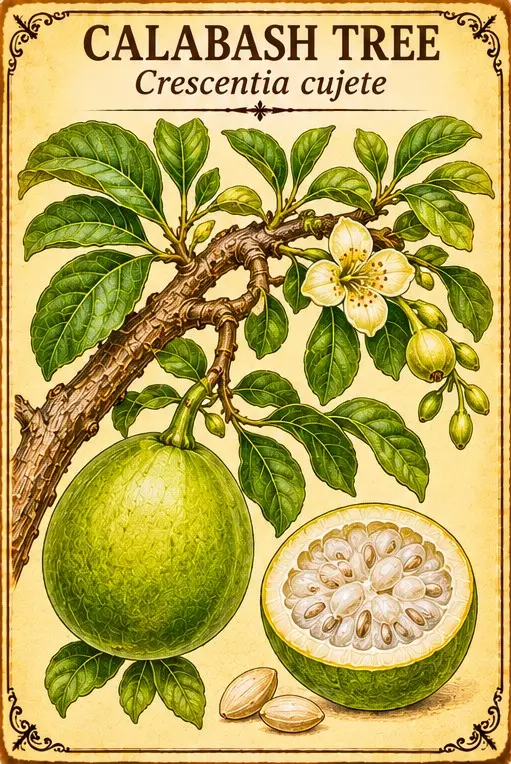
Calabash Tree
Crescentia cujete
A tropical American tree whose hard gourds become bowls. The fruit pulp is a Colombian flu remedy and, cooked into a syrup, a Cuban remedy for asthma and chest colds.
Safety at a glance
- PregnancyNothing recorded
- BreastfeedingNothing recorded
- MedicinesNothing recorded
- Who should avoid itNothing recorded
- AllergiesNothing recorded
- ToxicityNothing recorded
Tap a box to read the safety notes below. “Nothing recorded” means our sources don't cover it, not that it's safe.
What is Calabash Tree?
- Plant family
- Bignoniaceae, the trumpet-creeper family
- Parts used
- The fruit pulp, and the hard shell as a container
- Where it grows
- Tropical Americas
- Genus
- Crescentia
- Species
- cujete
Also called
Calabash
Regional names
Totumo, Güira
Traditionally used for
- Flu
- Asthma
- Chest colds (traditional)
Traditionally described as
- Fruit contains furanonaphthoquinones
Health topics
Where Calabash Tree appears in symptom search, and why. Being listed doesn't mean it's a proven treatment.
- Colds and Nasal Congestion
A Colombian and Cuban folk remedy for flu and chest colds. Not tested in people.
Safety
Depends on how it's prepared
No human medical or safety studies were found.[1]Study
What does the research say?
Traditional use
These are traditional uses, not proven treatments.
A tropical American tree with large, hard, gourd-like fruit. The Maya of the Yucatan have long grown it for the shells, which are made into bowls for daily and ceremonial use.[2]Study
On Colombia's northern coast a decoction of the fruit pulp, called totumo, is the most trusted remedy for flu.[1]Study
Haitian communities in Cuba cook the fruit pulp with honey, sugar and rum into a syrup (miel de güira) for asthma, chest colds and stomach pain.[3]Study
Laboratory & animal research
Lab and animal results show what might be worth studying in people. They don't show that the herb has these effects in humans.
The fruit contains compounds called furanonaphthoquinones that were active in lab tests on yeast.[4]Study
In short
No human medical or safety studies were found.
Sources
- [1] Folk medicine in the northern coast of Colombia: an overview · DOI: 10.1186/1746-4269-7-27Peer-reviewed study
- [2] Phenotypic differentiation between wild and domesticated varieties of Crescentia cujete L. and culturally relevant uses of their fruits as bowls in the Yucatan Peninsula, Mexico · DOI: 10.1186/1746-4269-9-76Peer-reviewed study
- [3] Uses of medicinal plants by Haitian immigrants and their descendants in the Province of Camagüey, Cuba · DOI: 10.1186/1746-4269-5-16Peer-reviewed study
- [4] Bioactive furanonaphthoquinones from Crescentia cujete · DOI: 10.1021/np50099a008Peer-reviewed study
This information is educational and traditional in nature, and is not a substitute for professional medical advice. Unfamiliar word? See what these words mean.