
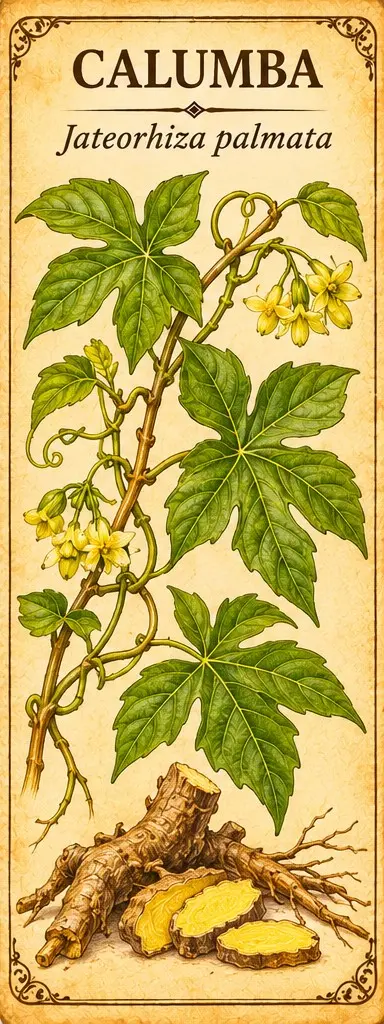
Calumba
Jateorhiza palmata
A very bitter African root, long used as a bitter tonic for poor digestion and appetite and for diarrhea. Modern research is very limited.
Safety at a glance
- PregnancyNothing recorded
- BreastfeedingNothing recorded
- Medicines1 note →
- Who should avoid itNothing recorded
- AllergiesNothing recorded
- ToxicityNothing recorded
Tap a box to read the safety notes below. “Nothing recorded” means our sources don't cover it, not that it's safe.
Calumba may interact with some medicines. If you take any medicine, read Interactions with medicines below and talk to your doctor or pharmacist before using it.
What is Calumba?
- Plant family
- Menispermaceae, the moonseed family
- Parts used
- The root
- Where it grows
- Eastern and southern Africa
- Genus
- Jateorhiza
- Species
- palmata
Also called
Columbo, Colombo Root
Older scientific names
Jateorhiza columba
Traditionally used for
- Poor digestion
- Loss of appetite
- Diarrhea (traditional)
Traditionally described as
- Root contains berberine-like alkaloids such as palmatine
Health topics
Where Calumba appears in symptom search, and why. Being listed doesn't mean it's a proven treatment.
- Cancer Research
Lab studies only: a root extract killed melanoma (skin cancer) cells. Not tested against cancer in people.
- Diarrhea
A traditional remedy for diarrhea and dysentery. Not studied in modern trials.
- Indigestion
A traditional bitter tonic for poor digestion. Not studied in modern trials.
- Loss of Appetite
Used as a bitter to stimulate appetite. Not studied in modern trials.
Natural compounds
Safety
Interactions with medicines
In mice, calumba root and its compound columbin changed how long anesthetic drugs kept them asleep, shortening it for some and lengthening it for another. This suggests it could affect how the body handles some medicines; it hasn't been studied in people.[1]Study
Depends on how it's prepared
No modern human medical or safety studies were found.[2]General reference
What does the research say?
Traditional use
These are traditional uses, not proven treatments.
Calumba root is a very bitter African herb, brought to Europe by Portuguese traders in the 1600s. It's used in Africa for diarrhea and dysentery, and in Brazil and Turkey for poor digestion, nausea, loss of appetite and as a bitter tonic.[2]General reference
Victorian doctors gave calumba combined with an iron preparation for chronic diarrhea.[3]Traditional text
Laboratory & animal research
Lab and animal results show what might be worth studying in people. They don't show that the herb has these effects in humans.
The root contains berberine-like alkaloids, including palmatine and columbamine. In lab tests, a root extract killed human melanoma cells.[4]Study
In short
No modern human safety studies; may affect how some medicines work.
Sources
- [1] Columbin isolated from calumbae radix affects the sleeping time of anesthetized mice · DOI: 10.1248/bpb.18.634Peer-reviewed study
- [2] Calumba (Jateorhiza palmata). Tropical Plant Database — Rain-Tree PublishersGeneral reference
- [3] The Value of the Liquor of the Pernitrate of Iron, in Combination with Calumba, in Cases of Chronic Mucous Diarrhoea · DOI: 10.1136/bmj.2.519.626Traditional text
- [4] Determination of the Content of Isoquinoline Alkaloids in Selected Plant Extracts and Study of Their Cholinesterase-Inhibiting Activity and Cytotoxicity Against Human Melanoma Cells Using In Vitro and In Silico Methods · DOI: 10.3390/molecules31193544Peer-reviewed study
This information is educational and traditional in nature, and is not a substitute for professional medical advice. Unfamiliar word? See what these words mean.