
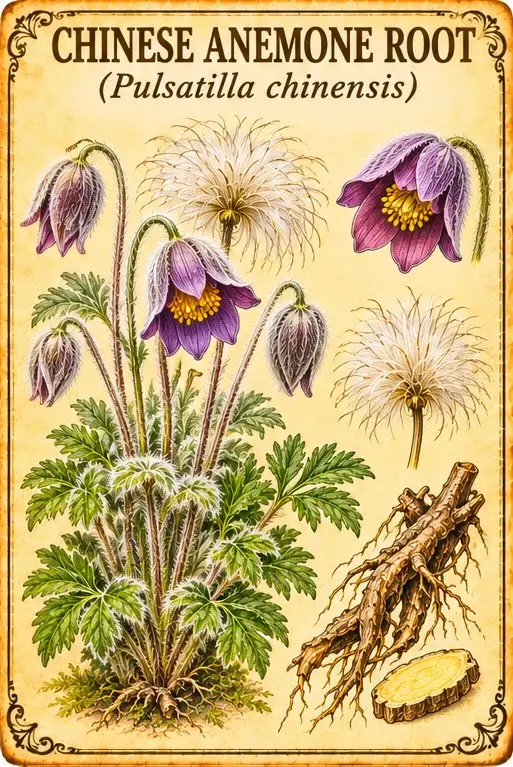
Chinese Anemone Root
Pulsatilla chinensis
Bai Tou Weng, the dried root of Pulsatilla chinensis, the main traditional Chinese herb for dysentery. A formula built around it helped ulcerative colitis in trials.
Safety at a glance
- Pregnancy1 note →
- BreastfeedingNothing recorded
- MedicinesNothing recorded
- Who should avoid itNothing recorded
- AllergiesNothing recorded
- Toxicity1 note →
Tap a box to read the safety notes below. “Nothing recorded” means our sources don't cover it, not that it's safe.
What is Chinese Anemone Root?
- Plant family
- Ranunculaceae, the buttercup family
- Parts used
- The dried root
- Genus
- Pulsatilla
- Species
- chinensis
Also called
Bai Tou Weng, Pulsatilla Root, Radix Pulsatillae
Traditionally used for
- Dysentery
- Diarrhea (traditional)
Traditionally described as
- Root rich in saponins
Health topics
Where Chinese Anemone Root appears in symptom search, and why. Being listed doesn't mean it's a proven treatment.
- Cancer Research
Lab and animal studies only: compounds from the root slowed many kinds of cancer cells and triggered their death. Not tested against cancer in people.
- Diarrhea
The main traditional Chinese herb for dysentery; a formula containing it helped ulcerative colitis in trials.
Traditions that use it
- Traditional Chinese Medicine
Considered the most important single herb for dysentery, especially with blood and pus in the stool.
Safety
Pregnancy
It is not recommended during pregnancy.[1]General reference
Toxicity testing
The fresh plant and root contain protoanemonin, a strong irritant. Touching it can cause redness, blistering and itching, and eating the fresh herb can cause nausea, vomiting, stomach pain and diarrhea. Drying and boiling turn it into a much less toxic compound, which is why only the dried root, boiled into a tea, is used. Never use the fresh herb.[1]General reference
What does the research say?
Traditional use
These are traditional uses, not proven treatments.
Chinese anemone root, Bai Tou Weng, is the dried root of Pulsatilla chinensis. In traditional Chinese medicine it is considered the most important single herb for dysentery, especially with blood and pus in the stool, and is used to clear heat and cool the blood.[1]General reference
Laboratory & animal research
Lab and animal results show what might be worth studying in people. They don't show that the herb has these effects in humans.
Many lab and animal studies show compounds from the root slowing the growth of different cancer cells and triggering their death.[2]Review or trial
Research in people
Baitouweng decoction is a traditional formula built around this root together with other herbs. A 2024 review of 24 trials in 2,131 people with ulcerative colitis found it worked better than standard Western medicines in those trials and lowered signs of inflammation. The authors said better-designed, blinded, placebo-controlled trials are still needed. Because it is a formula, the root's own effect is unclear.[3]Review or trial
A 2023 review of 17 trials in 1,611 people found a modified Baitouweng decoction may help bowel inflammation caused by radiation treatment, but the quality of the evidence was low and its safety still needs confirming.[4]Review or trial
In short
Fresh plant is a strong irritant; use only dried and boiled; not in pregnancy.
Sources
- [1] Bai Tou Weng (Pulsatilla chinensis / Chinese Anemone Root) in Traditional Chinese Medicine — TCMIOGeneral reference
- [2] Pulsatilla chinensis (Bge.) Regel: A Systematic Review on Anticancer of Its Pharmacological Properties, Clinical Researches and Pharmacokinetic Studies · DOI: 10.3389/fonc.2022.888075Review or clinical trial
- [3] Efficacy and safety of BaitouWeng decoction for ulcerative colitis: A meta-analysis of randomized and controlled trials · DOI: 10.1097/MD.0000000000038704Review or clinical trial
- [4] Clinical Evidence and Potential Mechanisms in Treating Radiation Enteritis with Modified Baitouweng Decoction · DOI: 10.1155/2023/9731315Review or clinical trial
This information is educational and traditional in nature, and is not a substitute for professional medical advice. Unfamiliar word? See what these words mean.