
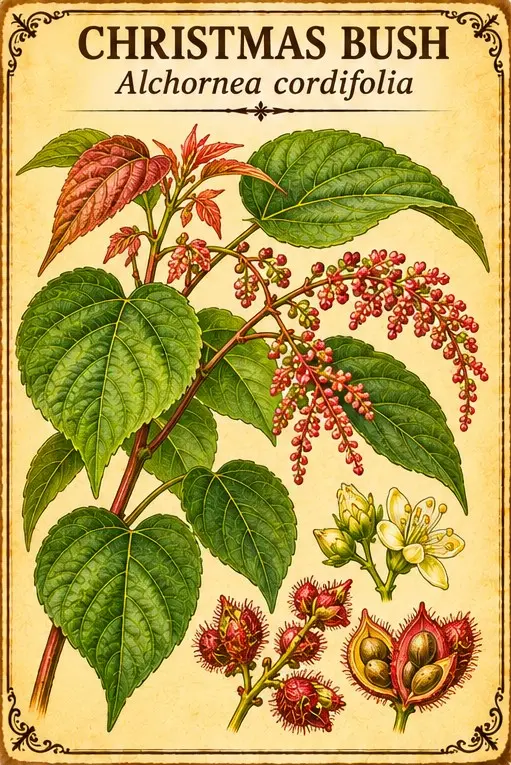
Christmas Bush
Alchornea cordifolia
A tropical African shrub used for coughs, diarrhea, infections and sickle cell anemia. A leaf compound stopped red blood cells from sickling in lab tests.
Safety at a glance
- PregnancyNothing recorded
- BreastfeedingNothing recorded
- MedicinesNothing recorded
- Who should avoid itNothing recorded
- AllergiesNothing recorded
- ToxicityNothing recorded
Tap a box to read the safety notes below. “Nothing recorded” means our sources don't cover it, not that it's safe.
What is Christmas Bush?
- Plant family
- Euphorbiaceae, the spurge family
- Parts used
- The leaves, and also roots and bark
- Where it grows
- Tropical Africa
- Genus
- Alchornea
- Species
- cordifolia
Traditionally used for
- Cough
- Diarrhea
- Sickle cell anemia (traditional)
Traditionally described as
- Leaves contain quercitrin and other flavonoids
Health topics
Where Christmas Bush appears in symptom search, and why. Being listed doesn't mean it's a proven treatment.
Safety
Depends on how it's prepared
Its safety in people hasn't been studied in trials.[1]Study
What does the research say?
Traditional use
These are traditional uses, not proven treatments.
Laboratory & animal research
Lab and animal results show what might be worth studying in people. They don't show that the herb has these effects in humans.
Research in people
In 10 healthy people, fufu made with the leaves raised blood sugar less than plain fufu.[3]Study
In short
Its safety in people hasn't been studied in trials.
Sources
- [1] Recent trends in phytochemistry, ethnobotany and pharmacological significance of Alchornea cordifolia (Schumach. & Thonn.) Muell. Arg. · DOI: 10.1016/j.jep.2016.06.021Peer-reviewed study
- [2] Isolation and Characterisation of Quercitrin as a Potent Anti-Sickle Cell Anaemia Agent from Alchornea cordifolia · DOI: 10.3390/jcm11082177Peer-reviewed study
- [3] Effect of Alchornea cordifolia on Glycemic Indices of Varieties of Fufu Among Healthy Subjects · DOI: 10.1016/j.cdnut.2024.102076Peer-reviewed study
This information is educational and traditional in nature, and is not a substitute for professional medical advice. Unfamiliar word? See what these words mean.