
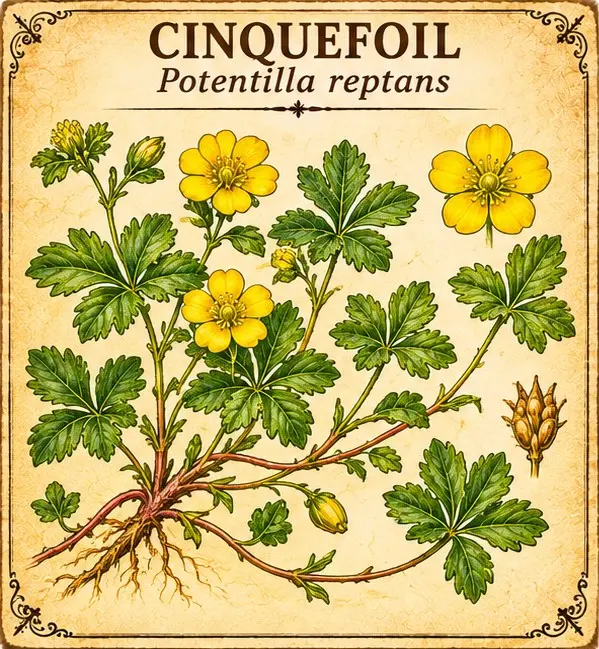
Cinquefoil
Potentilla reptans
Creeping cinquefoil, a five-fingered-leaf herb used in 10th-century Anglo-Saxon wound remedies. Its root extract fought wound bacteria in lab tests.
Safety at a glance
- PregnancyNothing recorded
- BreastfeedingNothing recorded
- MedicinesNothing recorded
- Who should avoid itNothing recorded
- AllergiesNothing recorded
- ToxicityNothing recorded
Tap a box to read the safety notes below. “Nothing recorded” means our sources don't cover it, not that it's safe.
What is Cinquefoil?
- Plant family
- Rosaceae, the rose family
- Parts used
- The root (rhizome) and aerial parts
- Where it grows
- Europe, North Africa and western Asia
- Genus
- Potentilla
- Species
- reptans
Also called
Creeping Cinquefoil
Traditionally used for
- Wounds
- Heart and circulation (traditional)
Traditionally described as
- Root rich in tannins and triterpenes
Health topics
Where Cinquefoil appears in symptom search, and why. Being listed doesn't mean it's a proven treatment.
- Cuts, Wounds, Burns and Skin Ulcers
Used in Anglo-Saxon wound remedies; root extracts fought wound bacteria in lab tests. Not tested in people.
Safety
Depends on how it's prepared
No human medical or safety studies were found.[1]Study
What does the research say?
Traditional use
These are traditional uses, not proven treatments.
Laboratory & animal research
Lab and animal results show what might be worth studying in people. They don't show that the herb has these effects in humans.
A root extract stopped Staphylococcus aureus and other wound bacteria from growing in lab tests.[2]Study
In mice, a root extract reduced skin swelling about 90% as well as the steroid dexamethasone.[1]Study
In isolated rat hearts, a root extract reduced damage and irregular heartbeats after blood flow was cut off and restored.[4]Study
In short
No human medical or safety studies were found.
Sources
- [1] Antioxidant and anti-inflammatory activity of Potentilla reptans L.Peer-reviewed study
- [2] Antimicrobial assays of three native British plants used in Anglo-Saxon medicine for wound healing formulations in 10th century England · DOI: 10.1016/j.jep.2012.09.031Peer-reviewed study
- [3] Medicinal plants used for cardiovascular diseases in Navarra and their validation from official sources · DOI: 10.1016/j.jep.2014.09.047Peer-reviewed study
- [4] Cardioprotective and anti-apoptotic effects of Potentilla reptans L. root via Nrf2 pathway in an isolated rat heart ischemia/reperfusion model · DOI: 10.1016/j.lfs.2018.11.021Peer-reviewed study
This information is educational and traditional in nature, and is not a substitute for professional medical advice. Unfamiliar word? See what these words mean.