
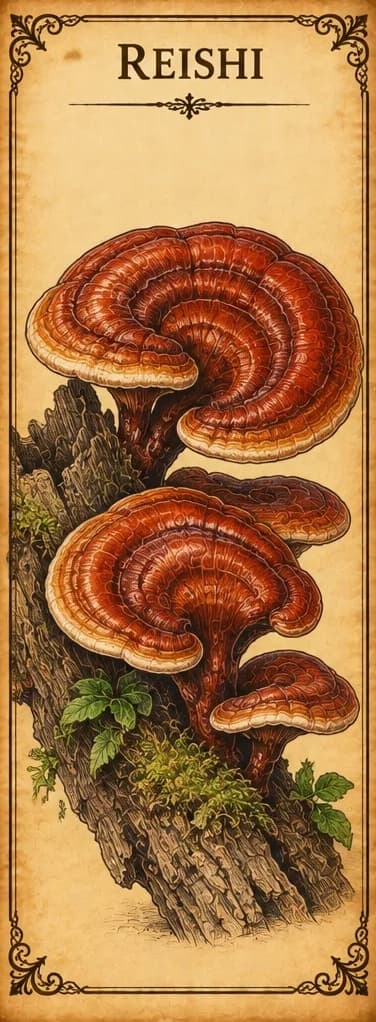
Reishi
Ganoderma lucidum
A mushroom prized for centuries in traditional Chinese, Japanese and Korean medicine. A Cochrane review found it didn't lower heart disease risk factors.
Safety at a glance
- PregnancyNothing recorded
- BreastfeedingNothing recorded
- Medicines1 note →
- Who should avoid itNothing recorded
- AllergiesNothing recorded
- Toxicity1 note →
Tap a box to read the safety notes below. “Nothing recorded” means our sources don't cover it, not that it's safe.
Reishi may interact with some medicines. If you take any medicine, read Interactions with medicines below and talk to your doctor or pharmacist before using it.
What is Reishi?
- Plant family
- Polyporaceae, a family of bracket fungi (mushrooms that grow on wood)
- Parts used
- The mushroom. Reishi spore powder is also sold.
- Genus
- Ganoderma
- Species
- lucidum
Also called
Lingzhi, Mushroom of Immortality
Traditionally used for
- Energy
- Immune support
- Heart health
Traditionally described as
- Immune support
Health topics
Where Reishi appears in symptom search, and why. Being listed doesn't mean it's a proven treatment.
- High Blood Pressure
A Cochrane review found reishi didn't lower blood pressure in people with type 2 diabetes.
- High Blood Sugar
A Cochrane review found reishi didn't lower long-term blood sugar in people with type 2 diabetes.
- High Cholesterol
A Cochrane review found reishi didn't lower cholesterol in people with type 2 diabetes.
- Liver Safety Warnings
Case reports describe liver damage from reishi, including one death.
Traditions that use it
- Traditional Chinese Medicine
Holds an important place in the traditional medicine of China, Japan, Korea and other Asian countries, where it's used to increase energy, boost the immune system and support general health.
How it's prepared
Common ways Reishi is prepared or sold. This isn't advice on how to take it; see Safety below.
Safety
Interactions with medicines
Reishi may raise the risk of bleeding with blood thinners such as warfarin, or anti-platelet medicines. It may also work against medicines that suppress the immune system, and may affect chemotherapy and medicines that are broken down by liver enzymes.[2]General reference
Technical detail: cytochrome P450 substrates; chemotherapy interaction is theoretical (antioxidant capacity).
Side effects
Other side effects include nausea, trouble sleeping, dry mouth and constipation. Rare reports include chronic diarrhea and sudden nerve problems.[2]General reference
Technical detail: also reported: pseudoparasitosis, hypereosinophilia, acute neurotoxicity.
Toxicity testing
Case reports describe liver damage from reishi, including one death.[2]General reference
Depends on how it's prepared
Reishi spore powder may raise the level of CA72-4, a blood marker used to monitor some cancers.[2]General reference
What does the research say?
Traditional use
These are traditional uses, not proven treatments.
Reishi holds an important place in the traditional medicine of China, Japan, Korea and other Asian countries, where it is used to increase energy, boost the immune system and support general health.[2]General reference
Reishi has been eaten for its medicinal properties in Asia for more than 2,000 years, and is becoming popular in Western countries for heart health.[3]Review or trial
Laboratory & animal research
Lab and animal results show what might be worth studying in people. They don't show that the herb has these effects in humans.
In lab and animal studies, reishi affected the immune system and showed possible cancer-preventing effects.[2]General reference
Research in people
A 2015 Cochrane review found 5 trials with 398 people. In the trials that could be analyzed, all in people with type 2 diabetes, taking 1.4–3 g of reishi a day for 12–16 weeks did not lower long-term blood sugar (HbA1c), cholesterol, blood pressure or triglycerides compared with placebo. People taking reishi were somewhat more likely to have side effects, though none were serious. The reviewers concluded the evidence doesn't support using reishi to treat heart disease risk factors.[3]Review or trial
Technical detail: HbA1c WMD −0.10% (95% CI −1.05 to 0.85); total cholesterol WMD −0.07 mmol/L; LDL-C WMD 0.02 mmol/L; adverse events RR 1.67 (95% CI 0.86 to 3.24).
Small trials suggest possible benefits for urinary symptoms in men, mild effects on blood sugar and less anxiety. There is limited evidence that reishi may boost immunity in people with cancer, but more research is needed on its safety and effectiveness.[2]General reference
In short
Liver damage has been reported; may raise bleeding risk with blood thinners.
Sources
- [1] Antitumour, Antimicrobial, Antioxidant and Antiacetylcholinesterase Effect of Ganoderma Lucidum Terpenoids and Polysaccharides: A Review · DOI: 10.3390/molecules23030649Peer-reviewed study
- [2] Reishi Mushroom — Memorial Sloan Kettering Cancer Center, About HerbsGeneral reference
- [3] Ganoderma lucidum mushroom for the treatment of cardiovascular risk factors — Cochrane Database of Systematic Reviews · DOI: 10.1002/14651858.CD007259.pub2Review or clinical trial
This information is educational and traditional in nature, and is not a substitute for professional medical advice. Unfamiliar word? See what these words mean.