
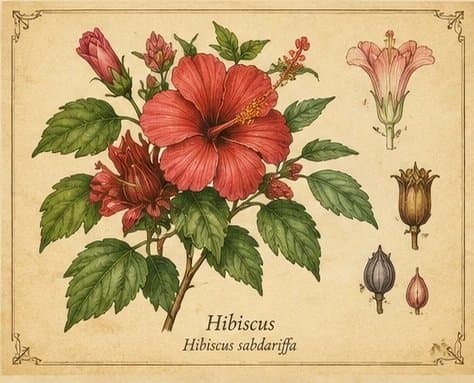
Hibiscus
Hibiscus sabdariffa
The tart red calyces of this flower are made into a tea known as roselle or sour tea. Reviews of trials suggest it may lower blood pressure.
Safety at a glance
- PregnancyNothing recorded
- BreastfeedingNothing recorded
- Medicines3 notes →
- Who should avoid itNothing recorded
- AllergiesNothing recorded
- ToxicityNothing recorded
Tap a box to read the safety notes below. “Nothing recorded” means our sources don't cover it, not that it's safe.
Hibiscus may interact with some medicines. If you take any medicine, read Interactions with medicines below and talk to your doctor or pharmacist before using it.
What is Hibiscus?
- Plant family
- Malvaceae, the mallow family
- Parts used
- The calyces (the cup of leaf-like parts at the base of the flower), dried for tea and extracts
- Where it grows
- Widely grown in many African and Southeast Asian countries
- Genus
- Hibiscus
- Species
- sabdariffa
Also called
Roselle, Sour Tea
Traditionally used for
- Tea
- High blood pressure
- Cholesterol
Traditionally described as
- May lower blood pressure
- Antioxidant
Health topics
Where Hibiscus appears in symptom search, and why. Being listed doesn't mean it's a proven treatment.
- High Blood Pressure
Reviews of trials found hibiscus tea or extract lowered blood pressure, though many trials were small or of poor quality.
- High Cholesterol
A 2022 review found a small drop in LDL cholesterol.
Traditions that use it
- African Traditional Medicine
Widely grown in many African and Southeast Asian countries, where it's drunk as a tea and used in traditional medicine.
Natural compounds
How it's prepared
Common ways Hibiscus is prepared or sold. This isn't advice on how to take it; see Safety below.
- Culinary Preparation
The sour young leaves are eaten as a vegetable.[1]General reference
- Syrup
The calyces (the fleshy red cups often sold as "flowers") are made into syrups and jams.[1]General reference
- Tea / Infusion
Hibiscus tea is drunk hot or cold in many countries.[2]Review or trial
Safety
Interactions with medicines
In rats, hibiscus taken with the water pill hydrochlorothiazide greatly increased urine output, which raises the risk of dehydration, though the drug dose used doesn't match human doses. Because hibiscus acts on the same enzyme as ACE-inhibitor blood pressure medicines such as ramipril, how the two interact still needs to be studied.[3]Review or trial
In a small study of 6 healthy men, drinking hibiscus tea before taking acetaminophen (Tylenol) made the body clear the drug faster. How much of the drug was absorbed didn't change.[4]Study
Technical detail: zobo drink 1.5 h before 1 g acetaminophen; significant changes in elimination rate and half-life, total clearance up 11.69%.
In healthy men, taking the malaria medicine chloroquine with hibiscus tea cut the amount of drug reaching the blood to under a third of what it was with water. This could make the medicine work less well.[5]Study
Technical detail: 600 mg chloroquine; AUC 2.16 vs 7.52 mg·h/L with water; Cmax 148 vs 553.
Side effects
Hibiscus is considered safe to consume. In the trials reviewed, one study reported mild stomach symptoms that went away within a week; no other side effects were reported at doses up to 10 g a day. Animal studies found no toxicity at high doses.[3]Review or trial
Hibiscus has an excellent safety and tolerability record.[6]Study
Hibiscus is generally considered safe, but its sourness can make heartburn worse.[1]General reference
What does the research say?
Traditional use
These are traditional uses, not proven treatments.
Hibiscus (roselle) has traditionally been used as a food, in hot and cold drinks, as a flavoring and as an herbal medicine.[6]Study
Hibiscus is drunk hot or cold in many countries and is used in folk medicine, including for high blood pressure.[2]Review or trial
In Mexico, roselle hibiscus is valued as a liver and kidney tonic and a traditional weight-loss herb. Herbalists use the tea for colds, mouth sores and sore throats. The calyces (the fleshy red cups often sold as "flowers") are also made into jams, syrups and the drinks called sorrel in the Caribbean and agua de Jamaica in Mexico, and the sour young leaves are eaten as a vegetable. These uses come from herbal practice and haven't been tested in clinical trials.[1]General reference
Laboratory & animal research
Lab and animal results show what might be worth studying in people. They don't show that the herb has these effects in humans.
In lab and animal studies, hibiscus extracts showed antibacterial and antioxidant effects, protected the kidneys and liver, increased urination, and affected cholesterol, blood sugar and blood pressure. Possible reasons include blocking ACE, an enzyme that raises blood pressure (the same target as some blood pressure medicines), and relaxing blood vessels. Many of these studies used extracts whose contents weren't well described.[6]Study
Technical detail: inhibition of α-glucosidase, α-amylase and angiotensin-converting enzyme; direct vasorelaxant effect or calcium channel modulation.
Research in people
A 2010 review of 4 trials with 390 people found hibiscus lowered blood pressure more than black tea, but less than the blood pressure medicines captopril and lisinopril. The trials were short and mostly poor quality, so the reviewers concluded they don't provide reliable evidence to recommend hibiscus for high blood pressure.[2]Review or trial
A 2015 review of 5 trials with 390 people found hibiscus lowered systolic blood pressure (the top number) by about 7.6 mm Hg and diastolic (the bottom number) by about 3.5 mm Hg. The drops were bigger in people whose blood pressure started higher. The authors called for better-designed trials.[7]Review or trial
Technical detail: fixed-effect meta-regression; SBP WMD −7.58 mm Hg (95% CI −9.69 to −5.46); DBP WMD −3.53 mm Hg (95% CI −5.16 to −1.89).
A 2022 review of 17 trials found hibiscus lowered systolic blood pressure by about 7 mm Hg more than placebo, most in people with raised blood pressure, and about as much as blood pressure medicines in trials that compared them. It also lowered LDL ("bad") cholesterol slightly compared with other teas and placebo. The authors said more studies are needed to find the right dose and length of use.[3]Review or trial
Technical detail: SBP −7.10 mm Hg (95% CI −13.00 to −1.20) vs placebo, I² = 95%; vs medication SBP 2.13 mm Hg (95% CI −2.81 to 7.06); LDL −6.76 mg/dL (95% CI −13.45 to −0.07).
In short
How it interacts with blood pressure medicines and water pills hasn't been fully studied; check with your doctor.
Sources
- [1] The Medicinal Benefits of Hibiscus — Chestnut School of Herbal MedicineGeneral reference
- [2] The effectiveness of Hibiscus sabdariffa in the treatment of hypertension: a systematic review — Phytomedicine · DOI: 10.1016/j.phymed.2009.09.002Review or clinical trial
- [3] A systematic review and meta-analysis of the effects of Hibiscus sabdariffa on blood pressure and cardiometabolic markers — Nutrition Reviews · DOI: 10.1093/nutrit/nuab104Review or clinical trial
- [4] Effect of zobo drink (Hibiscus sabdariffa water extract) on the pharmacokinetics of acetaminophen in human volunteers · DOI: 10.1007/bf03190570Peer-reviewed study
- [5] Significant reduction in chloroquine bioavailability following coadministration with the Sudanese beverages Aradaib, Karkadi and Lemon · DOI: 10.1093/jac/33.5.1005Peer-reviewed study
- [6] Hibiscus sabdariffa L. – a phytochemical and pharmacological review — Food Chemistry · DOI: 10.1016/j.foodchem.2014.05.002Peer-reviewed study
- [7] Effect of sour tea (Hibiscus sabdariffa L.) on arterial hypertension: a systematic review and meta-analysis of randomized controlled trials — Journal of Hypertension · DOI: 10.1097/HJH.0000000000000585Review or clinical trial
This information is educational and traditional in nature, and is not a substitute for professional medical advice. Unfamiliar word? See what these words mean.