
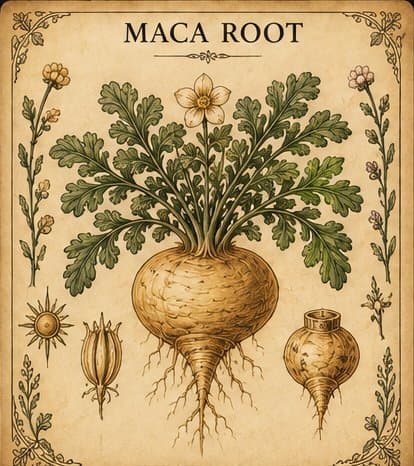
Maca
Lepidium meyenii
A root vegetable from the high Andes of Peru, used for centuries as food and to boost energy and fertility. Its effects haven't been proven in rigorous trials.
Safety at a glance
- Pregnancy1 note →
- BreastfeedingNothing recorded
- Medicines1 note →
- Who should avoid it1 note →
- AllergiesNothing recorded
- Toxicity1 note →
Tap a box to read the safety notes below. “Nothing recorded” means our sources don't cover it, not that it's safe.
Maca may interact with some medicines. If you take any medicine, read Interactions with medicines below and talk to your doctor or pharmacist before using it.
What is Maca?
- Plant family
- Brassicaceae, the mustard and cabbage family
- Parts used
- The underground tuber (root), similar to a radish or turnip, which can be white, black or red
- Where it grows
- Grown high in the Andes mountains of Peru, above 4,000 meters
- Genus
- Lepidium
- Species
- meyenii
Also called
Peruvian Ginseng, Maca Root
Traditionally used for
- Energy
- Fertility
- Sexual health
- Menopause
Traditionally described as
- Adaptogen
Health topics
Where Maca appears in symptom search, and why. Being listed doesn't mean it's a proven treatment.
- Fertility
Traditionally used to boost fertility. Studies on sperm quality have mixed results.
- Menopause Symptoms
A review of 4 small trials found limited evidence that it eases menopause symptoms.
- Sexual Health
Early studies suggest it may help sexual well-being in men and sexual problems in women, but it hasn't been proven in rigorous trials.
Traditions that use it
- Native American Ethnobotany
Used for centuries in the Peruvian Andes as a food and medicine to improve health, energy and fertility, and as an adaptogen for anemia and female hormone balance.
How it's prepared
Common ways Maca is prepared or sold. This isn't advice on how to take it; see Safety below.
- Capsule
It's also taken as capsules.[1]General reference
- Culinary Preparation
Maca is eaten as a vegetable.[2]Health agency
- Powder
The powdered root is mixed into foods and drinks such as smoothies and oatmeal.[1]General reference
- Tincture
Herbalists use it as a tincture.[1]General reference
Safety
Interactions with medicines
Maca may add to the blood-pressure-lowering effect of losartan. It may also interfere with testosterone blood tests.[3]General reference
Who should avoid it
If you have a hormone-sensitive cancer, such as breast or uterine cancer, talk with your doctor before using maca.[3]General reference
Side effects
Side effects are uncommon and mild, mostly stomach and gut symptoms and headaches.[2]Health agency
Pregnancy
Avoid maca if you are pregnant or breastfeeding.[3]General reference
Toxicity testing
There have been no convincing reports linking maca to liver injury. LiverTox rates it an unlikely cause of liver damage, though its use has been limited.[2]Health agency
How much to use
Recommended daily amounts vary widely, from 500 to 3,000 mg a day, depending on the product and its intended use.[2]Health agency
What does the research say?
Traditional use
These are traditional uses, not proven treatments.
Maca is both a vegetable and a traditional herbal medicine. In Peru it has been used for centuries as a food supplement to improve health, and as a medicine to boost energy and fertility.[2]Health agency
In the Andes, maca has been used for centuries as an adaptogen (a plant traditionally used to help the body cope with stress) to manage anemia, infertility and female hormone balance.[4]Review or trial
Laboratory & animal research
Lab and animal results show what might be worth studying in people. They don't show that the herb has these effects in humans.
Maca contains natural compounds, including glucosinolates, that showed antioxidant activity and reduced inflammation in lab studies.[3]General reference
In animals, maca extracts improved sexual function and fertility, and also improved memory and learning, reduced prostate size and improved bone strength.[2]Health agency
Research in people
Studies in people have had conflicting results. Maca is promoted for sex drive, sperm count, mood, memory, energy and stamina, but none of these effects has been proven in rigorous controlled trials.[2]Health agency
Early studies suggest maca may improve how men feel about their sexual well-being, but results on semen quality are mixed. In women, several studies suggest it may help sexual problems caused by antidepressants or menopause.[3]General reference
A 2011 review found 4 small trials of maca for menopausal symptoms, all showing favorable effects. But the trials were too few, small and low in quality to draw firm conclusions, and maca's safety hadn't been proven. The reviewers called the evidence limited.[4]Review or trial
Technical detail: Kupperman Menopausal Index and Greene Climacteric Score.
In short
Avoid during pregnancy and breastfeeding; may affect testosterone blood tests.
Sources
- [1] Maca — Herban Herbalist materia medica — Herban Herbalist (herb shop)General reference
- [2] Maca. In: LiverTox: Clinical and Research Information on Drug-Induced Liver Injury — National Institute of Diabetes and Digestive and Kidney Diseases (NIH)Government health agency
- [3] Maca — Memorial Sloan Kettering Cancer Center, About HerbsGeneral reference
- [4] Maca (Lepidium meyenii) for treatment of menopausal symptoms: A systematic review — Maturitas · DOI: 10.1016/j.maturitas.2011.07.017Review or clinical trial
This information is educational and traditional in nature, and is not a substitute for professional medical advice. Unfamiliar word? See what these words mean.