
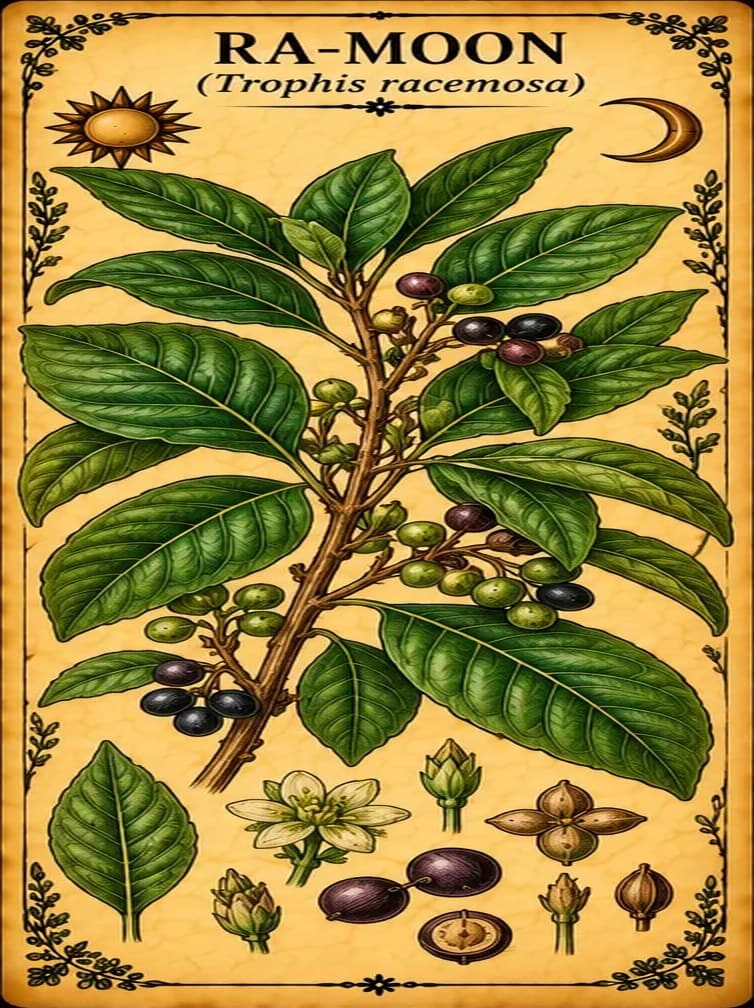
Ra-Moon
Trophis racemosa
Ramoon, a Jamaican tree whose bark is made into tea and roots drinks as a traditional remedy for libido, and whose leaves feed livestock. It hasn't been studied in people.
Safety at a glance
- PregnancyNothing recorded
- BreastfeedingNothing recorded
- MedicinesNothing recorded
- Who should avoid itNothing recorded
- AllergiesNothing recorded
- ToxicityNothing recorded
Tap a box to read the safety notes below. “Nothing recorded” means our sources don't cover it, not that it's safe.
What is Ra-Moon?
- Plant family
- Moraceae, the fig and mulberry family
- Parts used
- Mainly the bark, often made into a tea or added to roots drinks. The leaves are also used.
- Where it grows
- Grows in Jamaica, including Manchester, St. Elizabeth, Westmoreland, St. Ann and Portland; grows best in woodlands on limestone
- Genus
- Trophis
- Species
- racemosa
Also called
Ra Moon
Regional names
Ramoon
Traditionally used for
- Libido (traditional)
- Roots drinks
- Livestock fodder
Traditionally described as
- Folk remedy (not studied in people)
Health topics
Where Ra-Moon appears in symptom search, and why. Being listed doesn't mean it's a proven treatment.
- Sexual Health
A traditional Jamaican remedy for low libido. This use hasn't been tested in research.
Traditions that use it
- Caribbean Folk Medicine
Used in Jamaica as a tea and in roots drinks for libido, and to help livestock breed.
How it's prepared
Common ways Ra-Moon is prepared or sold. This isn't advice on how to take it; see Safety below.
- Tea / Infusion
The bark is mostly used, as a tea or in roots drinks.[1]General reference
What does the research say?
Traditional use
These are traditional uses, not proven treatments.
Jamaica's Forestry Department says the leaves make good fodder for livestock, and that in Jamaica the plant is also used to increase breeding in animals.[2]Health agency
A Jamaica Observer article describes ra-moon as a traditional remedy used by both men and women to boost libido, popular among Rastafarians. The bark is mostly used, as a tea or in roots drinks. The article notes the tree is becoming rare because of high demand.[1]General reference
Laboratory & animal research
Lab and animal results show what might be worth studying in people. They don't show that the herb has these effects in humans.
Researchers at the University of the West Indies isolated a natural compound from the plant. Eye drops made from it lowered the pressure inside the eye in dogs. It also made muscle in the gut and airways contract in lab tests.[3]Study
Technical detail: quaternary muscarinic alkaloid; 0.5–2% solutions lowered intraocular pressure by 6.6 to 15.7 mmHg, blocked by atropine; contracted isolated guinea-pig ileum and trachea via M1/M3 receptors.
In short
Its safety hasn't been studied.
Sources
- [1] Raise libido with ra-moon — Jamaica ObserverGeneral reference
- [2] Ramoon (Trophis racemosa) — Forestry Department, Government of JamaicaGovernment health agency
- [3] Isolation of a muscarinic alkaloid with ocular hypotensive action from Trophis racemosa — Phytotherapy Research · DOI: 10.1002/(SICI)1099-1573(199912)13:8<670::AID-PTR514>3.0.CO;2-8Peer-reviewed study
This information is educational and traditional in nature, and is not a substitute for professional medical advice. Unfamiliar word? See what these words mean.