
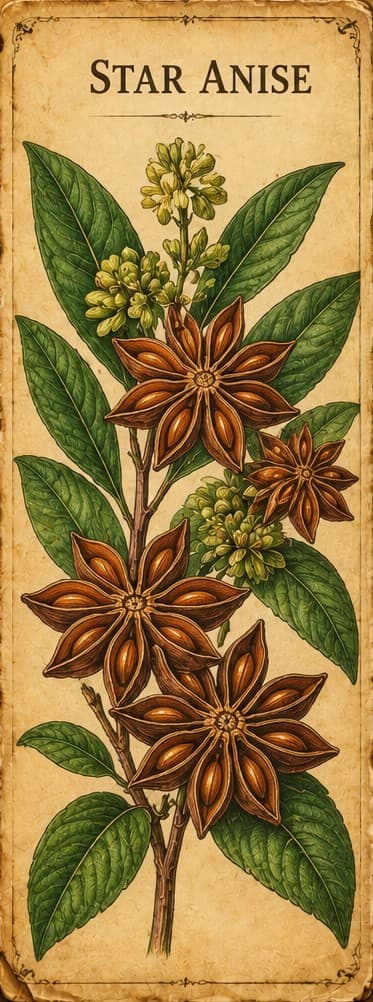
Star Anise
Illicium verum
The star-shaped fruit of an evergreen tree, used as a spice and in traditional Chinese medicine. Don't give star anise tea to babies: it has made infants seriously ill.
Safety at a glance
- PregnancyNothing recorded
- BreastfeedingNothing recorded
- MedicinesNothing recorded
- Who should avoid itNothing recorded
- AllergiesNothing recorded
- Toxicity1 note →
Tap a box to read the safety notes below. “Nothing recorded” means our sources don't cover it, not that it's safe.
What is Star Anise?
- Plant family
- Schisandraceae, the magnolia-vine family
- Parts used
- The dried star-shaped fruit, used whole or ground as a spice, in teas, and for its essential oil
- Genus
- Illicium
- Species
- verum
Also called
Chinese Star Anise, Badian
Traditionally used for
- Cooking spice
- Stomach pain (traditional)
- Infant colic (traditional; not safe)
Traditionally described as
- Antioxidant (in lab tests)
- Kills bacteria (in lab tests)
Traditions that use it
- Traditional Chinese Medicine
Used in Chinese medicine to "warm" the body, ease pain and help the flow of qi, and in formulas for belly pain.
How it's prepared
Common ways Star Anise is prepared or sold. This isn't advice on how to take it; see Safety below.
- Culinary Preparation
Star anise has long been a cooking spice in China.[1]Study
Safety
Toxicity testing
Don't give star anise tea to babies. Doctors in one report saw 7 infants with nerve-related symptoms after being given star anise tea at home.
Part of the problem is Japanese star anise, a related plant that is poisonous to the nerves. Dried, the two look alike, and the report found Chinese star anise contaminated with Japanese star anise.[2]Study
Technical detail: Japanese star anise is Illicium anisatum.
Contamination
Japanese star anise contains substances that can cause seizures. Other poisoning cases from star anise products have been reported, mostly from accidentally eating related plants, and occasionally from eating far too much.[1]Study
Technical detail: the convulsants anisatin and neoanisatin (I. anisatum); veranisatins A–C from I. verum were convulsant and lethal in mice at 3 mg/kg by mouth.
What does the research say?
Traditional use
These are traditional uses, not proven treatments.
Star anise has long been a cooking spice in China and was brought to Europe in the 17th century. In traditional Chinese medicine it's described as warming, easing pain and helping the flow of qi (the body's energy).
Old Chinese formulas include it for lower belly pain and hernia. China lists it as both a food and a medicine.[1]Study
Many communities have given star anise tea to babies for colic. Doctors now advise against this (see Safety).[2]Study
Laboratory & animal research
Lab and animal results show what might be worth studying in people. They don't show that the herb has these effects in humans.
In lab tests, star anise and its essential oil have shown antioxidant activity and killed some bacteria. Star anise is also the main natural source of shikimic acid, the starting material for making the flu medicine Tamiflu.[1]Study
Technical detail: 201 compounds identified; shikimic acid is the precursor for industrial synthesis of oseltamivir phosphate.
Research in people
In a 2021 trial, 50 people used a star anise mouthwash and a dummy mouthwash in turn, for 21 days each. The star anise mouthwash reduced gum inflammation, gum bleeding and mouth bacteria compared with the dummy.[3]Study
In short
Don't give star anise tea to babies; toxic Japanese star anise can be mixed in and looks the same.
Sources
- [1] A Comprehensive Review of the Pharmacology, Chemistry, Traditional Uses and Quality Control of Star Anise (Illicium verum Hook. F.): An Aromatic Medicinal Plant · DOI: 10.3390/molecules28217378Peer-reviewed study
- [2] Neurotoxicities in infants seen with the consumption of star anise tea · DOI: 10.1542/peds.2004-0058Peer-reviewed study
- [3] Crossover Analysis of the Astringent, Antimicrobial, and Anti-inflammatory Effects of Illicium verum/Star Anise in the Oral Cavity · DOI: 10.1155/2021/5510174Peer-reviewed study
This information is educational and traditional in nature, and is not a substitute for professional medical advice. Unfamiliar word? See what these words mean.