
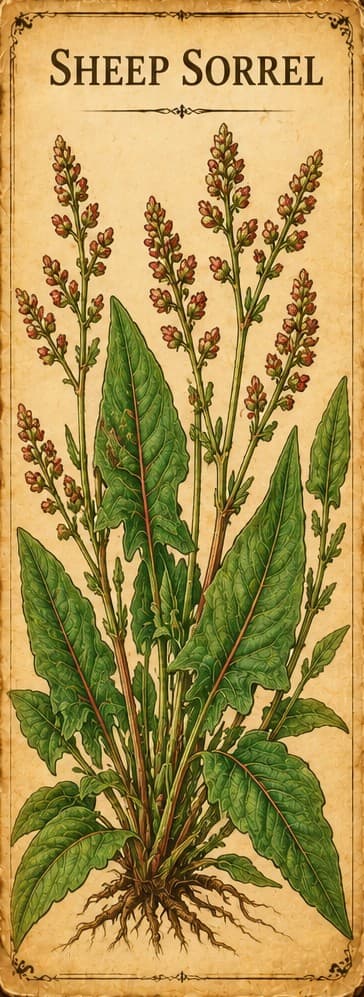
Sheep Sorrel
Rumex acetosella
A common weed best known as one of the four herbs in Essiac, a tea sold as a cancer remedy. The US National Cancer Institute found no good evidence that Essiac works against cancer.
Safety at a glance
- PregnancyNothing recorded
- BreastfeedingNothing recorded
- MedicinesNothing recorded
- Who should avoid it1 note →
- AllergiesNothing recorded
- ToxicityNothing recorded
Tap a box to read the safety notes below. “Nothing recorded” means our sources don't cover it, not that it's safe.
What is Sheep Sorrel?
- Plant family
- Polygonaceae, the buckwheat and dock family
- Parts used
- The above-ground parts, as part of the Essiac and Flor Essence tea mixtures
- Genus
- Rumex
- Species
- acetosella
Also called
Red Sorrel, Sheep's Sorrel
Traditionally used for
- Essiac tea ingredient
Traditionally described as
How it's prepared
Common ways Sheep Sorrel is prepared or sold. This isn't advice on how to take it; see Safety below.
- Tea / Infusion
Sheep sorrel is one of the herbs in Essiac, a mixture taken by mouth as a tea.[1]Health agency
Safety
Who should avoid it
Essiac and Flor Essence aren't approved by the FDA to treat cancer or any other condition.[1]Health agency
Side effects
The only side effects reported with Essiac are nausea and vomiting. Flor Essence may cause more frequent bowel movements and urination, swollen glands, skin blemishes, flu-like symptoms or mild headaches.[1]Health agency
What does the research say?
Traditional use
These are traditional uses, not proven treatments.
Sheep sorrel is one of the four herbs in Essiac, together with burdock root, Indian rhubarb root and slippery elm bark. A Canadian nurse made Essiac popular in the 1920s and ran a cancer clinic in Ontario from 1934 to 1942. She said the recipe came from a patient, who said it came from an Ojibwa healer. Flor Essence contains the same four herbs plus four others.[1]Health agency
Laboratory & animal research
Lab and animal results show what might be worth studying in people. They don't show that the herb has these effects in humans.
In lab and animal studies, Essiac mostly showed no effect against cancer. Eight animal experiments at Memorial Sloan Kettering found no effect on the immune system or on cancer. In one rat study of breast cancer, more rats given Flor Essence developed tumors than rats given none.[1]Health agency
Technical detail: tumor incidence 82.5% (controls) vs 90% and 97.3% (Flor Essence groups). NCI testing found no anticancer activity and lethal toxicity at the highest concentrations; one 2004 study found reduced growth of prostate cancer cells.
Research in people
No controlled studies in people show that Essiac or Flor Essence works. In a review of 86 cancer patients in Canada who took Essiac between 1978 and 1982, 47 didn't benefit and 4 had a measurable response. No clinical trials of Essiac have been published in medical journals.[1]Health agency
In short
Essiac isn't FDA-approved to treat cancer or any other condition.
Sources
- [1] Essiac/Flor Essence (PDQ): Health Professional Version — National Cancer Institute (NIH)Government health agency
This information is educational and traditional in nature, and is not a substitute for professional medical advice. Unfamiliar word? See what these words mean.