
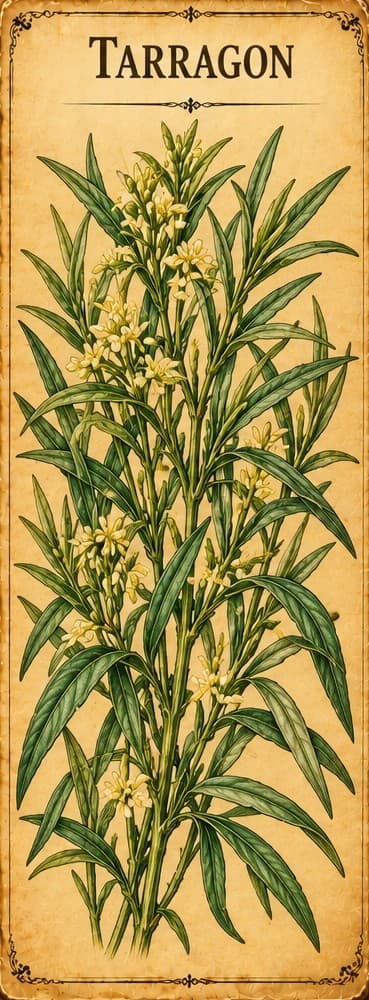
Tarragon
Artemisia dracunculus
A kitchen herb used in traditional medicine in Iran, Pakistan, Azerbaijan and India for digestive problems, pain, sleep and worms. Its essential oil is high in estragole, a substance of concern, though water extracts contain very little.
Safety at a glance
- PregnancyNothing recorded
- BreastfeedingNothing recorded
- MedicinesNothing recorded
- Who should avoid itNothing recorded
- AllergiesNothing recorded
- Toxicity1 note →
Tap a box to read the safety notes below. “Nothing recorded” means our sources don't cover it, not that it's safe.
What is Tarragon?
- Plant family
- Asteraceae, the daisy family
- Parts used
- The leaves and above-ground parts, fresh or dried, as a spice or tea
- Genus
- Artemisia
- Species
- dracunculus
Also called
Estragon, French Tarragon, Russian Tarragon
Traditionally used for
- Cooking
- Digestion (traditional)
- Pain (traditional)
- Sleep (traditional)
- Worms (traditional)
Traditionally described as
- May help reduce inflammation (in animal studies)
- May relieve pain (in animal studies)
Health topics
Where Tarragon appears in symptom search, and why. Being listed doesn't mean it's a proven treatment.
- High Blood Sugar
In one small trial in prediabetes, tarragon slightly lowered HbA1c and insulin output.
- Indigestion
Traditionally used in Iran, Pakistan, Azerbaijan and India for digestive problems. Not tested in trials.
How it's prepared
Common ways Tarragon is prepared or sold. This isn't advice on how to take it; see Safety below.
- Culinary Preparation
Tarragon is a spice in Asia, Europe and the Americas.[1]Study
Safety
Toxicity testing
Tarragon essential oil can contain large amounts of estragole and methyleugenol, two substances that raise safety concerns. No poisoning or gene damage has been reported at amounts people normally eat. Water-based preparations such as tea contain very little of these substances and are considered low risk.[2]Study
Technical detail: estragole up to 82% and methyleugenol up to 39% of the essential oil.
What does the research say?
Traditional use
These are traditional uses, not proven treatments.
Tarragon is a spice in Asia, Europe and the Americas. In traditional medicine in Iran, Pakistan, Azerbaijan and India, it's used:
- For digestive problems
- To ease pain and inflammation
- To help sleep and for epilepsy
- To lower fever
- For intestinal worms
Laboratory & animal research
Lab and animal results show what might be worth studying in people. They don't show that the herb has these effects in humans.
In animal studies, mainly in rodents, tarragon has shown possible effects on inflammation, pain, blood sugar and liver protection.[2]Study
Research in people
In a small Mexican trial, 24 people with prediabetes (impaired glucose tolerance) took 1,000 mg of tarragon or a dummy pill twice a day for 90 days. Tarragon slightly lowered long-term blood sugar (HbA1c), insulin output and systolic blood pressure, and raised HDL ("good") cholesterol.[3]Study
Technical detail: HbA1c 5.8% to 5.6%; systolic BP 120 to 113 mmHg.
In short
The essential oil is high in estragole and methyleugenol; the herb used in cooking and teas contains much less.
Sources
- [1] Artemisia dracunculus (Tarragon): A Review of Its Traditional Uses, Phytochemistry and Pharmacology · DOI: 10.3389/fphar.2021.653993Peer-reviewed study
- [2] Artemisia dracunculus L. (tarragon): a critical review of its traditional use, chemical composition, pharmacology, and safety · DOI: 10.1021/jf202277wPeer-reviewed study
- [3] Effect of Artemisia dracunculus Administration on Glycemic Control, Insulin Sensitivity, and Insulin Secretion in Patients with Impaired Glucose Tolerance · DOI: 10.1089/jmf.2016.0005Peer-reviewed study
This information is educational and traditional in nature, and is not a substitute for professional medical advice. Unfamiliar word? See what these words mean.