
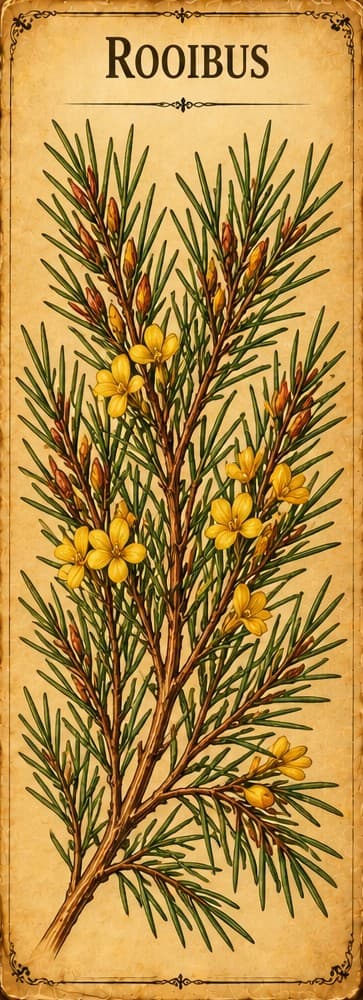
Rooibos
Aspalathus linearis
A South African shrub whose leaves make a caffeine-free red tea. A few small studies in people have mixed results, and there are rare reports of liver injury.
Safety at a glance
- PregnancyNothing recorded
- BreastfeedingNothing recorded
- MedicinesNothing recorded
- Who should avoid itNothing recorded
- AllergiesNothing recorded
- Toxicity1 note →
Tap a box to read the safety notes below. “Nothing recorded” means our sources don't cover it, not that it's safe.
What is Rooibos?
- Plant family
- Fabaceae, the pea and bean family
- Parts used
- The leaves and stems, fermented or unfermented, as a tea or extract
- Where it grows
- South Africa
- Genus
- Aspalathus
- Species
- linearis
Also called
Red Bush Tea, Redbush, Green Rooibos
Traditionally used for
- Herbal tea
- Caffeine-free drink
Traditionally described as
- Antioxidant (in lab and animal studies)
How it's prepared
Common ways Rooibos is prepared or sold. This isn't advice on how to take it; see Safety below.
- Capsule
It's also sold as capsules and tablets.[1]Study
- Tea / Infusion
Rooibos is a popular South African herbal tea, mostly drunk as red or green rooibos.[1]Study
Safety
Toxicity testing
Liver injury linked to rooibos tea has rarely been reported. In one case, a 52-year-old man developed sudden hepatitis and liver failure after drinking a South African tea of rooibos and buchu. A liver biopsy showed injury from a toxin, and he recovered after stopping the tea. The authors suggested small-batch teas may vary in what they contain.[2]Study
What does the research say?
Traditional use
These are traditional uses, not proven treatments.
Rooibos is a popular South African herbal tea. It contains no caffeine and is low in tannins. It's mostly drunk as red or green rooibos (green rooibos has more flavonoids), and is also sold as capsules and tablets.[1]Study
Laboratory & animal research
Lab and animal results show what might be worth studying in people. They don't show that the herb has these effects in humans.
Rooibos contains flavonoids such as aspalathin and nothofagin. Most of what's known about its antioxidant effects and its possible effects on inflammation comes from animal and cell studies.[1]Study
A 2018 review combined 12 studies in diabetic rats and mice. Rooibos extracts and their plant compounds lowered blood sugar, most strongly with extracts rich in a compound called PPAG. This hasn't been confirmed in people.[3]Review or trial
Research in people
A 2023 review found only 18 studies of rooibos in people, with 488 participants in total, and their results conflicted:
- 6 cups a day improved a marker of oxidative stress, lowered blood sugar and improved insulin sensitivity, in healthy people and those at risk of heart disease
- 4 cups a day had no effect on blood pressure in people prone to kidney stones
The studies were too few and too small to confirm or rule out real effects.[1]Study
In short
Rare cases of liver injury have been linked to rooibos tea.
Sources
- [1] The health benefits of rooibos tea in humans (Aspalathus linearis): a scoping review · DOI: 10.4081/jphia.2023.2784Peer-reviewed study
- [2] Tea not Tincture: Hepatotoxicity Associated with Rooibos Herbal Tea · DOI: 10.14309/crj.2013.20Peer-reviewed study
- [3] A Beneficial Role of Rooibos in Diabetes Mellitus: A Systematic Review and Meta-Analysis · DOI: 10.3390/molecules23040839Review or clinical trial
This information is educational and traditional in nature, and is not a substitute for professional medical advice. Unfamiliar word? See what these words mean.